This story from the Adirondack Explorer, a nonprofit news outlet covering people and policy in the state forest preserve, is part of a special winter guide presented in partnership with the Times Union.
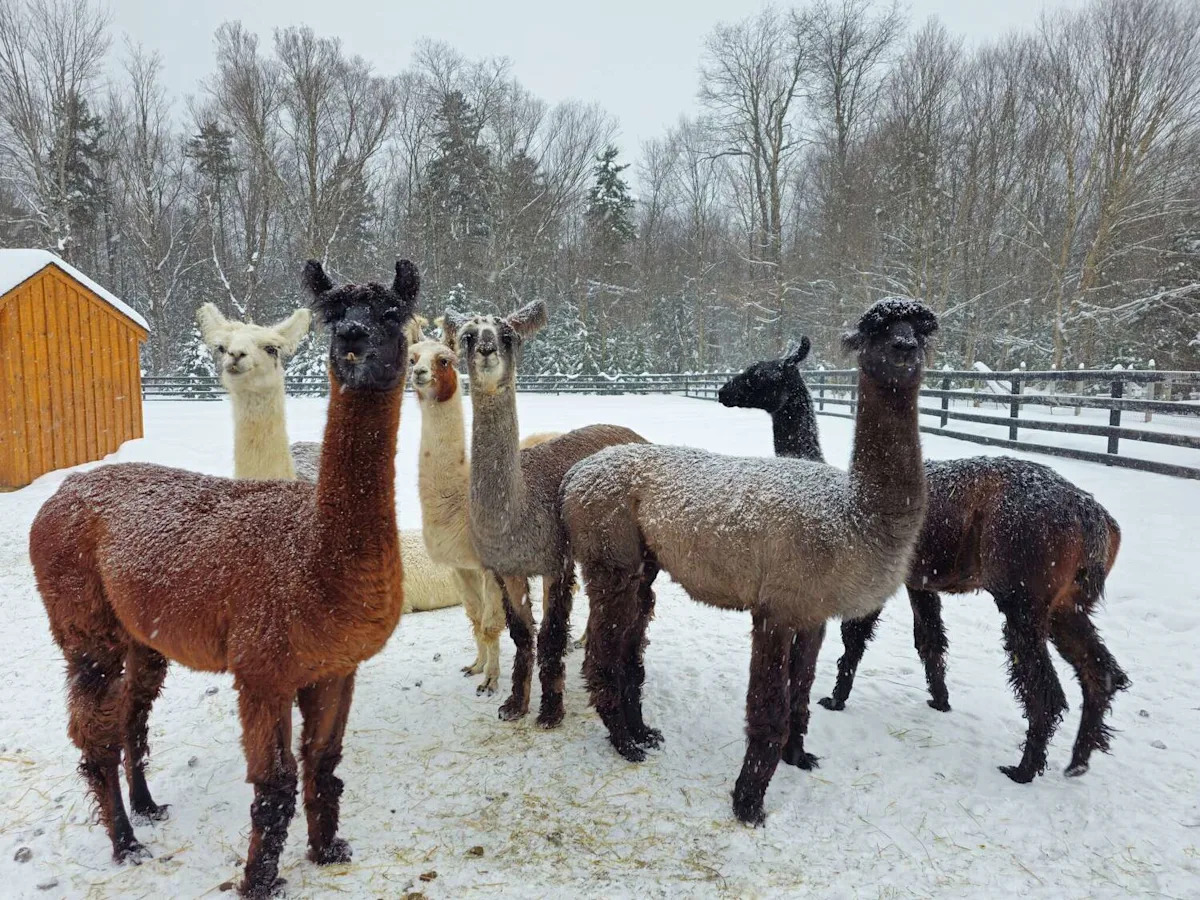
What do 10 llamas, George Clooney, Adirondack hiking trails, and a photo shoot have in common?
If you go
Llama treks are offered daily, year-round at Moose River Farm, located at 168 Woodcraft Rd, in Old Forge. The llama trek schedule in the summer is typically a full trek at 10 a.m. and 3 p.m. and a full trek in winter at 11 a.m. and 3 p.m.. Mini-treks are usually scheduled for the middle of the day.
Those who wish to schedule a llama trek can make a reservation with Phinney by emailing mooseriverfarm@gmail.com or texting 315-240-4707. For more information about Moose River Farm, visit: mooseriverfarm.com
They are all part of the unique and memorable experience of llama trekking, a family-friendly excursion dreamed up seven years ago by Anne Phinney of Moose River Farm in Old Forge.
The idea of llama trekking was born from a program in which Phinney taught children about caring for animals. Children aged 8 to 12 would visit the farm one day a week in the summer and handle the animals. While Phinney continued to incorporate new animals into the program, something “woolly” was missing.
“I decided on llamas because they are a working animal, still more reliable than motorized vehicles for distributing supplies in the Andes Mountains,” she said. “Llama fiber is a secondary purpose.” What she didn’t know was how much she would grow to love them.
After a two-year search, Phinney purchased two llamas from Dakota Ridge Farm in Ballston Spa.
“I walked my llamas through our farm and it was like lightning went through my body,” Phinney said. There was no turning back.
Phinney invited visitors to join in on their daily walks, an idea that quickly became popular. “As word got around, I needed to add more llamas. Turns out llamas are sweet creatures who enjoy human companionship,” she said.
A cross between a horse and a teddy bear, llamas are curious about meeting new people and are good listeners when it comes to following directions. They are smart, hard working and yet very sweet. They enjoy hugs, walks in the woods and even posing for photos with their walking partners.
The llama love multiplied quickly for Phinney: “What started as two llamas became three, became six, and now we have 10 llamas. I call it llama math. The llamas really do run the farm,” she said. “And they know it.”
Llama trekking basics
There are healing aspects of nature and animals, and with llama trekking, folks get to experience the best of both, Phinney said.
The treks have been a focal point of the farm for the past several years, and although Phinney misses the children’s program, she loves conducting farm tours and llama walks, and meeting with families from the Adirondacks and beyond.

A youngster gets a helping hand as this trekking group from the Floyd area experiences a full trek on a snowy January afternoon. (Jamie Organski/Adirondack Explorer)
Phinney offers two types of llama walks: a full trek and a mini-trek. The full trek ($30 per person) is a mile-long loop and takes about an hour and a half. The outing includes a guided llama walk through the farm’s scenic trails and a farm tour where visitors meet all the animals. In addition to 10 llamas, the farm has five horses, two miniature donkeys (named Bing and Frankie), goats that Phinney has dubbed her middle-school mean girls, even a 10-month old camel named Kipling. She also keeps a variety of turkeys, ducks, geese and chickens.
The mini-trek ($20 per person) is geared toward those with low or limited mobility or small children who would do better with a shorter distance. The mini-trek includes the farm tour and a short 10-minute guided llama walk.
While llama trekking is suitable for all ages and abilities, children need to be 8 years and older in order to walk their own llama. Younger children may share a llama with an adult. Phinney reminded llama trekkers to dress for the weather and wear appropriate footwear.
“No teenagers shivering in Crocs, and no flip-flops or sandals around hooved animals,” she said with a laugh.
A personal pairing
Phinney said she enjoys matching up each llama trekker with their own llamas based on personality traits for optimal compatibility.
“Bluff, Majic, and Malibu (the ladies of the group) stick together, as they do not particularly like the boy llamas. Bravo is the George Clooney of the llamas and he is gorgeous. Adonis has no sense of humor, is gentle, and all business. He walks the trail like a periscope. Stormy is bouncy like a big dog and therefore needs a walking partner who is confident. Ty likes to lick everyone’s hair and Lloki is an adolescent ADHD male with a ‘pick me’ attitude. Quix is a good hugger and Chokko has one gear: nice and slow.”
The high point of the llama trek is the photo shoot, where visitors line up to hug, feed, and pet their llamas, while Phinney uses their cell phones to capture individual shots, couples portraits, family photos, and action shots.
“The reactions I’ve captured are priceless,” Phinney said. “People leave with smiles on their faces and with something concrete they can share with family and friends. The llamas are more than happy to oblige.”
Origins of Moose River Farm
Phinney grew up in a suburb outside of Philadelphia. The youngest of four children, she had a dog, a cat, and an addiction to horses that remains with her to this day.
“I needed horses like oxygen,” she said. “All day, every day. My parents are not surprised by my lifestyle. There was this ache. I needed to care for them, feed them, clean them, and I still feel that way. I need to be around animals every day and am so lucky to live this life. It is better than I ever could have imagined.”

Anne Phinney with her husband, Rod, among the llamas of Moose River Farms. (Jamie Organski/Adirondack Explorer)
She and her husband, Rod, married in 1986 and lived on Sixth Lake in Inlet where they had 3 acres of land and built a 4-stall barn. Wishing to expand the farm, the couple purchased 77 acres of wooded property in 2000 that would become the site of Moose River Farm and their home. In four years, Rod cleared the land, milled the wood, built the barn, and built the house, according to Phinney. The purpose of the barn was to train horses privately.
Phinney retired as a Town of Webb UFSD school teacher in 2018 and has written two books, “Finding My Way to Moose River Farm: Living with the Animals of the Adirondacks” and “They Teach Without Words: The Animals of Moose River Farm.”
Phinney has hosted farm open houses for a number of fundraisers where 100% of proceeds go toward the selected organization. A few of these include a living nativity event to benefit a Utica-based organization in providing groceries to veterans (feedourvets.org), a benefit for the Herkimer County Humane Society, and a read-in for the Inlet Public Library.
This article originally published at A woolly good time: Llama trekking in Old Forge.