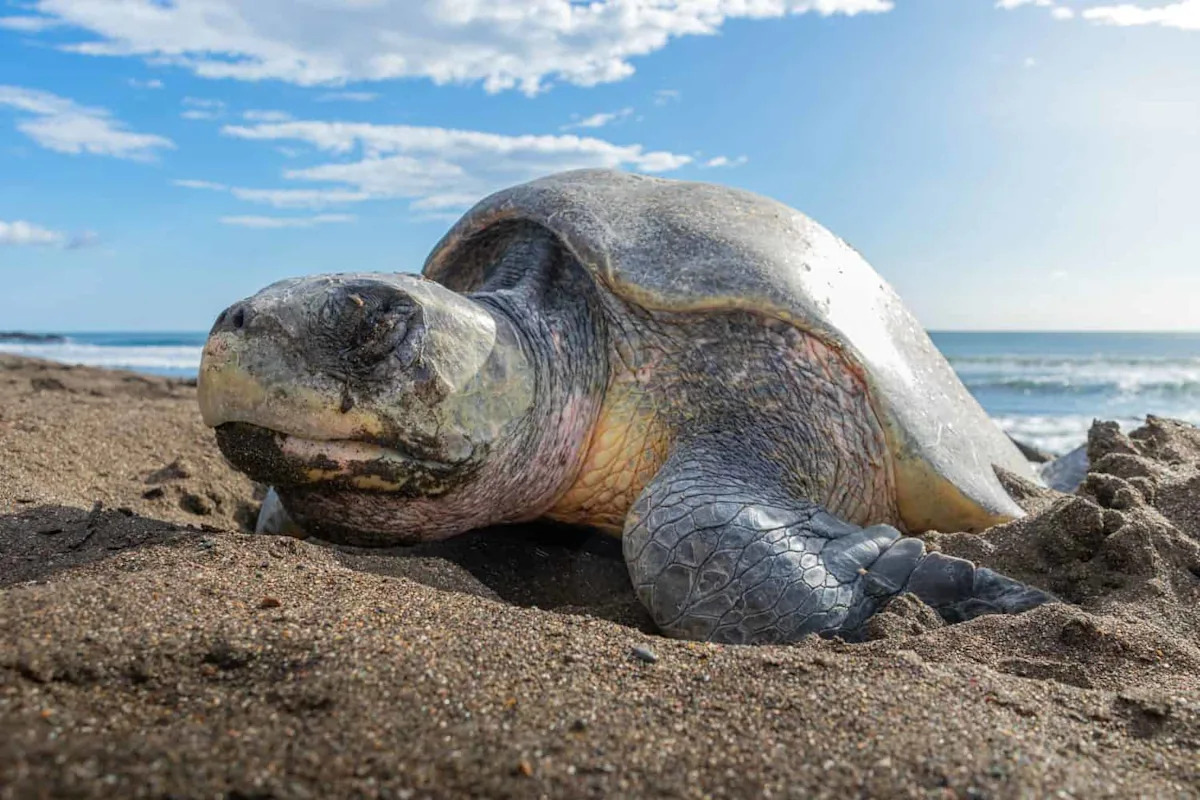
The post This Giant Ancient Turtle Dwarfs Its Modern Ancestors appeared first on A-Z Animals.
Turtles today are often slow-moving, modestly sized creatures, but their ancient relatives were quite different. Long before modern turtles evolved into the familiar forms we recognize today, some species grew to tremendous proportions, dominating rivers and seas with massive shells and powerful jaws. These prehistoric giant turtles lived in environments that allowed them to thrive at sizes that seem almost unimaginable by today’s standards.
One such ancient turtle was so enormous that it makes even the largest living turtles look small by comparison. Towering over its modern descendants, this giant reptile shows how dramatically life on Earth can change over millions of years. By examining its size, habitat, and behavior, we can better understand the evolutionary success of turtles as a whole. Let’s learn about the huge creatures that once ruled their world.
Modern-Day Turtles

©Michael Murray/iStock via Getty Images
(Michael Murray/iStock via Getty Images)
With over 300 species alive today, turtles are old animals that have existed on earth for a very long time. Despite all being turtles, each species is different from the other in terms of appearance, habitat, and diet.
Land Tortoises vs. Sea Turtles

©iStock.com/Greg Sullavan
(iStock.com/Greg Sullavan)
Some turtles are sea turtles, but many more live on land (tortoises) or in freshwater habitats. Their size, length, and color depend on their species, and it is almost impossible to find any two turtles that are identical.
Most people tend to confuse turtles with tortoises because of their similar features. The primary difference between both animals is in their habitat. While tortoises are strictly terrestrial animals, turtles are aquatic animals or prefer to spend most of their time in the water. There is also a difference in how their shells are shaped, their behaviors, and their diets. The turtles that roamed the earth before now are rumored to have been bigger than any that live today. Let’s look at some.
How Big Can a Modern Turtle Get?

©iStock.com/YasserBadr_Beenthere
(iStock.com/YasserBadr_Beenthere)
Leatherback sea turtles are the largest living and can weigh up to about 1,500 lbs. at the extreme high end, but most turtles do not reach such a hefty weight. The average sea turtle is around 420 pounds.
1. Stupendemys

The enormous Stupendemys geographica, a freshwater turtle species estimated to be the largest ever to have existed, is the first extinct turtle on the list, in no particular order. This turtle lived in South America during the Miocene epoch, from around 13 million years ago to about 5 million years ago.
It was given its name by experts in 1972 because of its outrageous size, with its shell the size of a car. The Stupendemys turtle resided in a vast freshwater wetland that covered a large portion of northern South America, including areas of Peru, Colombia, Venezuela, and Brazil.
Going by research, experts concluded that it took over 100 years for this turtle to reach its maximum size. The average Stupendemys shell grew as long as 10 feet, and these turtles weighed around 2,500 pounds. Because of their size, it is believed that these turtles ate a lot to maintain their weight. According to research based on their strong jaws, teeth, and skulls, experts were able to deduce that these turtles were likely omnivorous or ate a varied diet.
2. Meiolania

The Meiolania was first believed to be a lizard similar to a Megalania, but on further analysis of their fossils, experts discovered that they were actually turtles. These turtles were terrestrial and lived from the Middle Miocene period to the Pleistocene period, approximately 20 million to 50,000 years ago.
Unlike any other turtle that ever lived, the Meiolania had two spikes on its head to help fight predators, but this meant that it could not insert itself fully into its shell, like other turtles. It also had a spiked tail, probably for defensive purposes. These turtles were massive, weighing above 1,000 pounds and over eight feet long.
Experts believe that the Meiolania was a herbivore that mainly depended on grass and plants near bodies of water. However, some experts stated that the horns on their heads and tails meant they could easily hunt and kill other animals, but most think they had these spikes primarily for protection. Although these turtles were terrestrial, they liked to live in coastal areas near the water. The fossils of this turtle have been found in parts of Australia, New Caledonia, and some other Pacific islands.
3. Archelon

©Warpaint/Shutterstock.com
(Warpaint/Shutterstock.com)
So far, the largest extinct turtle ever discovered, the Archelon is a turtle that existed during the Late Cretaceous period (~80–66 million years ago). This turtle was over 13 feet long when measured from nose to tail and was 16 feet wide from one flipper tip to the other, larger than any other turtle fossil found. Aside from its incredible length, the Archelon also weighed a lot, with a body mass of 4,900 pounds.
There is no similarity between this ancient turtle and the ones that currently exist. Although its shell looked almost like that of present-day sea turtles, it was made of a different material and was not as hard. One of the primary ways to identify this turtle was by its flipper-like arms and legs, which were very wide and long and helped it propel through the waters.
The Archelon was carnivorous and is believed to have fed on mollusks, jellyfish, and crustaceans found on the seafloor. Catching prey for this turtle was a breeze because of its hooked beak, strong jaws, and equally strong feet that acted as paddles and helped move its heavy body through the water. Because of its size, the Archelon is not believed to have had many predators, but its primary predator would most likely have been prehistoric sharks.
The preferred habitat of this ancient turtle was the oceans of North America, particularly the Western Interior Sea, which, at some point, cut directly through the continent. The fossils of this turtle were first discovered in 1895 in South Dakota, which, at some point, was entirely covered by water. Fossils of this turtle have also been found in North Dakota and parts of Wyoming.
The post This Giant Ancient Turtle Dwarfs Its Modern Ancestors appeared first on A-Z Animals.