Over many of the past several years it seems as though winter really gets started around early January. Well, that’s not the case this year, as we have been in full winter mode since mid-November. Last year’s winter also put in a much stronger showing than recent winters.
With all of the snow that keeps blanketing us, the birds have definitely been enjoying the bird feeding stations that so many of us have been keeping filled every day. We certainly have had plenty of very challenging winter weather to deal with over the last two months!
I often admire how the birds survive these long cold windy nights. They instinctively know where to find shelter. Most birds find protected places out of the wind like in deep thickets over an embankment and in the dense tops of evergreens. Several species of birds that nest in hollow cavities generally also find nighttime shelter in hollow cavities, which seem to me to be the best option!
Cavity nesters include the various Woodpeckers, Chickadees, Tufted Titmice, Nuthatches, Bluebirds, Kestrels and Owls. Whether they use their same nesting cavities for roosting over the winter, I’m not sure. Probably in many cases they do. Here at home over the last several years, including this winter, the Downy Woodpecker is using the Bluebird nest box for roosting. If you have winter Bluebirds hanging around this winter, they are likely using one of your Bluebird nest boxes to roost in.

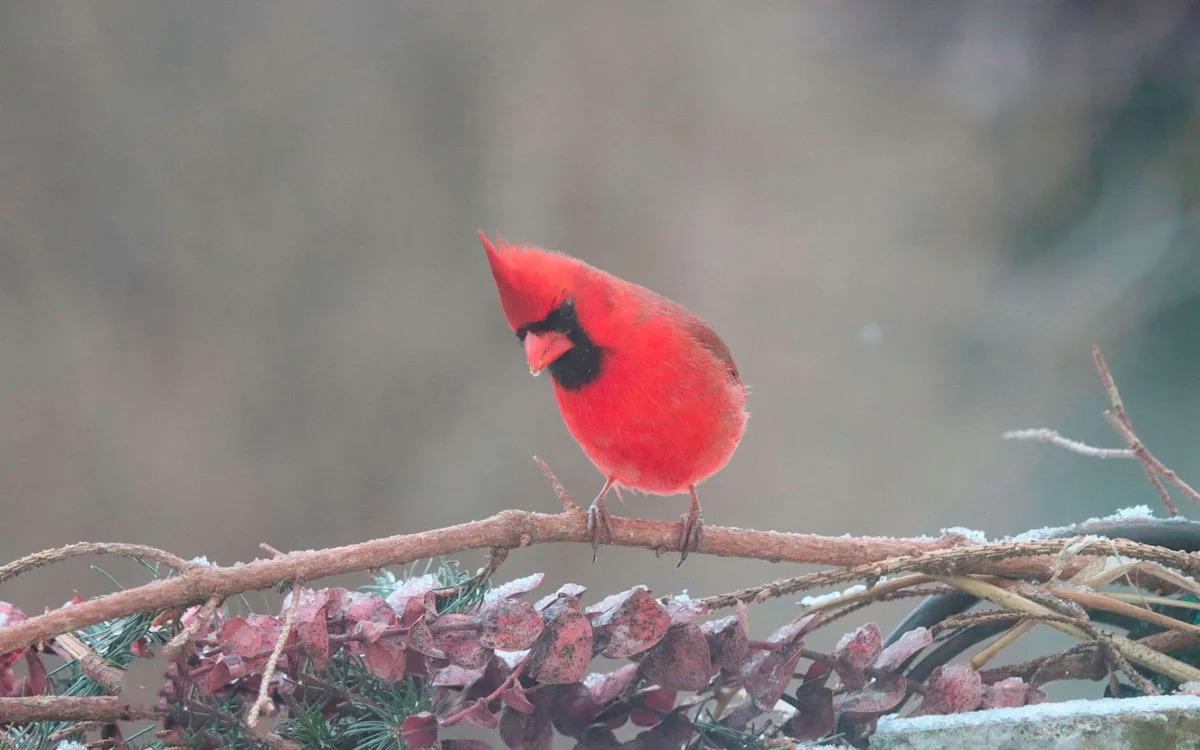
Reader Janie Ferguson captured this photo of a radiant cardinal with a bit of ice on its beak from tapping through the ice for sunflower seeds in Steuben County, NY.
Note that they all pile into the same box so as to keep each other warm. In summer, once the babies fledge (which means leave the nest) none of the adults or fledglings come back to sleep in the nest box – it’s dangerous in there with several summer predators around. If the adults decide to have another brood of young, they may use that same box again – especially if they were successful with the first brood.
Most Kestrels migrate south for the winter, but some stay here and may use the Kestrel box. Owls may switch roosting sites throughout the year. Here at home, we have a sugar maple tree in front of our birdfeed shop and about 10 feet up the trunk is a hollow cavity that the Screech Owl uses to roost in. I do not believe it uses it for nesting. The hole faces the southeast so sometimes the owl props itself up into the opening to catch some warm rays of sunshine on cool, but sunny winter days. But most of the time the owl remains hidden down in that cavity and the other birds know that the owl is in there. They “tell” me that the owl is present when every once in a while, sometimes daily, they take turns scolding it and yelling “fowl” things into the owl’s roosting cavity!
Anyways, the birds are well adapted to weathering the winter cold – especially when they have had plenty of high energy food to eat during the day. Despite survival stamina that these birds have, providing them feed over the winter and spring definitely makes the difference in whether or not many birds actually do survive.
You may notice that the bird feeder isn’t always busy on nicer winter days, as the birds also know enough to go find natural food as well. It is the heavy snowfalls, very cold temperatures, and prolonged nasty winds that make survival pretty tough. I feel so much better when I have all of my feeders full and ready for the next bout of rough weather!
More: How to attract birds to feeding stations with nyjer seeds | Birding column
Yes, this is a winter when the birds are really counting on us to supplement their natural food supply. As I’ve mentioned before, feeding the birds and watching them brings so much entertainment and joy to us. It’s a win-win situation for the birds and us humans.
I encourage you to keep a close eye on the variety of birds at your feeding station. Yes, we love the many pretty regulars such as the Cardinals, Blue Jays, Woodpeckers, and many more. But it’s also fun to watch for some of the less common ones. An example that I can share with you right now is that we have an Eastern Towhee coming pretty steadily. It’s a ground feeding bird and very pretty. Look it up in your field guide or on your bird app. It used to be called Rufous-sided Towhee.
So many birds love to eat feed on the ground. We actually feed more on the ground than we do on a bird feeder! So, you can start feeding birds simply by putting out a piece of plywood on the ground, or maybe on a slightly raised platform, or on your porch floor, and you’d be surprised how much action you get!
— Hans Kunze writes a New York state-focused birding column.
This article originally appeared on The Evening Tribune: Helping birds survive winter with food, nest boxes for roosting