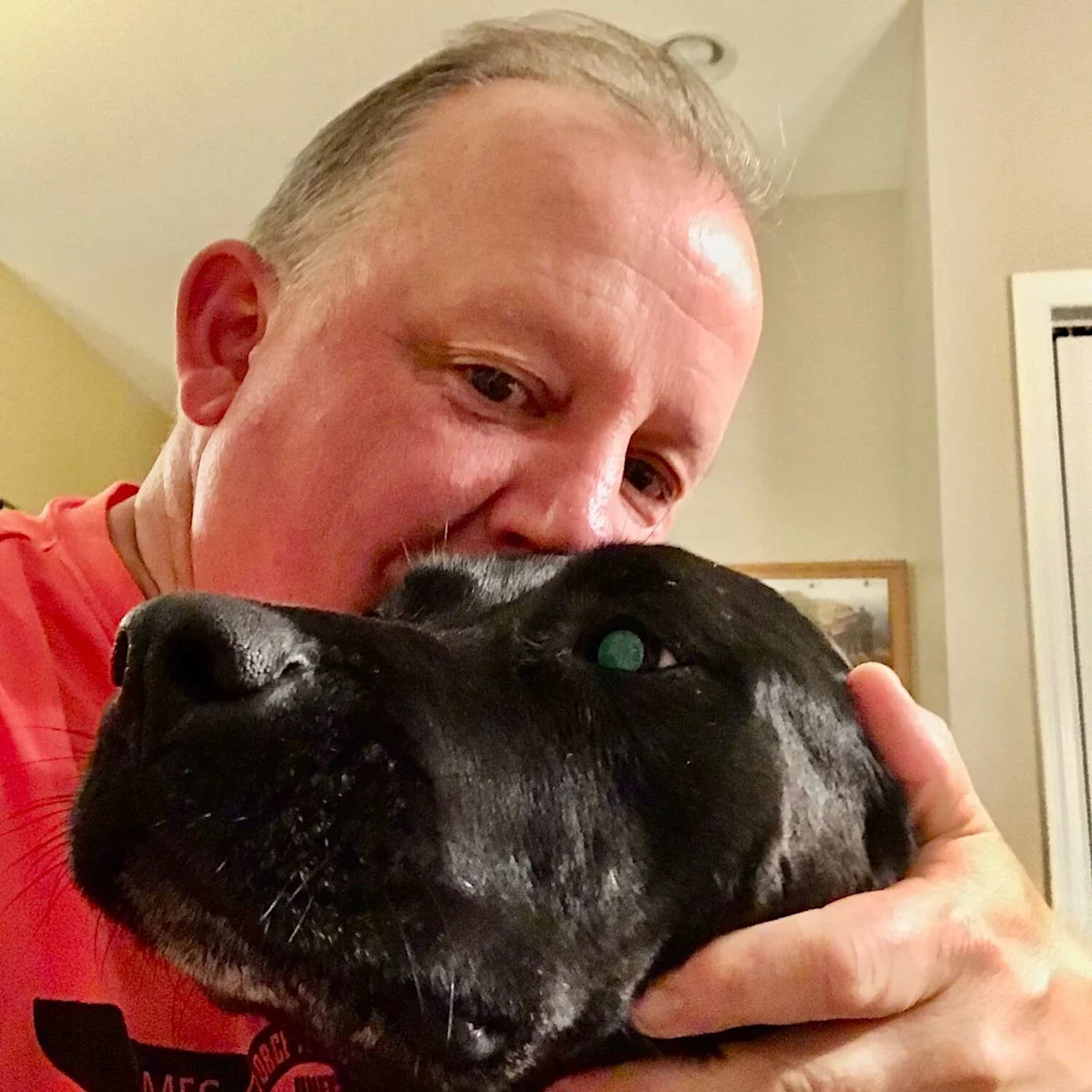
GUILDERLAND – Our dog Lily had more lives than a cat.
When we adopted her, Lily was a wild child of about 2, a female pitbull mix, jet black, with a heart-shaped white patch on her chest and a dab of white on two toes of her back left paw.
She was a 60-pound dynamo with rippling muscles whose motor ran hot and operated at only two speeds: overdrive and turbo.
The young couple who adopted Miss Lillian (her proper name) from Adirondack Pitbull Rescue was relocating to an apartment in the Carolinas and could only bring one of their two pitbulls. They chose Charlie, Lily’s big brother, a huge white beast who, we learned, roughhoused aggressively with Lily by grabbing her collar in his mouth and whipping her around like a rag doll.
When she could escape Charlie’s bullying, Lily ran free as the wind in fields of tall grass around their country home. The couple simply opened the back door to let the dogs run wild, as far as an acre of electric dog fencing allowed.
Adapting from nearly feral freedom to suburban confinement was a major adjustment for Lily, and for us. My wife, Mary, and I had been without a dog for about a year after we put down our 14-year-old black Lab, Daisy. Our daughter, Caroline, a freshman at Fordham University’s Lincoln Center campus in Manhattan, found a photo of Lily online. We all fell hard for her.
Lily arrived with off-the-charts anxiety. She tore around the house and hopped sofas like a hurdler. She was whip-smart and a stealthy troublemaker. Leaving her home alone for even a short span was a crapshoot. We got a child lock for the pull-out kitchen cabinet trash bin after she figured out how to open it and dump out the garbage, hunting for food scraps. We firmly shut bathroom doors after she chewed up a disposable razor. Christmas lights, a hardcover copy of “Harry Potter” and garage drywall all succumbed to Lily’s unease when we stepped out. She gnawed rock-hard Nyla bones down to a nub.
I retrieved Daisy’s old crate from the basement. Lily’s brute force bent the heavy wire slats and she squeezed out the top – her Shawshank redemption. I reinforced it with heavier wire.
Even on walks through the woods, Lily found trouble. She tumbled down gorges and crashed through dead trees, charging in hot pursuit of chipmunks. She got sprayed by skunks. I was too late to intervene when I spied the tail of a mole or vole disappear down her throat. We monitored her, as the vet said. No problem for indomitable Lily.
I thought Lily was a goner after she swallowed mice poisoning that I (or so I thought) securely stored in the garage, high and out of reach, that she uncovered after being left unattended for two minutes. We called the vet, who suggested hydrogen peroxide to induce vomiting. I rushed to the 24-hour CVS. Caroline held Lily while I poured spoonfuls of the liquid into her mouth. It was a cold winter night, so we ran her around the kitchen until she finally threw up – green pellets of poison dappling the foamy retching.
She was a sweet and affectionate dog when it didn’t feel like we were breaking a wild stallion. Two things saved our sanity: bike rides and Chuckit!
Lily was extraordinarily athletic and needed to burn off excess energy. Long walks and jogging beside me on a leash didn’t cut it.
I started taking Lily on rides alongside my mountain bike. She galloped in rhythm a few feet from my front wheel, never breaking stride, never distracted, never yanking me off balance. She was in the zone. We had found our groove. In quiet hours, we looped around our neighborhood’s roads at a good clip for a half-mile or more. Lily returned home, tongue lolling, exhausted and content. This became our ritual for letting Lily’s inner wild child out.
The other savior was a large Chuckit! ball launcher. I perfected my technique so I could heave a ball 80 or 90 yards. At the soccer field, I’d say “Chuckit!” and Lily would take off like a rocket, tracking the arc of the ball by its whistling sound overhead. With a perfect lead throw, she watched it bounce off the grass and leaped a few feet off the ground to snag it on one hop. She’d sprint back and drop it at my feet, ready to fetch again. She ran herself dog-tired. I bought glow-in-the-dark balls and wore a head lamp in winter.
The seasons and years piled up. Where did that wild child go? Dogs are the mile markers of a family’s journey. She matured into a sweet teen who loved to snuggle on the couch. She was a loyal adult who slept next to my desk while I wrote. She was a stellar senior travel companion. We made countless road trips to New York City, where Caroline and I had a favorite table at a dog-centric café in Central Park. Mary and I cherished fall vacations at dog-friendly rentals in Provincetown, where Lily had the run of Race Point and got corner seats on heated patios at bars and restaurants along Commercial Street.
We grew gray together, Lily and me. We stopped the in-sync bike rides when she tired easily. Our sessions of Chuckit! got shorter. In dog years, she crested 90. We humans only get a short time with these magnificent animals that mark the rhythms of our daily lives from the moment we wake up to the moment we go to sleep. How do any of us deserve such unconditional love?
My mom kept a magnet on her refrigerator: “I aspire to be the person my dog thinks I am.” A magnet on our refrigerator said: “All dogs are therapy dogs. The majority of them are just freelancing.”
It has been a year of loss for our family after my mother-in-law died in April at 90 and my mom at 93 in June.
At the end of Lily’s road, the week before Christmas, I called my friend and neighbor, Gary, a pet care service owner, who took wonderful care of Lily for years. He came over and laid down next to Lil, as he called her. He rubbed her muzzle and said goodbye. He reminded us that we were doing the right thing, knowing when to let a dog die with dignity, a promise we make to our pets. We hugged and choked back tears.
On her final night, I lifted Lily’s gaunt body onto the bed. I stroked her velvety ears and whispered that she was a great dog. She fell asleep. After some time, her legs started twitching, her body jerked and she let out muffled yelps. The wild child dreaming. Out in the tall grass.
Run, Lily, run.
You’re free.
Paul Grondahl is the Opalka Endowed Director of the New York State Writers Institute at the University at Albany and a former Times Union reporter. He can be reached at grondahlpaul@gmail.com
This article originally published at Grondahl: How Lily marked the rhythms of our lives.