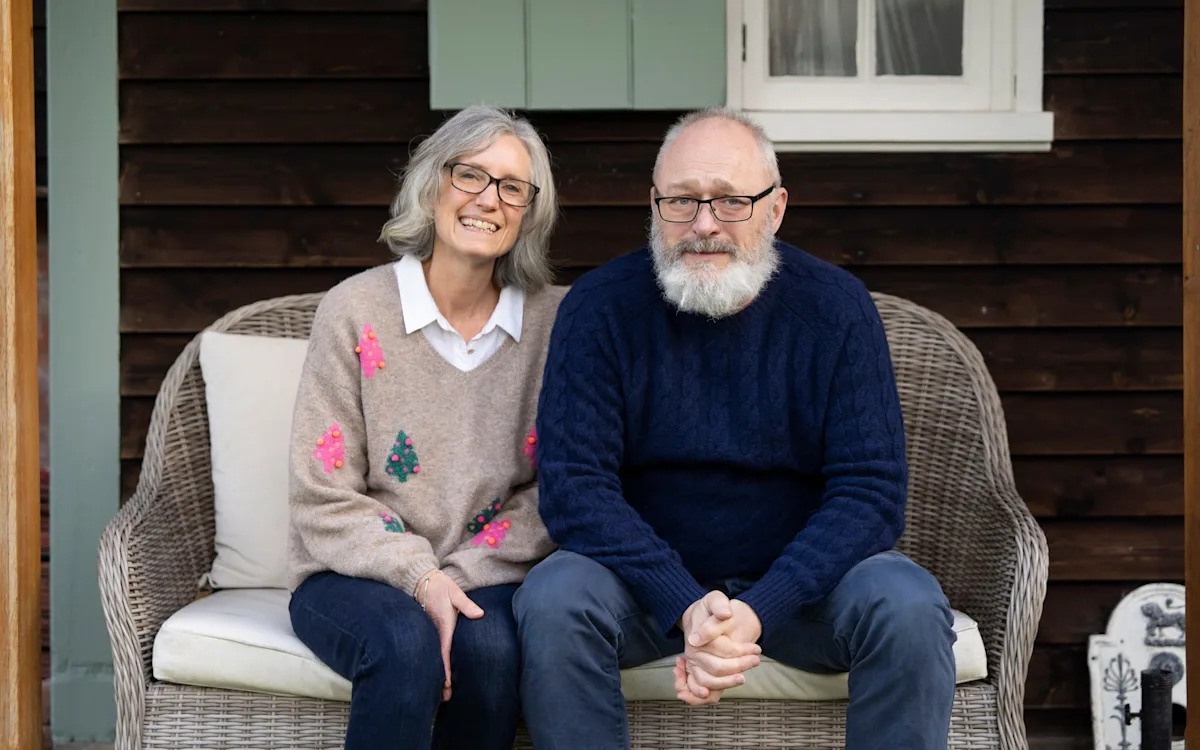
“I don’t think anyone can describe what it feels like to lose a child. He went out of the house one day and he didn’t come back,” says Nicola Brown whose 21-year-old son Jake passed away in December 2017 following a car accident.
At the time of Jake’s death, Nicola had been working as a special needs teaching assistant at a school near their home in Burton upon Trent in Staffordshire. “I didn’t go back to work,” says the 58-year-old, who lives with her husband Andrew, also 58, and their daughter Ellie, 30. “Life just stopped. Somehow, we got through the months that followed, but by autumn 2018 I was in a bad place. I felt I had nothing to get up for in the morning, I just didn’t see the point,” she recalls.
In the depths of her grief, Nicola realised her life needed renewed purpose and focus. “I was fortunate that Andrew, who used to be a technology consultant, was the breadwinner, which meant I could consider volunteering. I am a dog lover, and we have always had pet dogs, including Monty, our 14-year-old Bearded Collie. Jake absolutely loved animals, too. He worked in a garden centre and the summer before he passed, he saved two kittens he’d found. That was just the type of person he was. I knew I wanted to do something in this area.”

Nicola and her son Jake were both animal lovers, which prompted her to volunteer with Canine Partners – Andrew Fox
During her research, Nicola discovered Canine Partners, a charity that breeds and trains dogs to help people with physical disabilities.
“If Jake had survived the accident – and there was hope at one point – he might have required assistance himself, so helping somebody in that situation seemed like the perfect fit,” says Nicola who reached out to the charity to become a puppy training volunteer or “puppy parent”.
Essentially, it means being paired with an eight-week-old puppy and, over the course of a year, providing early socialisation skills and training before they move out of the house and onto the next stage of the programme.
“In December 2018, almost a year to the day after Jake died, I got my first puppy, a yellow Labrador Retriever cross called Saffy. She brightened my life immediately. Grief is isolating and I’d become a bit of a recluse. Not only did Saffy give me focus and drive because I had to tend to her on a practical level, but she forced me out into the world again.”
The pair, Nicola says, went everywhere together. Having Saffy also gave people something to talk to Nicola about other than Jake’s death. “It provided relief and space to breathe when I needed it most. I could just be ‘Nicola’, and not the mum of Jake who died.”

Nicola became doggy midwife and nanny to Rosa, the Labradoodle – Andrew Fox
Saffy stayed with Nicola until she was 16 months old. She then moved onto advanced training and has subsequently become a canine partner for a woman in a wheelchair. “Knowing she was going to do such good work made it easier to say goodbye to her, and also we knew another puppy would be arriving,” says Nicola.
This turned out to be Rosa, a Labradoodle who arrived in January 2020 who is yet to leave.
“We did the puppy parenting role until she was a year old, but then, Canine Partner’s breeding team wanted to explore Rosa’s potential as a brood bitch. This was partly because of her coat, which doesn’t shed much so is ideal for someone with allergies, but also her temperament. She’s such a good girl and so maternal.”
Nicola was given the option to pass Rosa onto a brood volunteer and continue working as a puppy parent or keep Rosa and change her volunteering role to doggie midwife and nanny.
It wasn’t a difficult decision to make.
“From the off, Rosa and I have had such a special bond and incredibly, she shares her birthday with Jake. It was like it was meant to be.”

Nicola will keep Rosa as a family dog once her role breeding for Canine Partners is finished – Andrew Fox
To date, Rosa has had three litters with mates chosen by the charity’s breeding division. The first two litters were pure Labradoodles and the third, born in October, were Labradoodle crossed with Golden Retriever.
“It was the prettiest litter we’ve had, they were absolutely gorgeous,” says Nicola who only said goodbye to them a few days before our chat.
The role is hard work, from making sure Rosa has everything she needs to be a good mum, to weaning and transitioning the puppies into a pen, and then feeding them, taking them outside to toilet and doing one-to-one socialisation. But, she says, it is so worthwhile, especially when you get updates as they move through the training programme.
To become a brood volunteer, you need to go through an application process, which includes a home visit to assess suitability. If successful, you are given a well-socialised dog to live with you as a member of the family who will be mated once a year.
Although you do not need to have previous experience of litters to become a dog breeding volunteer for Canine Partners, you do need to live within a designated area, approximately an hour and a half of the training centre in Osgathorpe, Leicestershire.
“You also need to have enough time, energy and space, but the charity covers expenses, from food to veterinary costs. And you get so much support. Canine Partners do a wonderful job of looking after you generally, which is lovely. It is like a new family. I’ve met so many wonderful people, not just those who work for the charity, but fellow volunteers who have their own unique reasons for doing this.”
Canine Partner’s broods will typically have three or four litters before they are retired from the programme, so Rosa will be observed over the next six to eight months before the charity decides whether or not to go ahead with another litter.
“When she retires from breeding, Rosa will be signed over to us, and she will be our pet dog forever, but I will continue to work closely with Canine Partners and volunteer in some capacity as it is so close to my heart,” says Nicola.
“I can’t advocate for them enough. Canine Partners saves people’s lives by pairing dogs with those who need them, and in a roundabout way they have done the same for me. I had counselling and a lot of support from my family and friends following Jake’s passing, but I just needed something else and volunteering has brought me so much joy.”