The post The Truth About What’s Inside a Turtle Shell appeared first on A-Z Animals.
Quick Take
-
Shell integration typically involves 50 to 60 individual bones fusing into a permanent structural cage.
-
The carapace creates a mechanical constraint that prevents the chest from expanding during respiration.
-
Modern anatomy shows that rib fusion provides strong protection but also limits the expansion of the chest cavity and internal organ volume.
-
Mapping the embryonic stage was necessary to identify the moment organs migrate into the shell.
Cartoons often suggest turtles wear shells like removable armor. Those stories show turtles stepping out, swapping shells, or treating them like clothing. Biology disagrees. A turtle shell is not an accessory. It is a living bone, permanently fused to the spine and ribs, filled with organs, muscles, blood vessels, and nerves. The shell is an integral part of the turtle’s skeleton, not just a container around the body.
The Shell as a Living Skeleton
Understanding what lies inside a turtle’s shell explains why turtles move, breathe, and survive the way they do. Their anatomy looks unusual because evolution reshaped the skeleton instead of adding armor on top. The result is a body plan found nowhere else among living vertebrates.
A turtle’s shell functions as part of the skeleton, not as an external covering. The upper shell, known as the carapace, develops from ribs and vertebrae that flatten and fuse during growth. These bones connect directly to the spine, making the shell inseparable from the rest of the skeleton. The lower shell, called the plastron, protects the underside of the body and joins the carapace at the sides. Because the shell contains bone cells, nerves, and blood vessels, it grows as the turtle grows. Injuries to the shell cause pain and bleeding, just like injuries to other bones.

The turtle does not wear its shell like a hermit crab. Instead, the shell is fused to the spine and ribs to make one inseparable body.
©Kuttelvaserova Stuchelova/Shutterstock.com
(Kuttelvaserova Stuchelova/Shutterstock.com)
Scutes and the Outer Covering
The outer surface of most turtle shells is covered with plates called scutes made of keratin, the same material found in human fingernails. These scutes form distinct patterns that help identify species. Beneath each scute lies bone, but the scute layout does not perfectly match the shape of the underlying skeleton.

Turtles, like this North American box turtle, have distinct colors and shapes on their shells that help identify the species.
©RenEgAdeRooStEr/Shutterstock.com
(RenEgAdeRooStEr/Shutterstock.com)
Some turtles, such as softshell turtles, lack hard scutes. Instead, they have a leathery skin covering a reduced bony framework. Despite the flexible surface, the shell underneath still connects to the spine and ribs. The outer layer protects internal tissues while allowing growth and repair over time.
Carapace, Plastron, and Structural Connections
The shell consists of two main regions: the carapace, which covers the back and includes bones along the front edge, sides, and rear, and the plastron, which forms the base of the shell and develops from bones related to shoulder and chest structures in early reptiles. Strong bony bridges connect the top and bottom sections into one solid unit. These components leave openings for the head, limbs, and tail. In some species, parts of the plastron can move slightly, allowing the turtle to close itself more tightly. This movement improves protection while keeping the shell structurally sound.

A turtle’s shell includes the upper carapace and the lower plastron.
©KellyNelson/Shutterstock.com
(KellyNelson/Shutterstock.com)
Spine, Ribs, and Shoulder Placement
One of the most unusual features of turtle anatomy is the placement of the shoulder girdle. In most land vertebrates, the shoulder blades sit outside the ribcage. In turtles, the ribs expand outward and fuse into the shell, enclosing the shoulders inside the ribcage.
The spine runs along the top of the shell and connects directly to the carapace. The ribs flatten instead of curving around the chest. Because of this arrangement, removing the shell would require removing the spine and ribs. A turtle cannot survive without its shell because the shell is the skeleton itself.
Internal Organs Within the Shell
Inside the shell are the turtle’s vital organs, arranged tightly against the bony walls. The lungs sit just beneath the carapace, while the heart and liver occupy the central area. The stomach and intestines fill much of the remaining space. There is no empty space inside the shell that would allow a turtle to separate from it.

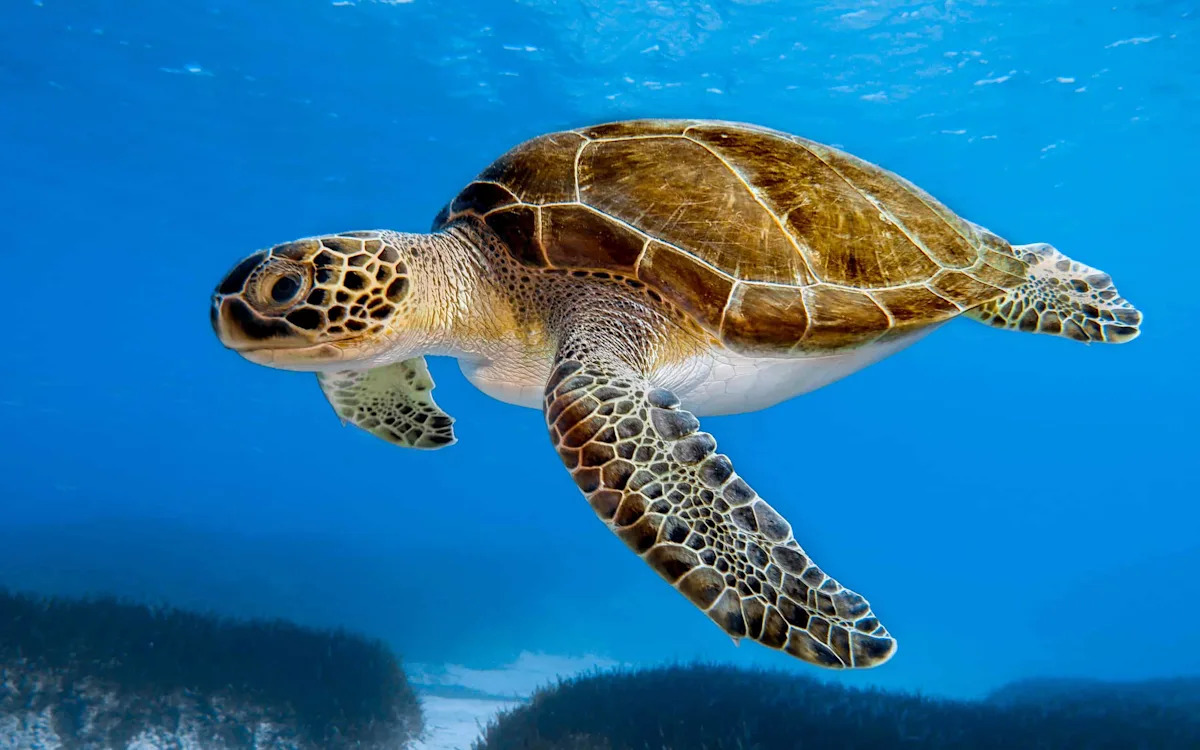
A sea turtle swims through the water, with its shell tightly holding the organs that keep its body working and balanced.
©David Carbo/Shutterstock.com
(David Carbo/Shutterstock.com)
Blood vessels and nerves pass through channels in the bone, allowing sensation and healing. Damage to the shell can affect internal organs due to their close proximity. This arrangement shows that the shell shapes the turtle’s body, rather than simply enclosing it.
Breathing Without Rib Movement
Because turtle ribs cannot move, breathing relies on muscles attached to the shell and surrounding tissues. These muscles shift internal organs to change lung volume. When organs move downward, the lungs expand and draw in air. When organs move upward, air is pushed out.
Some turtles also use movements of the limbs, neck, or throat to assist breathing. Aquatic species benefit from large lungs that help control buoyancy. This system allows turtles to breathe efficiently despite having a rigid shell.
Muscles and Movement
The shell supports a strong network of muscles. Limb muscles attach to the internal shoulder and pelvic bones, then extend outward into the legs or flippers. This arrangement provides power for walking, digging, or swimming. Sea turtles use large muscles for steady strokes, while land turtles rely on strength to push against soil and vegetation.

A turtle rests on a log, using muscles connected to its shell to hold its body steady and control its head and limbs.
©Ken Griffiths/Shutterstock.com
(Ken Griffiths/Shutterstock.com)
Neck muscles allow different styles of head retraction. Some turtles pull their heads straight back, while others bend their heads sideways. Muscles attached to the shell also help stabilize the body and assist breathing.
Shell Growth and Repair
Turtles grow continuously, and their shells grow with them. Bone expands at the edges of shell plates, while scutes show growth rings that reflect age and health. The shell does not shed as a single unit. Because the shell contains living bone, it can heal after injury. Wildlife veterinarians treat cracked shells using stabilization methods that allow the bone to repair itself over time. Healing may take months, but recovery is possible when damage does not reach vital organs.
Evolution of the Turtle Shell
The turtle shell evolved through gradual changes rather than sudden armor development. Fossil evidence shows early relatives with widened ribs and partial shells. Some fossils reveal a fully formed plastron before the carapace completed its development. Studies of turtle embryos support this history. During development, ribs grow outward into a ridge along the body instead of wrapping around the chest. Over millions of years, these changes produced the fully fused shell seen today.

Fossilized turtle remains show how shells developed over time as ribs slowly spread and fused into solid bone.
©Mike Brake/Shutterstock.com
(Mike Brake/Shutterstock.com)
Why the Empty Shell Idea Persists
The idea of an empty turtle shell persists because people confuse turtles with animals that carry external coverings. Snails and hermit crabs can leave or change shells, which fuels the misconception. Cartoons and children’s books reinforce this image. Medical imaging and shell injuries show the reality. X-rays reveal ribs, spine, and shoulder bones integrated into the shell. Once people see this structure, the idea of a removable shell no longer makes sense.
Seeing Turtles in the Wild
Wild turtles can be observed in wetlands, rivers, forests, and coastal waters across many regions. Freshwater species often bask on logs or riverbanks during warm months. Patience and distance improve chances of observing natural behavior without causing stress.

A turtle moves through the water, demonstrating how these animals live in natural habitats that should be observed with care and respect.
©Maurizio De Mattei/Shutterstock.com
(Maurizio De Mattei/Shutterstock.com)
Sea turtles are seen along coastlines, especially during nesting seasons. Viewing should follow local guidelines to avoid disturbing animals. Protected areas and wildlife refuges offer structured opportunities for observation while supporting conservation efforts.
Living Within the Shell
A turtle lives its entire life shaped by its shell. The shell determines breathing, movement, and survival strategies. It offers protection while limiting flexibility, creating a balance refined over evolutionary time. Viewing the shell as living bone rather than armor changes how turtles are understood. It highlights their vulnerability and the importance of careful study and protection. The shell is not something a turtle carries; it is an essential part of what a turtle is.
The post The Truth About What’s Inside a Turtle Shell appeared first on A-Z Animals.