The post The Jurassic Shrew: Meet the Venomous Mammal with a “Joystick” Nose appeared first on A-Z Animals.
Quick Take
-
The Hispaniolan solenodon is a “living fossil” that survived the asteroid that killed the dinosaurs.
-
Its lineage has remained virtually unchanged for 76 million years.
-
It possesses a bizarre toolkit for survival, including venomous saliva delivered through grooved teeth, a nose that pivots like a joystick on a ball-and-socket joint, and the ability to navigate in total darkness using echolocation.
-
Despite surviving for eons, the solenodon is now endangered. It faces extreme pressure from habitat loss and invasive predators like cats and dogs.
Deep in the leaf litter of Hispaniola lives a creature that defies modern evolutionary logic. The Hispaniolan solenodon (Solenodon paradoxus), or agouta, is a true living fossil. This little creature not only witnessed the age of the Tyrannosaurus rex but also survived the asteroid that brought that era to a cataclysmic end.
After spending eons in isolation on its Caribbean island, the Hispaniolan solenodon has retained prehistoric features that seem more suited to a fantasy novel. In a rare mammalian feat, it delivers a toxic, snake-like venom through specialized grooves in its teeth. Its nose is connected to its skull by a unique ball-and-socket joint, allowing it to pivot its snout with mechanical precision when hunting for prey.
The Last Survivor of the Cretaceous
While most prehistoric species either evolved into new forms or vanished into the fossil record, the Hispaniolan solenodon’s lineage has remained virtually unchanged for 76 million years. Today, this ginger-haired survivor is one of only two living members of the family Solenodontidae, along with the Cuban solenodon (Atopogale cubana). It is technically classified within the order Eulipotyphla, but it shares very little with its modern neighbors, having diverged from the ancestors of shrews and moles during the Late Cretaceous.

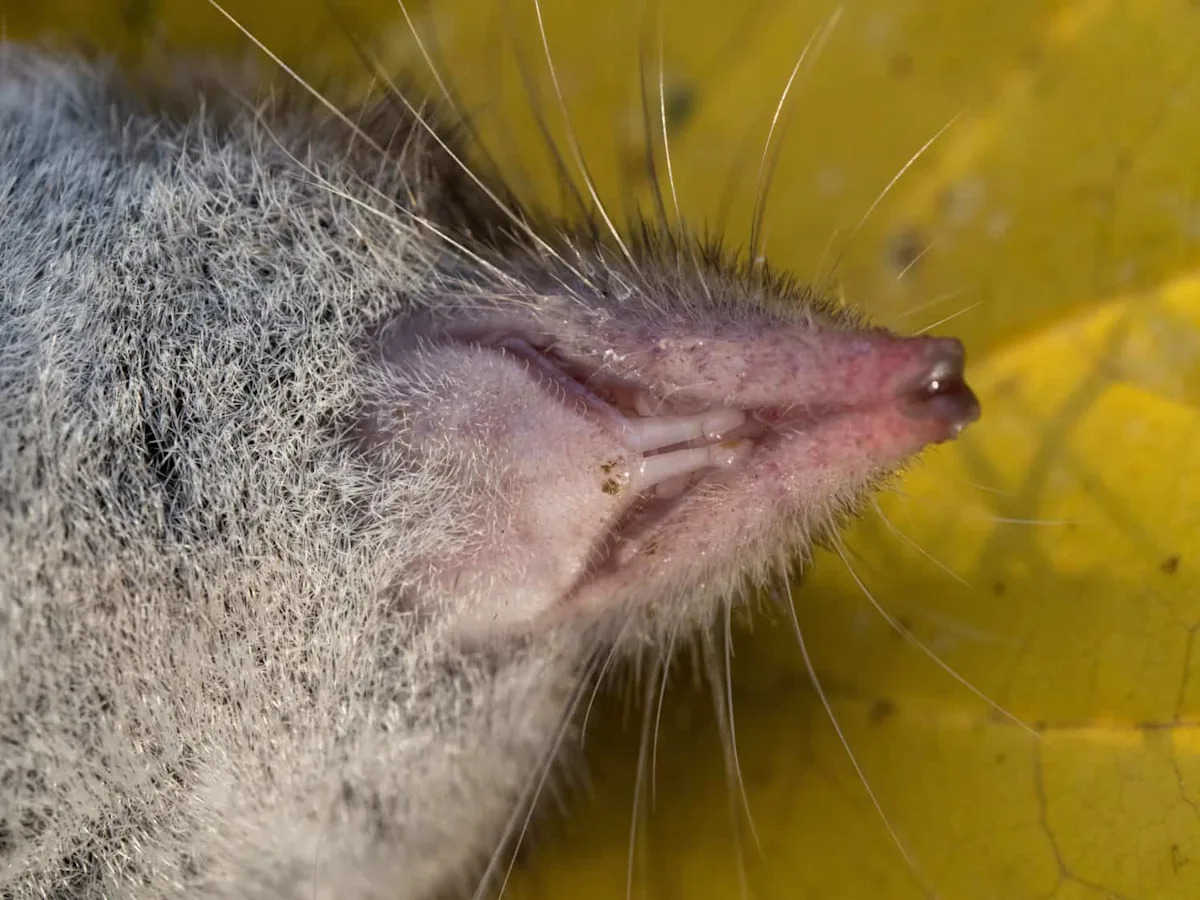
The solenodon is one of nature’s most fascinating oddities. Often described as a biological anomaly, its combination of physical tools is rarely seen in other warm-blooded creatures today. For example, its os proboscis is a specialized bone that forms a ball-and-socket joint at the base of its snout. This allows the solenodon to use its snout like a joystick, swiveling the long, flexible nose with pinpoint accuracy. As an insectivore, the solenodon uses its unusual nose dexterity to poke into narrow crevices and deep soil to sniff out hidden prey like worms, spiders, and snails.
The solenodon also carries a very unusual chemical weapon for a mammal: a venomous bite. This trait is a classic example of convergent evolution, in which the solenodon independently developed a venom delivery system similar to that of a snake. Its name literally translates from Greek as “grooved teeth,” referring to the deep channels in its lower incisors. When it bites, toxic saliva travels through these grooves and into its prey. This lethal adaptation allows this relatively slow-moving creature to quickly paralyze insects and small vertebrates, making it an unexpectedly formidable hunter in the undergrowth.
An Echolocating Excavator with a Zig-Zag Gait
The solenodon thrives in environments where eyes are often useless, so it has developed the rare ability to echolocate. By emitting a series of high-pitched clicks and whistles, it can “map” its environment. This allows the solenodon to dodge obstacles and pinpoint moving prey even in total darkness.

In the dense undergrowth, solenodons communicate primarily through scent rather than sight. The solenodon has specialized scent glands located in its armpits and groin that release a pungent, goat-like odor. This strong scent acts as a chemical breadcrumb trail, helping these solitary animals mark their territory and signal to potential mates through thick vegetation.
When the solenodon moves into open spaces, its behavior becomes even more unusual. It travels in a stumbling, zig-zag pattern that can look quite clumsy. This unique gait likely evolved because the solenodon had no natural predators for millions of years. As a result, it never needed to develop the ability to run in a straight, high-speed line. However, what this furry creature lacks in grace, it more than makes up for in raw power. Its front limbs have long, sickle-shaped claws that function like heavy-duty excavation tools. These allow the solenodon to rip through rotting logs and hardened soil to reach insects that other predators cannot.
Tracking a Shadow
Because the solenodon is a master of the shadows, finding one in Hispaniola’s dense, thorny deserts is quite a challenge. Researchers must rely less on direct sightings and more on interpreting the subtle clues the animal leaves behind. Conservationists and local guides scan the forest floor for “nose-pokes.” These are distinctive, cone-shaped holes in the dirt created by the solenodon’s flexible snout as it searches for food. In the silence of the night, the rustle of dry leaf litter can also signal the creature’s presence as it stumbles through the undergrowth.

Hispaniolan solenodons live in the dense undergrowth of the island’s forests.
©Leif Ingvarson/Shutterstock.com
(Leif Ingvarson/Shutterstock.com)
When they finally locate a solenodon, researchers typically secure the animal by its tail. Holding the tail keeps a researcher’s hands well away from the animal’s venomous bite. In addition, the solenodon’s tail lacks dense nerve endings, making it the least stressful point of contact during a brief physical exam.
Before being released back into the wild, each solenodon is weighed and measured to assess the health of the population. Many are also fitted with radio collars to track their movements over several months. These data provide essential information that helps conservationists actively protect solenodons from extinction.
Modern Threats to an Ancient Survivor
For millions of years, the Hispaniolan solenodon was among the island’s primary native predators. Living in an environment free of natural enemies, the solenodon never needed to develop the speed or flight instincts necessary to escape danger. Today, its lack of natural defenses is a serious problem. It is easily targeted by invasive species, particularly feral cats, dogs, and mongooses, that are faster and more aggressive hunters. To these modern carnivores, the slow-moving, ground-dwelling solenodon is a defenseless target with no instinctual escape plan.
Compounding the threat of predation is the aggressive fragmentation of the solenodon’s remaining habitat. Charcoal production, a primary energy source in the region, fuels massive deforestation. Agricultural expansion also continues to push deeper into the wilderness, clearing large tracts of land for crops and livestock.
This environmental decline is most visible at the border—where the contrast is so stark it is detectable even from space. The Dominican Republic has preserved large areas of protected green forest. In contrast, the Haitian side of the border is largely barren and deforested due to extreme economic pressure and political instability. This loss of habitat leaves the solenodon with fewer places to hide and limited resources to sustain its fragile population.

Global Conservation and Community Success
The challenges facing the Hispaniolan solenodon are great. However, there is a growing sense of optimism about the species’ future. When “The Last Survivors” conservation project launched in 2009, many experts feared the species was sliding toward immediate extinction. New surveys show that solenodons live in more territories than previously recorded. This suggests that the species is much more adaptable than scientists once believed.
Groups like the EDGE of Existence and the Darwin Initiative have joined forces with the National Zoo of the Dominican Republic, providing the funding and expertise needed to turn these findings into a lasting recovery. Conservationists are also working to rebrand the solenodon as a celebrated national treasure, rather than merely a “strange relic” of the past. By creating conservation-based jobs, they link the animal’s survival to the local economy. Now, communities have a direct financial incentive to protect the forest.
A 76-Million-Year Legacy at Risk

Much of Hispaniola’s unique wildlife vanished shortly after humans arrived, including monkeys and giant ground sloths. Today, the Hispaniolan solenodon is one of only two endemic non-flying mammals on the entire island, making its survival a critical priority for global biodiversity.
The solenodon survived mass extinctions and millions of years of change, but it is not invincible. Its current struggle is a reminder that even the toughest species can fail under modern pressures. As one of the last links to an ancient mammalian history, its loss would be a permanent erasure in our world’s evolutionary story.
The post The Jurassic Shrew: Meet the Venomous Mammal with a “Joystick” Nose appeared first on A-Z Animals.