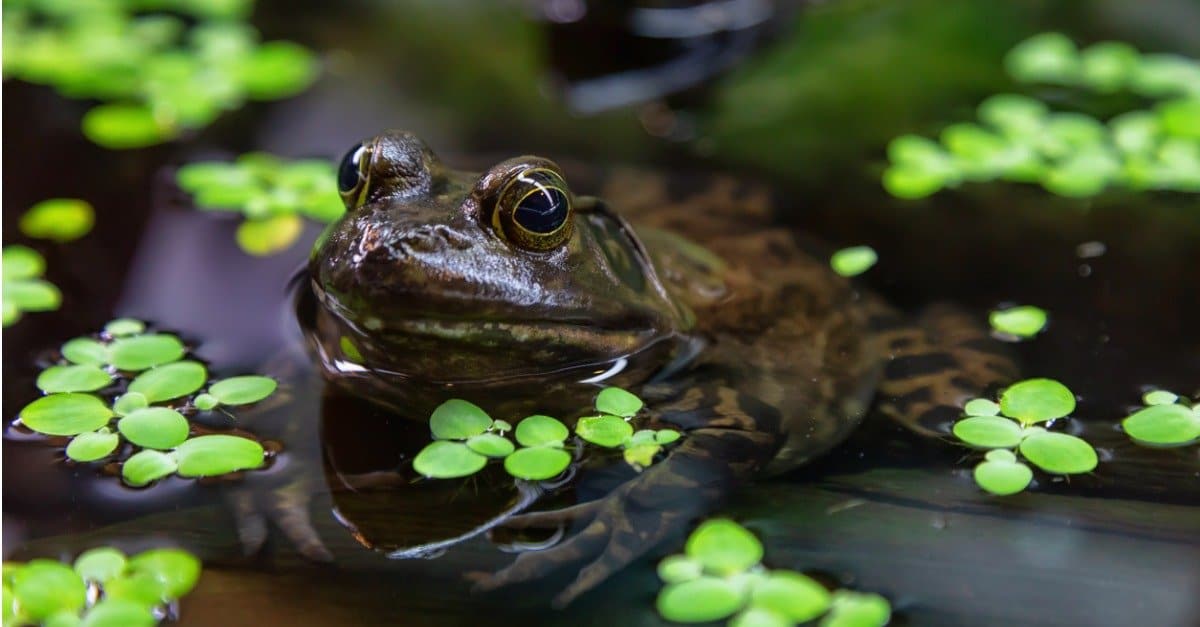
The post Massive Frogs Living in American Waters appeared first on A-Z Animals.
Quick Take
-
Frogs are amphibians belonging to the orderAnura, a group known for tailless bodies, powerful hind legs, and life cycles with a tadpole stage.
-
Frogs are found across the U.S. in ponds, lakes, rivers, pools, and wetlands.
-
Pig frog females tend to reach larger sizes than males.
-
Adult river frogs are not as large as bull frogs, measuring 3-5 in length.
-
Green frogs and bronze frogs have smooth skin, strong hind legs, and a ridge running along each side of the back.
Frogs are some of the most widespread amphibians in the United States, thriving in pretty much any area with plenty of water, like rivers, lakes, ponds, wetlands, and even temporary pools. These amphibians play an important role in freshwater ecosystems and are well recognized for their deep, resonant croaks echoing across summer nights and powerful leaps. While many frogs are small and easily overlooked, others grow to impressive sizes, making them stand out among the nation’s aquatic wildlife.
In this article, we explore a handful of large water-dwelling frogs found in the United States, highlighting their size, appearance, habitats, and behaviors. This list offers an up-close look at the diversity and adaptability of America’s amphibians. Dive in to discover which frogs earn their place among the giants of U.S. waterways.
What is a Frog?

©Viktor Loki/Shutterstock.com
(Viktor Loki/Shutterstock.com)
In general terms, frogs are amphibians belonging to the order Anura, a group known for tailless bodies, powerful hind legs, and life cycles that typically include an aquatic tadpole stage and a terrestrial adult stage. In the United States, many of the larger, water-associated frogs belong to a group commonly known as American water frogs, which are traditionally placed in the genus Lithobates.
Taxonomically, Lithobates is sometimes treated as a full genus and sometimes as a subgenus within Rana, depending on the scientific authority. Regardless of classification, these frogs share similar traits: smooth or slightly textured skin, strong swimming ability, and a close association with freshwater habitats such as ponds, lakes, rivers, and wetlands. They are found throughout most of North and Central America, from southern Canada to Panama.
Lithobates (or Rana) frogs vary widely in size, color, and behavior. Some species are large and robust, while others are more slender and moderately sized. Many have distinctive spots, stripes, or color morphs that help them blend into their surroundings. Unfortunately, several American water frog species face increasing threats from habitat loss, pollution, climate change, and disease, making conservation of healthy freshwater ecosystems critical to their survival.
1. The American Bullfrog

The largest frog found in bodies of water in the United States is the American Bullfrog (Lithobates catesbeianus). These frogs can grow up to 8 inches (20 cm) in length and weigh up to 1.5 pounds (0.68 kg). They are found throughout the United States in freshwater habitats such as ponds, lakes, and rivers. In addition to their large size, they are also known for their distinctivejug-o-rum call, which is often heard during the warmer months of the year.
2. Pig Frog

©iStock.com/passion4nature
(iStock.com/passion4nature)
Lithobates grylio, commonly known as the pig frog, is a large aquatic frog species found in the Southeastern United States. Adult pig frogs can reach lengths of up to 8 inches (20 cm) and weigh over one pound (However, weights over 1 lb. are rare, not typical). Females tend to be larger than males. They have a flattened head and a broad, muscular body with strong hind legs that are adapted for swimming. Their skin is brown or gray with dark spots or blotches. They have a white belly.
Pig frogs are found in a variety of aquatic habitats such as swamps, marshes, and slow-moving streams and rivers. They are generally active at night and feed on a variety of prey including insects, crustaceans, and small fish. They are also known for their deep, grunting call that sounds like the vocalization of a pig, which is how they got their common name.
Both the American bullfrog and the pig frog can reach similar sizes, with adult individuals of both species growing up to 8 inches (20 cm) in length and weighing over one pound (0.45 kg). However, there are some physical differences between the two species, such as the shape of their heads and the pattern of their skin markings. They also have different ranges, with the American bullfrog being found throughout most of North America, while the pig frog is more restricted to the Southeastern United States.
3. River Frog

Lithobates heckscheri, commonly known as the river frog, is a species of frog found in the Southeastern United States. Adult river frogs are medium-sized, measuring 3-5 in length. Females are generally larger than males. They have a flattened body shape, which helps them move through the water more efficiently, and they have long, muscular legs that are adapted for swimming and jumping. They are light brown or gray with darker spots or blotches on their backs. Their belly is white or yellowish in color.
As their name suggests, river frogs are found in or near bodies of water such as streams, rivers, and swamps. They are most common in slow-moving or still water with vegetation and a soft substrate. They are also known to inhabit nearby terrestrial habitats like forests, wetlands, and fields.
River frogs are active at night and feed on a variety of small prey such as insects, spiders, and small crustaceans.
4. Bronze Frog / Green Frog

The green frog and the bronze frog are closely related animals of the same species rather than entirely separate species. The bronze frog is commonly treated as a subspecies or regional color variant (Lithobates clamitans clamitans), distinguished primarily by its darker, bronze-to-brown coloration.
Green frogs and bronze frogs typically measure between 2 and 4 inches (5–10 cm) in length and have smooth skin, strong hind legs, and a ridge running along each side of the back. Their coloration can range from bright green to olive, brown, or deep bronze, depending on geography and local conditions. Both forms lack the heavy spotting seen in leopard frogs and instead have more uniform coloring.
These frogs are widespread in eastern North America, living in ponds, lakes, marshes, and slow-moving streams with abundant vegetation. Males are well known for their loud, twangy call, often compared to the sound of a plucked banjo string. Because the physical and behavioral differences between green frogs and bronze frogs are subtle, they are often grouped together in field guides and ecological studies.
Conservation Status

©BalkansCat/Shutterstock.com
(BalkansCat/Shutterstock.com)
Many species of the largest frogs found in the U.S. face conservation concerns due to habitat loss and degradation. These frogs require clean, stable freshwater habitats for breeding and development. Activities like agriculture, urbanization, and resource extraction have resulted in the destruction of their natural habitats. The use of pesticides and fertilizers in agricultural areas contaminates the water and harms these amphibians. In addition to habitat loss, these frogs face other threats, including climate change, disease, and predation by introduced species. To address these conservation concerns, efforts are being made to protect and restore freshwater habitats. Captive breeding and reintroduction programs are being implemented to help boost populations of some Lithobates species.
The post Massive Frogs Living in American Waters appeared first on A-Z Animals.