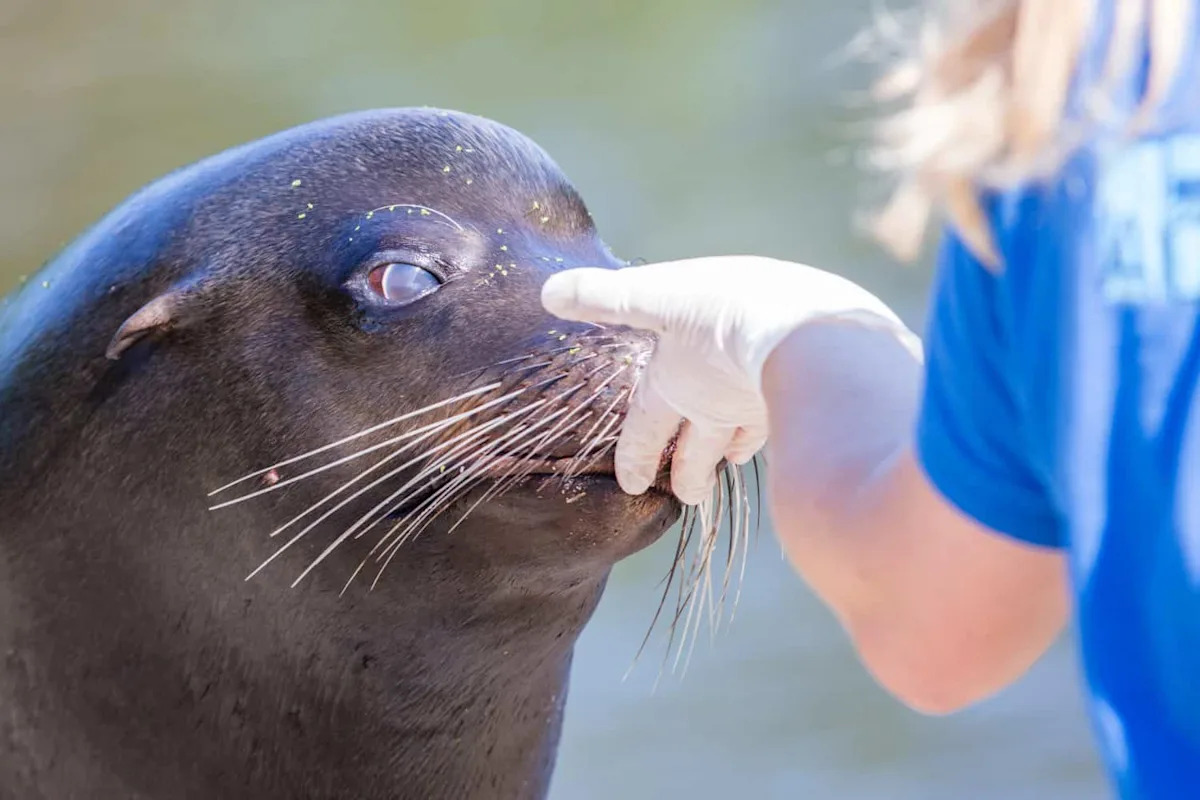
The post Miracle Sea Lion: Confetti Survives Disease and Gunshots, Inspires Hope in LA appeared first on A-Z Animals.
Quick Take
-
Confetti the sea lion survived multiple gunshot wounds and a lethal bacterial infection that required intense treatment.
-
Violence against sea lions is sadly common in California, and Confetti is not the first to suffer from gunshot wounds.
-
Retaining full mobility despite severe leptospirosis is a testament to the care offered at the Marine Mammal Care Center.
-
Animal rescues and rehabilitation centers are crucial to the survival of many marine species in California.
Some of the most miraculous survival stories come from the animal kingdom. While often harrowing, these tales reveal the nature of true determination and willpower. Oftentimes, they reveal what animals are capable of and how much strength an individual can summon. The story of one Los Angeles sea lion is doing precisely that. When Confetti the sea lion came back from the brink of tragedy, his story became one of dramatic heroism.
As experts continue to ponder his survival, many are chalking it up to Confetti’s sheer force of will; or perhaps, simply the innate instinct to live that lies dormant in many animals until circumstance calls it forth.
How Confetti Survived Not One, But Two Near-Fatal Injuries
This California sea lion is now a legend throughout Los Angeles. When Confetti was brought into the Marine Mammal Care Center, he was lethargic and showed little interest in anything, including food. Good Samaritans originally found him in Ballona Creek, where his early diagnosis was a severe bacterial infection. Leptospirosis is a common problem throughout California, particularly during warm-weather months. It’s the cause of many significant outbreaks among California’s young male sea lion population. The infection attacks the kidneys, which is often fatal, and is also highly transmissible.

California is known for its sea lion population, and visitors can often see them basking on docks and piers in San Francisco.
©B Brown/Shutterstock.com
(B Brown/Shutterstock.com)
Although outbreaks typically occur every three to five years, the 2025 outbreak was especially severe. High case numbers were already being reported by late summer. Confetti is one of many sea lions showing signs of severe dehydration, lethargy, and inability to move. Confetti’s symptoms were severe, but despite medical attention, his condition continued to worsen. An X-ray finally showed something shocking: Confetti not only suffered a severe kidney infection but also had two bullet wounds in his head.
How Did Confetti Survive Such Horrific Trauma?
While veterinarians confirmed that the two bullets stuck inside Confetti’s skull were not detrimental to his health, questions still arose. Mainly, how did he survive such violent injuries? The answer? Luck. John Warner, CEO of the Marine Mammal Care Center, confirmed with the San Francisco Gate that the two bullets did not hit any major veins or arteries. Their positioning also did not cause significant brain damage or injury to surrounding organs. In short, Confetti survived the gunshots by sheer chance.

Although experts warn the public to keep their distance, many ignore the laws governing California’s sea lions.
©PradaBrown/Shutterstock.com
(PradaBrown/Shutterstock.com)
As for his infection, Confetti’s caretakers are cautious but optimistic. He is currently undergoing treatment primarily for the bacterial infection. Since the interview, his condition has improved significantly, but his care team remains wary. Leptospirosis has a mortality rate of 66%-70% in affected animals. As of now, Confetti will continue getting fluids and treatment for his symptoms.
Violence Against California’s Sea Lions Is Sadly Common
San Francisco’s sea lions began trending in 2023, and not in a good way. In a video that eventually went viral, a man was shown harassing sea lions on Pier 39. Although he had been intoxicated, it set off a chain reaction of violence against the city’s beloved marine life. That year alone, the Marine Mammal Care Center reported a 30% increase in patients experiencing human or dog disturbances. Many of these involved poking, prodding, or chasing the sea lions off piers or beaches. Some cases involved people’s dogs, and other, more severe cases involved sea lions being dragged from their sunning spots.

The Marine Mammal Care Center is all too familiar with rehabilitating sea lions and seals, and has treated more than 10,000 since its opening.
©Daniel Avram/Shutterstock.com
(Daniel Avram/Shutterstock.com)
While sea lions are protected under the Marine Mammal Protection Act, those responsible for crimes against them are not always caught. More often than not, an injured sea lion is reported to the Marine Mammal Care Center, but their abuser is long gone. Sea lions can pose a threat to humans and pets because of their sharp teeth and large stature. However, in recent years, humans pose a far heftier risk to them.
How Conservation and Rehabilitation Centers Are Helping
At the time of writing, there are currently 16 sea lions and one northern elephant seal in the care of the Marine Mammal Care Center. When a call comes in reporting an injured animal, the care center’s staff does everything within their power to provide husbandry. This includes a stress-free environment that closely resembles the animal’s native habitat, administering medication, running tests, and conducting X-rays. Each animal is treated in-house and released only after a full recovery. As soon as they’ve regained full strength, the care team becomes hands-off, instead allowing the animal to move and attend to its own needs with supervision.

The Marine Mammal Care Center sees fewer seal rescues, but is equipped to treat a variety of California’s marine life.
©Iwona Fijol/Shutterstock.com
(Iwona Fijol/Shutterstock.com)
Following successful rehabilitation, caretakers assess the ocean conditions before releasing the animal back into the wild. Even this is a careful, well-planned, and educated process. Young animals may need assistance or a transition period, while permanently disabled animals may require rehoming. To do this, the Marine Mammal Care Center works with the National Fisheries Service to find placement. After every release, the care center monitors the animals as they learn to navigate wild waters once again. This is done via tagging and satellite data. Tracking may last for years, and each piece of data the Marine Mammal Care Center receives helps its research team study seals and sea lions.
Success Stories That Give Us Hope
Confetti will join a long list of patient stories available at the Marine Mammal Care Center. One of these is a sea lion named Timmi. She came to the care center with sarcocystosis (a parasite infection) and poxvirus. Timmi became a milestone for the center, as both a success story and its 10,000th patient to be rehabilitated. She quickly became an ambassador for the Marine Mammal Care Center, helping save thousands of animals since its opening in 1992. After months of intense treatment, a few scars, and severe hair loss, Timmi regained her health and was released in December of 2023.

Without proper care and treatment, the odds of these pups surviving domoic acid poisoning were slim.
©Robert Crow/Shutterstock.com
(Robert Crow/Shutterstock.com)
More recently, the Marine Mammal Care Center saved what they affectionately named the “pups that defied the odds.” After a toxic chemical bloom led to domoic acid poisoning for hundreds of San Francisco’s local sea lions, the center stepped in. While they were being treated, ten female sea lions gave birth, and six pups miraculously survived the ordeal. Without help from the Marine Mammal Care Center, their chances of survival were extremely low. As the caretakers treated the new moms, the effects of the toxin eventually subsided enough for them to nurse their pups.
Until now, sea lions exposed to domoic acid were typically euthanized or placed in aquariums. The Marine Mammal Care Center is working alongside many other care centers on the Pacific Coast to try to change that. Their success stories reveal how essential their efforts are to marine life and how aquatic environments benefit from their skills and knowledge.
The post Miracle Sea Lion: Confetti Survives Disease and Gunshots, Inspires Hope in LA appeared first on A-Z Animals.