The post Discover The 16 Official State Animals Of South Carolina appeared first on A-Z Animals.
Quick Take
-
The white-tailed deer causes millions of dollars in agricultural damage to cotton and soybean crops.
-
The Eastern tiger swallowtail begins its life cycle as a tiny caterpillar that resembles bird droppings.
-
The wild turkey was on the brink of extirpation in South Carolina, but has since rebounded.
From coastal plains and swamps to rolling hills and the Blue Ridge Mountains, South Carolina’s diverse geography supports a unique array of wildlife. To honor native animals, South Carolina has adopted several animal species to represent the Palmetto State. Continue reading to discover the 16 animals that have been designated as official state symbols.
State Bird: Carolina Wren
The Carolina wren (Thryothorus ludovicianus) was designated as the official bird of South Carolina in 1948.

Carolina wrens are larger than many other common wren species.
©Steve Byland/Shutterstock.com
(Steve Byland/Shutterstock.com)
Carolina wrens are approximately 5 inches long and weigh less than an ounce. They have an unbarred, cinnamon-colored underbelly and a rust-colored back. Their wings, tail, and undertail are banded black, while the neck and chin are white. Carolina wrens are found in forests, swamps, and backyards throughout South Carolina year-round.
State Animal: White-Tailed Deer
The white-tailed deer (Odocoileus virginianus) was designated as the official state animal of South Carolina in 1972.

Found in all 46 counties of South Carolina, the white-tailed deer is responsible for damaging crops across the state.
©iStock.com/Harry Collins
(iStock.com/Harry Collins)
The white-tailed deer was chosen for its historical importance. Deer were immensely important to both Native Americans and colonists in South Carolina, serving as a primary source of food, clothing, and trade.
Today, white-tailed deer impact South Carolina’s economy, contributing to a multi-billion-dollar hunting industry. However, they are also responsible for causing millions of dollars in agricultural damage annually to cotton, peanuts, and soybeans.
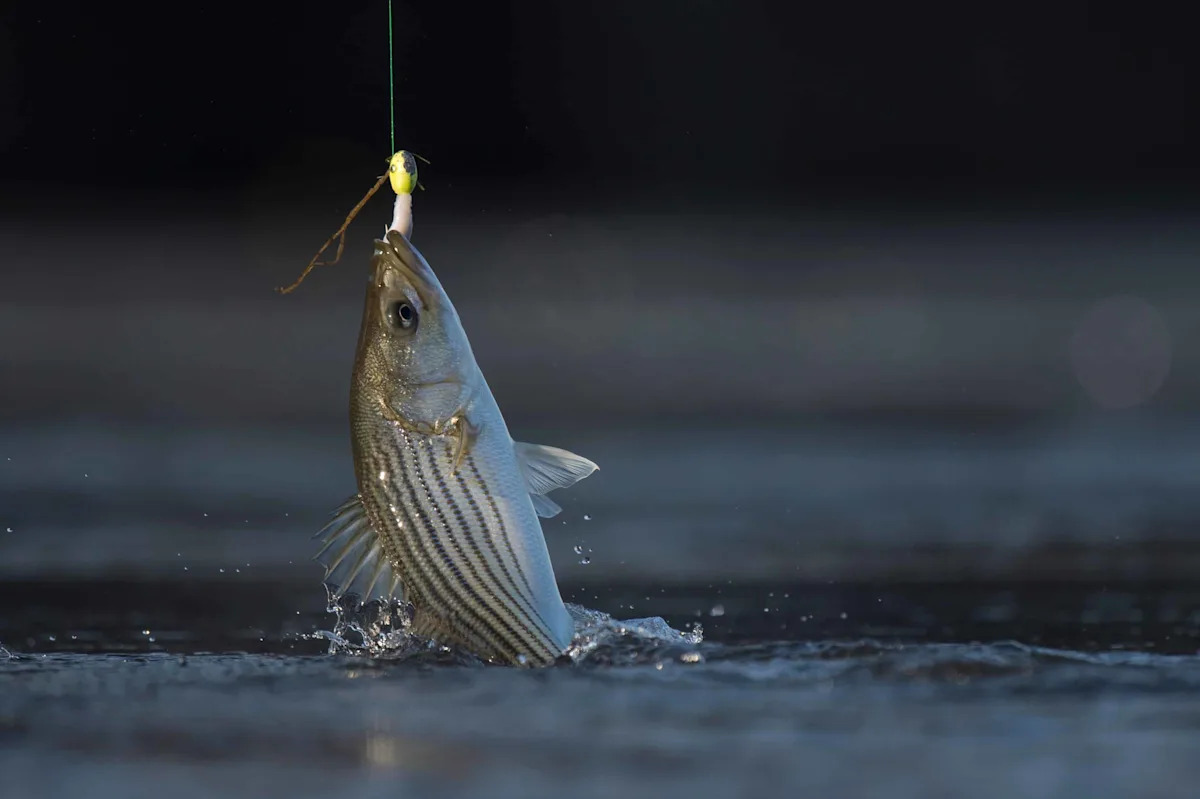
State Fish: Striped Bass
The striped bass (Morone saxatilis), also called the rockfish, was officially adopted as the state fish of South Carolina in 1972.

A mature striped bass is typically 3 feet long and weighs approximately 20 pounds
©slowmotiongli/Shutterstock.com
(slowmotiongli/Shutterstock.com)
The striped bass is a large predatory fish with black stripes running the length of its iridescent body, and a white underbelly.
The striped bass was chosen as South Carolina’s state fish for its impact on South Carolina’s economy through recreational fishing as well as international fishing tournaments.
State Wild Game Bird: Wild Turkey
South Carolina named the wild turkey (Meleagris) as its state wild game bird in 1976.
The wild turkey was chosen for its historical presence in the state, as a staple food for Native Americans and early colonists. The wild turkey was all but extirpated from the state by the early 1900s due to overhunting and habitat loss.

A female wild turkey roams around the Myrtle Beach State Park in South Carolina.
©Bob Balestri/iStock via Getty Images
(Bob Balestri/iStock via Getty Images)
Thanks to intensive conservation efforts, including the implementation of strict hunting regulations and successful trap-and-transfer relocation programs, wild turkeys are once again thriving and are present in all 46 counties in South Carolina.
State Shell: Lettered Olive 1984
The lettered olive shell (Oliva sayana) was adopted as the state shell of South Carolina in 1984. The shells can be found along the length of South Carolina’s Atlantic coast.

©Tom Korcak/Shutterstock.com
(Tom Korcak/Shutterstock.com)
The lettered olive shell is primarily inhabited by the lettered olive snail, a predatory, marine gastropod mollusk that lives in the sand. The lettered olive shell was chosen to honor Dr. Edmund Ravenel, a Charleston, South Carolina, physician who first identified the species in 1834. Ravenel named the species for the patterns on its shell, which he thought resembled letters or hieroglyphics.
State Dog: Boykin Spaniel 1985
The Boykin spaniel (Canis lupus familiaris) was made the official dog of South Carolina in 1985. The breed was developed in the early 20th century by Whit Boykin in South Carolina as the ideal dog for duck and wild turkey hunting.

Boykin spaniels have floppy ears.
©Cynthia Davison/Shutterstock.com
(Cynthia Davison/Shutterstock.com)
The Boykin spaniel is a medium-sized dog that stands 14 to 18 inches tall and weighs 25 to 40 pounds. Males are slightly larger than females. The Boykin spaniel’s
water-resistant, double-layered coffee-brown coat is medium-length and typically flat-to-curly.
State Insect: Carolina Mantid 1988
The Carolina mantid (Stagmomantis carolina) was officially recognized as South Carolina’s state insect in 1988. It is a medium-sized, native praying mantis found throughout South Carolina.

The Carolina mantid is a cannibalistic species.
©Sari ONeal/Shutterstock.com
(Sari ONeal/Shutterstock.com)
The Carolina mantid was chosen to represent South Carolina because it is a beneficial predator that helps control agricultural pests. A generalist predator, the Carolina mantid preys on a wide range of insects, including aphids, flies, moths, beetles, grasshoppers, and the invasive brown marmorated stink bug, which causes significant damage to a wide variety of crops, including peaches, tomatoes, peppers, corn, and soybeans.
State Reptile: Loggerhead Sea Turtle 1988
The loggerhead sea turtle (Caretta caretta) was officially adopted as the state reptile of South Carolina in 1988. Loggerhead sea turtles are found in nearly all of the temperate and tropical areas of Earth’s oceans, including the coast of South Carolina.

Loggerhead turtles navigate thousands of miles using the Earth’s magnetic field, often returning to the same beach where they hatched to lay their own eggs.
©Matteo photos/Shutterstock.com
(Matteo photos/Shutterstock.com)
One of the largest living hard-shelled sea turtles, loggerheads are named for their enormous head and strong jaws. They have a carapace (shell) that resembles a heart and is usually covered in barnacles and algae.

Sea turtle hatchlings are drawn to the ocean the moment they hatch.
©zulkamalober/Shutterstock.com
(zulkamalober/Shutterstock.com)
State Butterfly: Eastern Tiger Swallowtail 1994
The Eastern tiger swallowtail (Papilio glaucus) was recognized as the official butterfly of South Carolina in 1994. It is a large butterfly with a wingspan approaching 5 inches and was chosen for its role as a pollinator.

The Eastern tiger swallowtail caterpillar is recognized by its ocelli, also called eyespots or false eyes, which deter predators.
©Jay Ondreicka/Shutterstock.com
(Jay Ondreicka/Shutterstock.com)
Eastern tiger swallowtails hatch from a clutch of eggs as brown blobs that resemble bird droppings before becoming bright green caterpillars. The caterpillar then spins a chrysalis in which it will metamorphose into the black, orange, and blue butterfly known as the Eastern tiger swallowtail.

Eastern tiger swallowtails are frequently spotted in woodlands, parks, orchards, and residential gardens.
©J.J. Gouin/Shutterstock.com
(J.J. Gouin/Shutterstock.com)
State Amphibian: Spotted Salamander
The spotted salamander (Ambystoma maculatum) was designated as the official state amphibian of South Carolina in 1999.

Spotted Salamanders are large, measuring 6 to 8 inches long, including their tail.
©Matt Jeppson/Shutterstock.com
(Matt Jeppson/Shutterstock.com)
Because they spend the majority of their time under leaf litter, under fallen wood, or in underground tunnels, adults are rarely observed in the wild and are hard to find. These hardy amphibians have a lifespan of 20-30 years.
State Spider: Carolina Wolf Spider
In 2000, the Carolina wolf spider (Hogna carolinensis) was recognized as the official spider of South Carolina.
The spider gained recognition due to a campaign by Skyler B. Hutto, a third-grade student at Sheridan Elementary School in Orangeburg, South Carolina. It was chosen because it is the largest wolf spider in North America, it is common throughout the state, and it plays an important role as a natural pest controller.
Carolina wolf spiders prey on pests such as earwigs, beetles, ants, and crickets, reducing the need for chemical pesticides.

State Marine Mammal: Bottlenose Dolphin
The bottlenose dolphin (Tursiops truncatus) was adopted as the official marine mammal of South Carolina in 2009. They are found in the temperate waters off the coast of South Carolina.
Bottlenose dolphins are a major wildlife attraction, particularly in areas such as Hilton Head, Folly Beach, and Edisto Island. They are considered a major, year-round attraction for visitors, who can bear witness to the playful mammals on commercial boat tours, kayak trips, and eco-tours.

While inshore bottlenose dolphins breathe 2 to 3 times per minute, deep-water bottlenose dolphins can hold their breath for 15 minutes.
©iStock.com/Lefteris_
(iStock.com/Lefteris_)
State Duck: Wood Duck 2009
The wood duck (Aix sponsa), sometimes called the Carolina duck, was officially recognized as the South Carolina state duck in 2009. It is found year-round in the state and is the only migratory duck species that breeds in all geographic regions of the state.
Wood duck populations declined precipitously in South Carolina in the late 19th century due to a combination of unregulated hunting and severe habitat destruction. Hunters targeted the species for their meat and plumage, while widespread logging destroyed the hardwood forests and natural nesting cavities that wood ducks required.

The wood duck is one of the most colorful and iconic waterfowl in North America.
©Wirestock/iStock via Getty Images
(Wirestock/iStock via Getty Images)
Following these declines, intensive management programs and habitat restoration initiatives aided population rebounds, and these colorful ducks are once again prevalent throughout South Carolina.
State Migratory Marine Mammal: North Atlantic Right Whale
The North Atlantic right whale (Eubalaena glacialis) was officially recognized as the state migratory marine mammal of South Carolina in 2009. The critical, near-extinction status of the North Atlantic right whale is a primary reason for this recognition.

With fewer than 400 individuals left in existence, the North Atlantic right whale is among the rarest animals on Earth.
©6381380/iStock via Getty Images
(6381380/iStock via Getty Images)
Following decades of declining numbers, recent conservation efforts, habitat protections, and management measures have helped stabilize and slightly increase the North Atlantic right whale population, which now numbers approximately 380–384 individuals. While this marks a cautious, slow, multi-year recovery trend, the species remains critically endangered by threats like entanglement and ship strikes.
State Heritage Horse: Marsh Tacky Horse 2010
The Marsh Tacky horse (Equus ferus caballus) was designated as the South Carolina state heritage horse in 2010. It is a critically endangered colonial Spanish horse type that originated from Iberian horses brought to South Carolina by Spanish explorers and colonists.

Marsh Tacky horses are considered critically endangered and are among the rarest horse breeds in the world. With only around 400 left, this unique South Carolina heritage breed faces a high risk of extinction. Thankfully, there are active breeding programs for the critically endangered horse, primarily focused on conservation, genetic diversity, and preserving the breed’s unique Lowcountry heritage.
State Heritage Work Animal: Mule 2010
The mule (Equus caballus × Equus asinus), the hybrid offspring of a jack (male donkey) and a mare (female horse), was recognized as the South Carolina state heritage work animal in 2010.
Known for their intelligence and strength, mules were essential to South Carolina agriculture for two centuries. The mule population in the state peaked in the early 20th century before experiencing a steep decline following the Industrial Revolution.
Although the mule population in South Carolina is significantly smaller today than it was a century ago, the mule is not considered endangered. While the state’s mule population peaked in the 1920s with roughly 210,000 working animals, mules were largely replaced by tractors and trucks by the 1950s.

The post Discover The 16 Official State Animals Of South Carolina appeared first on A-Z Animals.