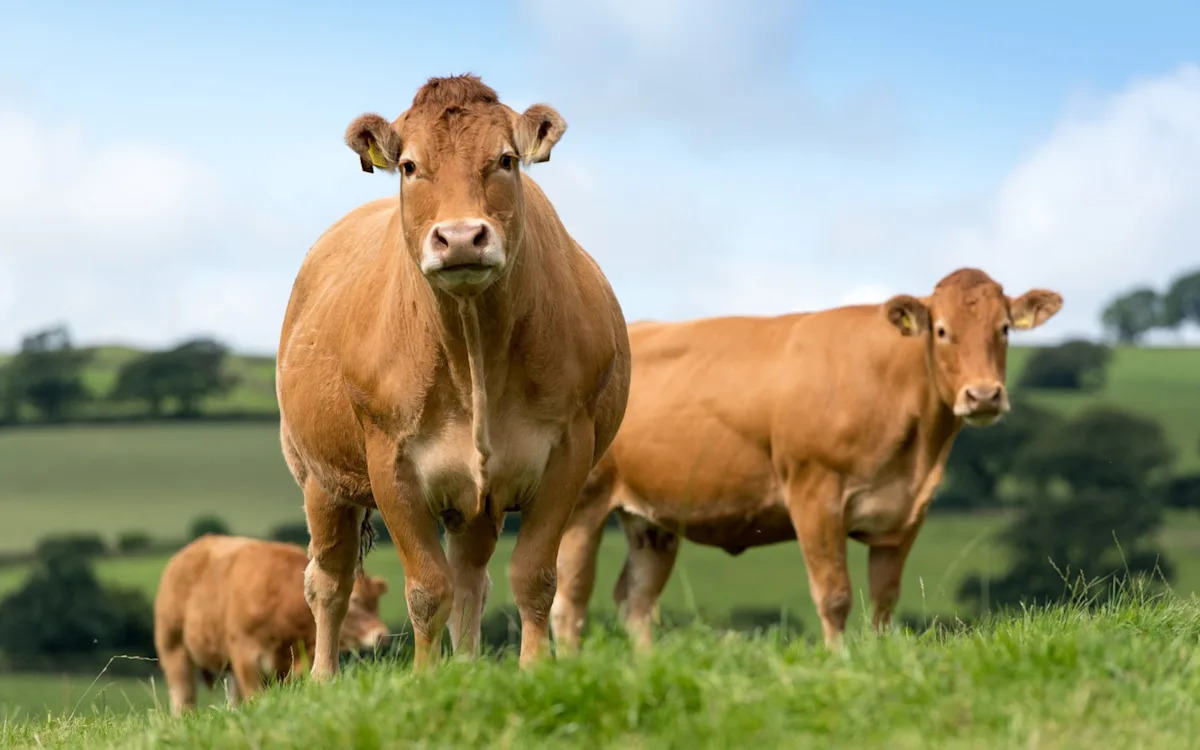
It sounds like the stuff of fantasy. Or Walt Disney. But when heartless rustlers in December 2022 made off with 14 of Anglesey farmer Sion Hughes’s prized cattle – and the cops duly tracked them down, mingled in a much larger herd some 120 miles away – Hughes hastened to the scene.
And, even though their ear-tags had been ruthlessly removed, identified all his cows in little more than a glance.
Their faces. Their expressions. That one’s distinctive gait; the way another flicked her left ear.

Sion Hughes was able to pick out his 14 stolen cows from a field of around a hundred cattle – Wales News Service
It sounds incredible to the townie – but a true stockman knows his stock. “You know, Douglas, I saw my sheep,” an Ardnamurchan crofter once murmured to an old friend, having returned from a rare jaunt through soft Lowland pastures.
The beasts had been borne away in the autumn lamb-sales months earlier, but he had recognised them instantly, even from his speeding train.

Mr Hughes said he had forged a bond with the animals when hand-rearing them – Wales News Source
When I was little, home on holiday with my grandparents in the Isle of Lewis, life still revolved around the house-cow.
Every crofter had one. She was unusual in two regards: she was usually the only beast or fowl on the premises that actually had a name – rarely imaginative; Daisy, Bella and Bonny were popular – and she was primarily cared for by the woman of the house.
She it was who, morning and night, milked her, often crooning some Gaelic lay; who supervised her calving – neighbours always on hand to help if there were difficulties – and reared that calf. In due season, taking its mother back to the bull.
Children were reared on milk, cream, tart salty butter and home-made “crowdie,” a pleasantly sour soft cheese. The cow, by its grazing-habits and abundant dung, enriched your pasture. In turn, you grew sufficient hay and corn to see her through the winter.
In the old order of thatched Hebridean blackhouses – the last were only abandoned in the 1980s – cow and family entered by the same door, she through winter living at the lower end of the dwelling and the rest of you by the other.
To this day, Sunday services in rural Lewis are at noon and six pm – as they had to be, when everyone had cows to milk.
So central was Daisy to croft and home that her sudden death was a disaster. My late father, born in 1940, remembered the door-to-door collections – everyone donating a shilling or two – to secure your unfortunate neighbours a new one.
And then it all ended, first gradually and then suddenly. In 1961 there were some 1,878 milch-cows in the parish of Barvas. In 1971 there were 693. By 1981, there were only three. For good and ill, the social order was changing. As Seamus Heaney mused of his own Derry community, education and ambition sweeping in:
Books open in the newly wired kitchens.
Young heads that might have dozed a life away
Against the flanks of milking cows were busy
Paving and pencilling their first causeways across the prescribed texts…

When I was little, life revolved around the house-cow – Dale Cherry
In the far city, you think we do not care for our animals. We do. When I was able to keep chickens, I knew every one of my hens: fed them layers’ pellets every morning and scattered corn for them at night.
I recall the sweet scent of a faintly stoned broody hen, tiny fluffy heads now and then popping up between her wings: how the flock, as one, would scurry joyously towards me when I set foot outside the door.
Last year, elderly neighbours had to bottle-rear an orphaned lamb. He duly prospered. Months later, I was passing as the gentle great-grandmother emerged into the sunlight.
The lamb at once rushed to the fence; she made for him, and for a long moment, chuckling away, scratched him between his budding horns as he waggled his behind ecstatically.
There is no commerce in such a moment; no calculation. There is but love.