“Hearst Magazines and Yahoo may earn commission or revenue on some items through these links.”
From the archives: This story originally appeared in the September 1930 issue of Popular Mechanics. We’re republishing it now as part of our ongoing look back at Pop Mech’s best feature stories from the last 125 years. It appears here as originally published; some details, terminology, or understandings may have changed over time.
Home from the Antarctic, Arthur T. Walden, chief sled-dog driver of the Byrd expedition to the south pole, caressed the last harness worn by his grand old dog “Chinook.”
It wasn’t much to look at, just a few straps sewed together, with the name “Chinook” crudely printed with a pen on the saddle girth, but to Walden it is the most precious and sacred relic of the greatest adventure of an adventurous life, even though he has several articles which were carried over the south pole.
For somewhere in cold, bleak Antarctica, in a crystal casket, beneath a blanket of snow, the lion-hearted husky, who filled that harness so heroically that his name and fame are known to dog lovers from pole to pole, is sleeping his last, long sleep. The wailing voice of the blizzard sings his requiem, the south pole itself is his monument.
How “Chinook’s” glorious career ended with his strange disappearance on that last adventure with his master is one of the most touching sagas of polar exploration, and is best told in Walden’s own words. But before beginning the story, he told me of the heroic work done by sled dogs to make the Byrd expedition a success and why it would have failed without them.
“Without sled dogs, the headquarters at Little America could never have been established,” he declared, “and but for them the geological expedition under the leadership of Dr. Laurence M. Gould could not have been accomplished.” Incidentally, Admiral Byrd, on his arrival at Panama City, was quoted as saying that “the geological survey, made by dog team, was the outstanding feat of the whole expedition.”
With the temperature averaging thirty to forty below zero and blizzards raging frequently, sled dogs carried Doctor Gould and his party of four dog drivers a distance of 1,300 miles in four months, though many dangerous crevasses had to be crossed en route and the journey had to be made in short stages, after outpost depots or caches of food and supplies had been established.
Near the Queen Maude range of mountains, the crevasses were especially numerous, and some were so wide that sledges and men had to be roped together and large knots tied in the ropes for the men to grasp in case they should break through the thin crust. Sometimes a whole string of dogs would be stretched across a crevasse like a suspension bridge, and it was not unusual for a couple of dogs to start fighting while hanging in midair.
It was in the pulling and hauling of hundreds of tons of freight from the supply ships to the site of Little America, however, that the sled dogs proved that they are still essential to the success of polar exploration, though the airplane has supplanted them as a means of conveying man to the poles.
When it was realized that a heavy tractor intended for freight hauling was of little or no use, the entire burden of transporting the elaborate equipment for the headquarters camp from the supply ships to the Barrier fell upon the shoulders of the sturdy, courageous huskies.

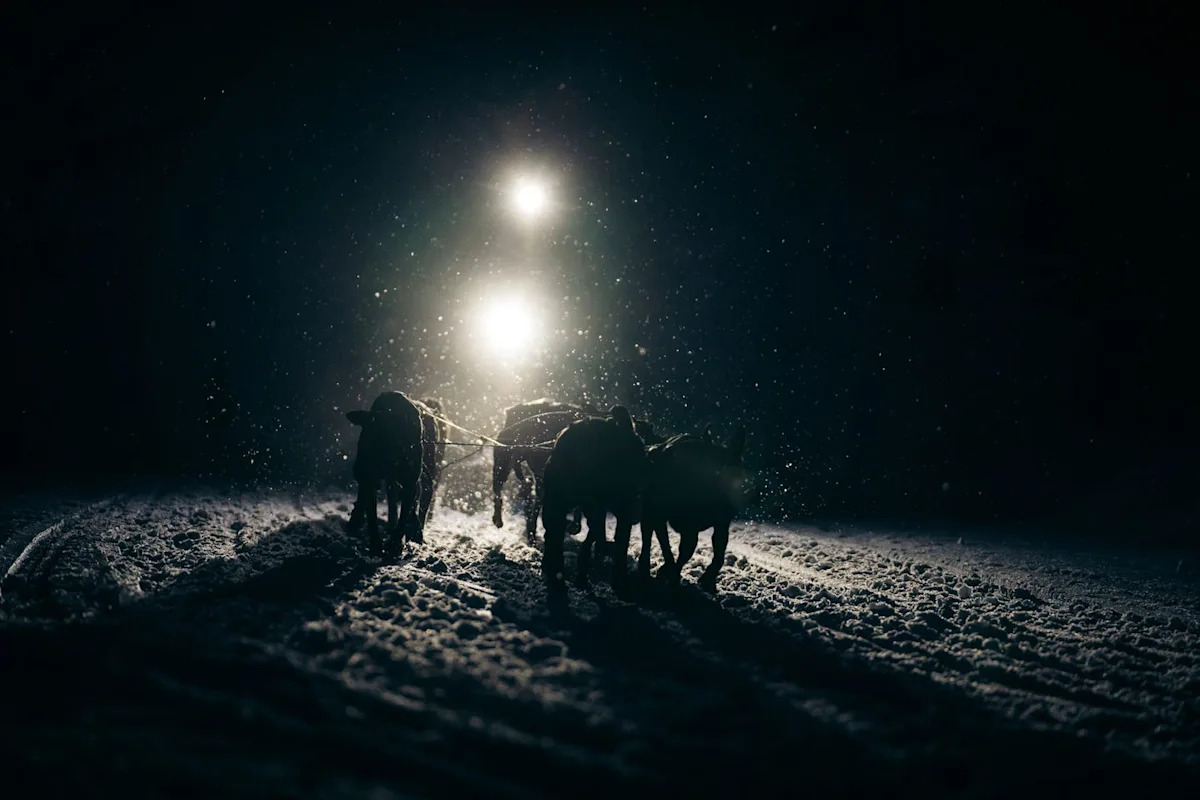
Sled dogs pull a sled loaded with supplies during one of Admiral Byrd’s expeditions to Antarctica, 1930.Historical – Getty Images
And when an auto truck, equipped with endless treads on the rear wheels and runners on the front axle instead of wheels, broke down soon after it started to lay caches of food at intervals in the direction of the pole, so that Admiral Byrd might pick them up in case he had to make a forced landing on his polar flight and walk back to Little America, the sled dogs carried on this important work of safeguarding the daring aerial explorer’s life.
When the expedition first reached the Bay of Whales, the nearest the “City of New York” could get to the Barrier was twelve miles. The time to get the camp established was limited to the few remaining weeks of the Antarctic summer and the dog teams were worked feverishly. In fact, for a while, they had to make two trips a day to and from the Barrier, or a total distance of forty-eight miles over pretty rough ice, with loads from 2,000 to 2,500 pounds, or more than 200 pounds to a dog, as there were usually nine huskies to a team.
During this rush “Chinook” was in harness as leader of Walden’s team every day, and on the hardest kind of pulling he did magnificent work. Not once did he shirk, or as his master put it, “his traces were always taut.” Moreover, he was a great inspiration to all the other dogs.
“The old dog seemed to sense that there was need for hurry,” Walden continued. “And I took fully as much pride in his performance on that freight-handling job as I did when he led my racing team to victory over the fleetest Canadian huskies in the first International Sled-Dog Derby.”
“But when the heaviest part of the hauling had been done, I noticed that the strain had told on him. His hair had turned quite gray and he was getting deaf. So, when he began to slow up on the return trips to the ship with the empty sleds, I decided that he had earned a rest. Accordingly, I began breaking in ‘Ballarat,’ one of his promising sons, to take his place as leader of my team.”
“Chinook didn’t show the least sign of jealousy when I put his son in his time-honored place, and apparently he was content to be recognized as the ‘king’ dog of the pack, or the one that all the other dogs respect and fear regardless of his position in a team. Of course, he knew instinctively that no other dog could usurp his place in my affections so long as he lived.”

Scene from the film With Byrd at the South Pole, 1930.Bettmann – Getty Images
“But there came a day when he realized that he was in danger of being deposed from his throne as king.”
“By that time ‘Ballarat’ was fairly well broken in as a leader and I was letting ‘Chinook’ run loose except when I needed his strength in emergencies to start an extra-heavy load or pull it over a pressure ridge. He enjoyed his freedom and I enjoyed giving it to him. But unfortunately it led eventually to the breaking of his heart. He was never the kind of bully dog that goes around with a chip on his shoulder all the time looking for a fight, yet he never was known to avoid a scrap when he was challenged, no matter what the odds were against him.”
“So, when three malicious huskies ambushed him one day while he was running loose, and all jumped on him at once, he met the challenge of his kingship nobly, and though his antagonists were much younger and more agile, he succeeded in holding his own for several minutes of terrific battling. But he finally went down and would have been killed in short order if I had not happened on the scene.”
“I believe that when ‘Chinook’ was downed by those three blood-hungry huskies, he realized only too well that the end of his reign as king was near at hand. They had humbled his pride. I jumped to the conclusion that he had started the fight. So, I chastised him, and that must have hurt his feelings all the more.”
“Later I learned that I had wronged him, but it was then too late to make amends. He was gone from my life forever, leaving my heart as empty as this harness.”
“By a striking coincidence ‘Chinook’s’ disappearance occurred on his twelfth birthday. On starting from Little America to go to the ship that day, I put him in harness at the head of my team to limber him up a bit and kept him there until after I got past the worst of the pressure ridges on the trail. Then I turned him loose with just his collar on, and he began to lag behind.”
“After that, I didn’t give him another thought until I had gone a couple of miles or more. Then I looked back, but he was nowhere in sight. I had passed three or four teams coming from the ship, however, and I reasoned that he had turned and followed one of them back to camp.”
“But when I returned to Little America in the afternoon, I learned that he hadn’t shown up there, and none of the other drivers had seen and recognized him, although one man said he had noticed a shape that looked like a dog away out on the ice to the west.”
“Knowing ‘Chinook’s’ keen homing instinct, I wasn’t particularly anxious about him at first, and I went to bed feeling confident that he would come into camp sometime during the night. But when I awoke next morning to find that he was still missing, I began to get real worried over his absence and went on a hunt for him.”
“All the other teams that could be spared joined in the search, but a bad storm came up early in the day and obliterated all tracks. The airplanes began to fly about that time, and Admiral Byrd ordered all the flyers to be on the lookout for ‘Chinook,’ but no sign of him was ever found.”
“He was always so careful in avoiding crevasses that I don’t think he fell into one, and there isn’t a chance that he lost his way. It is my firm belief that he was broken-hearted over his failure to hold his own in a fight and so he deliberately wandered away to die by himself in the most God-forsaken spot on earth.”
“One of the strangest things about his disappearance is that, the night before, he woke me up twice by placing one of his forepaws on my face just as his father ‘Kim’ did the night before he died. Perhaps that was his way of trying to tell me good-by.”

Fotkam – Getty Images
You Might Also Like