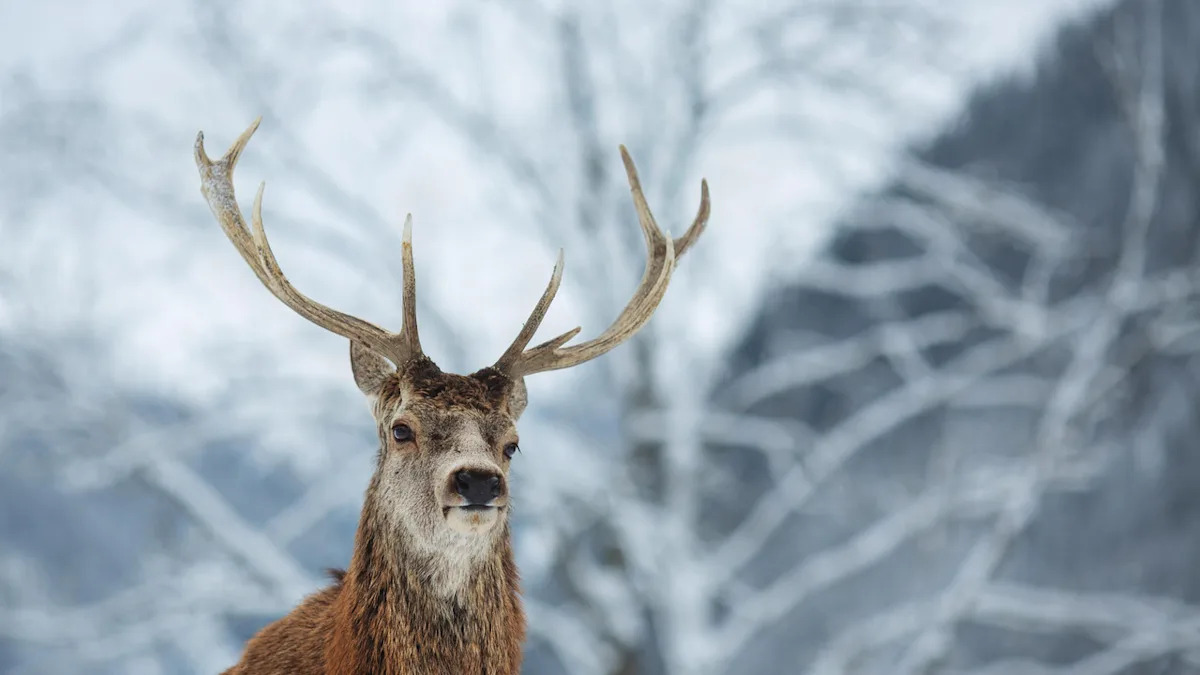
Reindeer get a lot more attention around Christmastime than at any other time of the year. After all, as the story goes, these cute animals are the ones responsible for pulling Santa’s sleigh across the entire world. But in case you thought that reindeer were only the stuff of Yuletide legends, we’re here to set the record straight. Reindeer are very real creatures, and fascinating ones at that. To prove that, we rounded up 12 fun facts about reindeer that will surprise you!
Unless you live somewhere where reindeer are more commonplace, like Finland or northern Canada, you might not know much about these amazing animals other than what you’ve heard in Christmas songs and stories—and let’s be real, most of that involves magical abilities that, sadly, real-life reindeer don’t possess. However, even if real reindeer can’t fly or bend the laws of space and time to help Santa deliver billions of presents in one night, reindeer are still exceptional animals in lots of other ways!
To find out some interesting reindeer facts, keep reading. After you learn more about them, you can test your family’s knowledge and see how much reindeer trivia they can get right. So don’t wait any longer, browse through to learn about reindeer history and why these artic animals are so beloved.
1. Caribou and Reindeer Are the Same Animal

A rare Gaspésie Woodland Caribou in Quebec, Canada.Image via Getty Images/pchoui
If you live in the US or Canada, you may have heard of or even encountered caribou before. That may make you wonder if reindeer and caribou are the same thing? Believe it or not, they are! Caribou and reindeer are the exact same thing, barring a few minor differences between subspecies from different parts of the world. Caribou is actually the name more commonly used for wild reindeer in North America, as it comes from the indigenous Mi’kmaq word qalipu, meaning “snow shoveler”—referring to their big, splayed-out hooves.
2. Reindeer Have Roughly the Same Lifespan as an Average House Cat

A reindeer mama walking with her calf.Image via Getty Images/milehightraveler
How long do reindeer live? In the wild, reindeer typically live up to 15 years of age. However, domesticated reindeer that are well cared for in captivity often live a little longer—up to roughly 20 years— because they have fewer environmental stressors affecting them and they are less vulnerable to predators like bears and wolves.
3. Reindeer Are Big

A reindeer with a snow-covered nose.Image via Getty Images/pawopa3336
Have you ever wondered how big reindeer are? From the way reindeer are described in Christmas movies and stories, you’d expect them to be little animals—after all, how else could you fit a team of eight or nine reindeer up on a rooftop? However, real-life reindeer are much bigger than Santa’s petite crew. The average male reindeer can easily stand over 4 feet tall, more than 6 feet long, and weigh up to 529 pounds! While females are slightly smaller, the average adult female still clocks in at around 6 feet long and over 300 pounds.
4. Reindeer Live in Colder Climes

A reindeer digging for food in the deep snow.Image via Getty Images/Feifei Cui-Paoluzzo
Where do reindeer live, exactly? There’s a reason why reindeer are commonly associated with Santa and the North Pole. Reindeer live in the Arctic tundra and in the cold, arboreal forests of Canada, Alaska, Greenland, Russia, Scandinavia and northern Asia.
5. Reindeer Are Built for the Snow

Reindeer running across a snow-covered landscape.Image via Getty Images/Arctic-Images
Do reindeer get cold? Though reindeer spend their entire lives living in frosty environments, they don’t mind the cold. Reindeer are optimized for life in snowy, windswept terrain. Their entire bodies are covered with hair, and their downy, double-layered coat shields them from the cold and traps warm air close to the body, insulating them so effectively that they don’t even melt the snow when they lie down in it. Their large noses also have an incredible amount of inner surface area with lots of blood vessels, which warms the icy air as they breathe it in.
Their wide, enormous hooves play two major roles in helping the reindeer thrive in their snowy environment as well. Firstly, as the aforementioned Mi’kmaq name for the animal implies, reindeer use their hooves as shovels to dig through the snow to find lichens and other plants when food is scarce. Secondly, their hoof’s wide surface area helps to even distribute the reindeer’s weight, preventing them from sinking too deeply into the snow as they walk through it.
6. Reindeer Are Natural Athletes

A pack of reindeer swimming in a river.Image via Getty Images/Tom Nebbia
Can reindeer fly? While real-life reindeer sadly can’t travel thousands of miles around the world in a single night by flying, they can still put in an impressive amount of miles per day when they’re migrating. In fact, reindeer will travel anywhere from 12-34 miles in a single day during migration season, and when they need to, they can also run at speeds of up to 50 mph! Though you might not expect it from looking at them, reindeer are also skilled swimmers, capable of swimming for miles at a time at speeds of 4-6 mph.
7. Reindeer Are Lichen Lovers

A reindeer grazing for food on snowy ground.Image via Getty Images/George Pachantouris
When it comes to food, what do reindeer eat? While kids may leave carrots out for them to eat on Christmas Eve, throughout the year, reindeer will actually dine on a wide variety of plant-based foods such as grass, sedges, sprouts, leaves and mushrooms. Their favorite food, however, particularly during the cold winter months, is something called “reindeer moss,” which is actually not a moss at all but a symbiotic algae-fungi organism called lichen. Reindeer moss is a carbohydrate-dense food source that grows even in the coldest of cold weather, making it the perfect food to keep reindeer fed all winter long.
8. Reindeer Can See Ultraviolet Light

A large reindeer at Santa’s Animal Farm in Finland.Image via Getty Images/burroblando
Unlike humans, reindeer can actually see light on the ultraviolet spectrum, and some scientists believe that they may have evolved this trait for food-finding. According to researchers at the University of St. Andrews, reindeer moss absorbs UV light, and while the pale lichen might be all but invisible to the naked human eye when it’s surrounded by snow, reindeer’s UV-sensitive eyes have no trouble spotting the tasty treat.
9. Reindeer All Sport Antlers—Boys and Girls Alike

A reindeer with antlers in a herd.Image via Getty Images/Arctic-Images
You may have thought that only male reindeer have antlers, but females do, too! They are the only deer species in which both males and females grow antlers, which might make gendering them correctly a bit difficult from a distance. Male reindeer do tend to have larger antlers than females, though—up to 4.5 feet long!
10. Santa’s Sled Team Might Have More Girl Power Than You Expect

A pair of reindeer in a corral at the Santa Claus Village in Finland.Image via Getty Images/Roberto Moiola / Sysaworld
Another way to differentiate male and female reindeer by their antlers is by when they shed them. Mature male reindeer normally shed their antlers right after the autumn mating season, whereas females keep their antlers all winter long and shed them in the spring. Most depictions of Santa’s reindeer, however, show them all sporting antlers even on Christmas Eve. That seems to indicate that some of, if not all of, Santa’s reindeer might actually be girls!
11. Reindeer Hooves Actually Do “Click Click Click”

Close-up of a reindeer’s hooves.Image via Getty Images/Kathi Hinz
As the song goes, reindeer hooves really do go “click click click” when they’re up on the housetop—and anywhere else they go. That sound doesn’t come from their hooves hitting a hard surface. Instead, the tendons in their feet slide over their foot bones as they walk, producing a loud clicking sound. Scientists believe that the clicking noise may help reindeer locate each other when traveling through dark or low-visibility conditions—even when Rudolph isn’t around to light the way.
12. Reindeer Are Seriously Social Animals

A large herd of roaming reindeer in Sweden.Image via Getty Images/Connect Images/Gary Latham
Reindeer stick together in a big way, particularly when it’s time to up sticks during migration season. Migrating reindeer often come together in massive herds of anywhere from 50,000 to 500,000, or sometimes even more. The biggest wild reindeer herd on record, the Taimyr Herd in northern Russia, reached a maximum population of around 1,000,000 reindeer in the early 2000s.
This story was originally published by PetHelpful on Dec 25, 2025, where it first appeared in the Wildlife section. Add PetHelpful as a Preferred Source by clicking here.