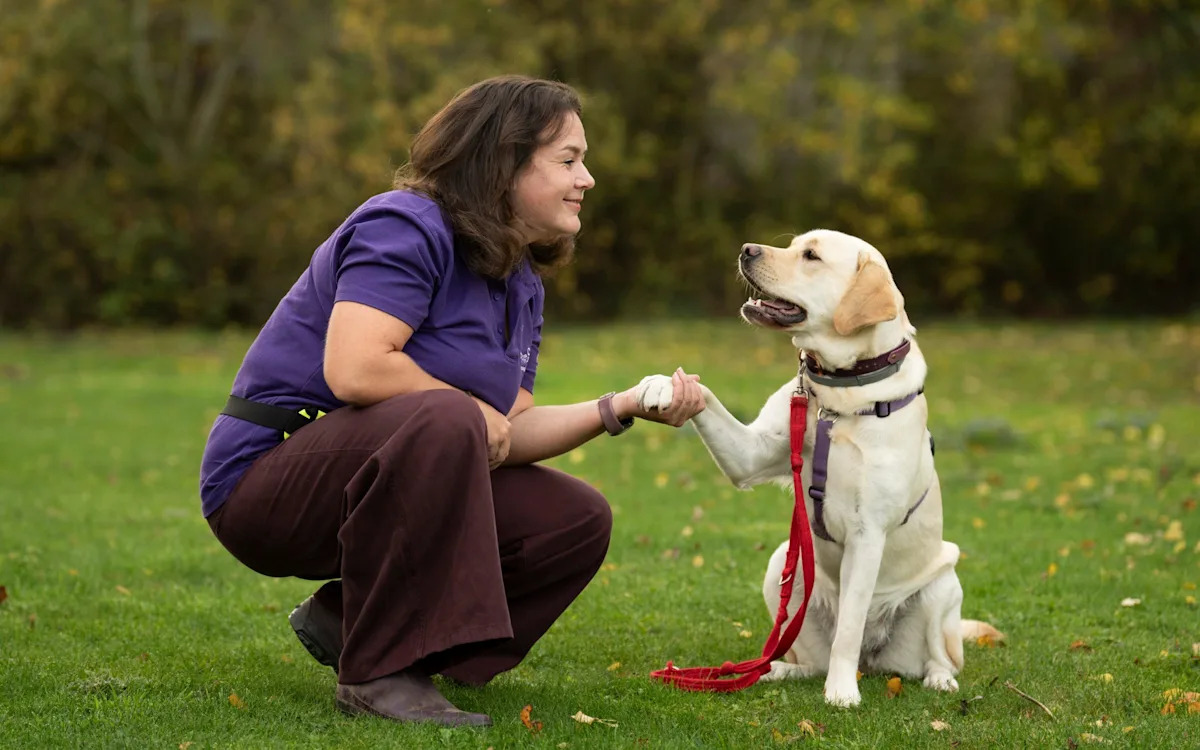
Most people know that an assistance dog helps someone with a disability – but beyond that, many false assumptions surround the animals. For example: dogs assisting the visually impaired aren’t the only canine helpers out there – people with deafness, epilepsy, paralysis, chronic fatigue and a whole range of other conditions also benefit from having an assistance dog.
Canine Partners, a charity supported by this year’s Telegraph’s Christmas Appeal, trains assistance dogs for about two years before matching them to people with disabilities, with the aim of creating a partnership which lasts the whole of the animal’s working life. The organisation trained 35 dogs this year; in 2026, it hopes to train 40. The charity also has a waiting list which is currently closed. Jenna Ellison, a partnership trainer at the charity, who is based in Nottingham, spends her days matching and working with the dogs and their prospective owners, continuously teaching them new skills until the dog retires.
Nicki Berry from Goole in the East Riding of Yorkshire, is one of the many people who benefits from the work Ellison and her team do. Berry has a nine-and-a-half-year-old assistance dog named Liggy. The pair have been matched since 2017 after Berry sustained a spinal cord injury five years earlier. Liggy helps Berry undress, loads and unloads the washing machine and helps her with her physiotherapy – lying on her leg to help reduce her cramps with pressure when she gets them.

Each dog is specially trained for its new owners needs
Eight myths about assistance dogs
Assistance dogs never get scared
“Not all dogs are made to be assistance dogs. If we find dogs that don’t like busy environments, we either look to match them with people who live in quieter areas and have a quieter lifestyle or we have to decide that perhaps being an assistance dog isn’t right for them,” says trainer Ellison. “It’s important the dogs are well socialised as puppies and even if something is a scary or overwhelming experience for them, to pair it with a positive reward such as a treat or a fuss so they want to go back to those environments.” But, Ellison adds “we would never force a dog to do something that it doesn’t enjoy.”
Assistance dogs are just for blind people
“We work with adults with physical disabilities, including amputations, MS, ME and chronic fatigue,” says Ellison. “If you are covered by the Equality Act as having a disability, then an assistance dog is for you. Canine Partners help adults with physical disabilities in a practical way: by picking things up, flicking switches, opening doors… Each different assistance dog will have a different skill set to help.”
Ellison says the charity works with an occupational therapist to identify areas a prospective assistance dog owner needs help with, then they adapt the dog’s training to cater to them. Standard skills include picking up dropped items, tugging open doors, hitting emergency alarms if their owner falls and even unloading the washing machine.
“Trying to figure out how we can get a dog to help someone is the bit of the job I really enjoy,” she says.

Assistance dogs are always on duty for whatever their owner needs
Assistance dogs never misbehave
While assistance dogs are incredibly well trained, “they’re still dogs at the end of the day, not robots,” says Ellison. “They still have crazy moments, they still get zoomies at the park. We work with a lot of labradors at Canine Partners who are very food orientated and might stand up and try and sniff someone’s food.”
Meeting another assistance dog can also cause them to become excited. “Quite a few dogs get excited when they spot another Canine Partner, or another working dog. One minute they’re calm and working professionally and then they see another assistant across the way which can send them all waggy and wiggly.”
Very boisterous dogs are not always well suited to be assistance dogs. “It’s also about finding the right career for the dog,” says Ellison. “A really boisterous dog could go into the army or the police.”
Assistance dogs are all Labradors
“Technically, an assistance dog could be any breed, because assistance dogs do all manner of different jobs,” explains Ellison. “Small breeds can still alert you to a medical condition, and don’t necessarily need to be the size of a labrador. Our main requisite is that the dogs are healthy, that they’ve got a suitable temperament and are able to do the tasks needed.
“Original guide dogs were German shepherds. We tend to use Labradors rather than golden retriever crosses, but we do have some poodle crosses for people who need a non-shedding dog. Medical detection dogs and hearing dogs are quite often spaniels.”

The dogs stay with volunteer families while they are being trained – Andrew Fox
Dogs in training have to live in kennels
Canine Partners have their own breeding programmes to try and retain the positive characteristics they look for in their new recruits, but outside of their training, dogs live with local foster owners until they’re placed in their forever homes, around the age of two. “When they’re being trained, the dogs are in kennels during the day, but they go out to volunteer family homes in the evening, so they get to go and relax and chill out in a home. It’s a bit like school,” she says.
It’s love at first sight with dogs and owners
The matching process is a bit like dating, says Ellison. “We have our applications, and we have our list of dogs, and then the trainer’s job is to try and marry the two. Sometimes it looks perfect on paper but then when they meet there’s no spark. A lot of applicants meet the dog and know straight away: ‘That’s my dog’. Sometimes it’s not an initial ‘wow’ but a gradual build.”
“For me and Liggy, it was a bit tricky,” says Berry. “When we met she had just started chasing leaves when the wind blew. The rustling sound drove her crazy, and we ended up having several ‘matching’ visits to see if she could be trained out of it, but she did eventually calm down. I think she will always be a leaf chaser, but other than that, she’s perfect.”
Assistance dogs are always working
“Guide Dogs have ‘on duty’ and ‘off duty,’ which is denoted by when they put their harness on. But Canine Partners tend to be on duty all the time,” says Berry. “However, they’re more like a TV on standby than doing things all the time. In the park while Liggy was playing with another dog, I dropped one of my gloves on the floor. As soon as she realised, she ran over to me, picked up the glove, handed it back, and went back to play.”
You can’t touch assistance dogs
“Liggy is friendly and one of the reasons it’s helpful for her to be that way is that if I had a fall and needed help, I could let her go, and she would find somebody to assist me. In that way, it does help if she likes people.”
Having a friendly dog also serves as an icebreaker with other people, says Berry. “Some people don’t know what to say to you, but most are happy to stroke or talk about a dog and they focus on her which can be quite nice.” However, make sure to ask before petting an assistance dog in case they are working.
Canine Partners is one of four charities supported by this year’s Telegraph Christmas Charity Appeal. The others are Prostate Cancer Research, Motor Neurone Disease Association, and The Not Forgotten. To make a donation, please visit telegraph.co.uk/appeal2025 or call 0151 317 5247