The post The Art of Deception: How the Ghost Mantis Masters Leaf Mimicry appeared first on A-Z Animals.
Quick Take
-
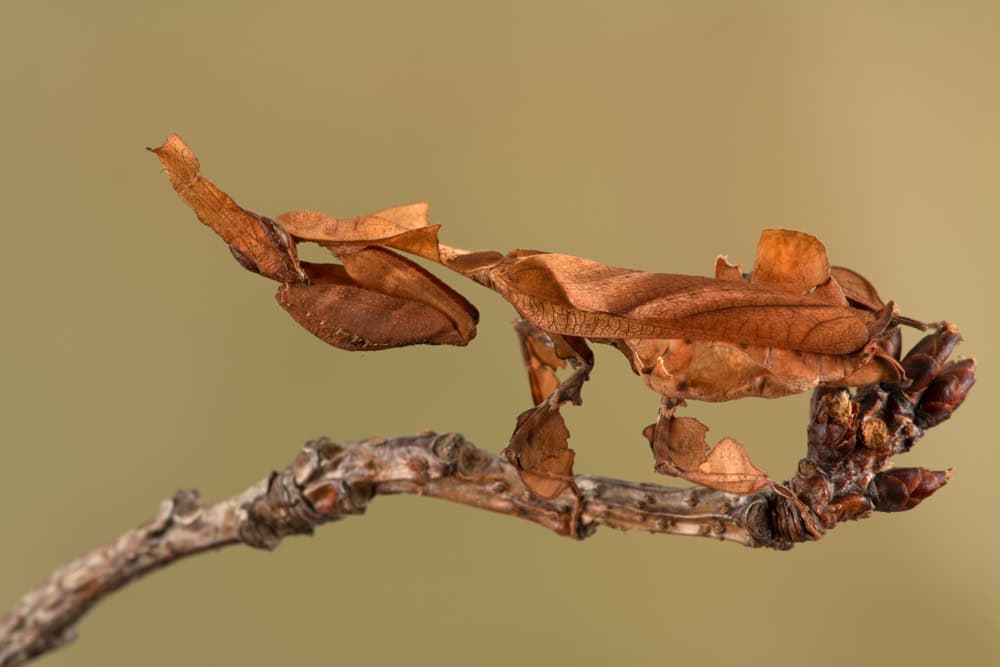
The ghost mantis looks just like a dead leaf.
-
Their thorax and limbs are brown and shaped like foliage.
-
They further resemble a leaf by tucking their forelegs tight against their body.
-
If disturbed, they rock like a leaf blowing in the wind.
What’s the cleverest way to avoid being noticed by a predator in a forest? Make yourself look like a dead leaf, of course! Meet the ghost mantis, a master of disguise and mimicry. These fascinating creatures have an extraordinary appearance that helps them evade their bird predators. Let’s find out more about them.
Where Will You Find a Ghost Mantis?
The ghost mantis (Phyllocrania paradoxa) is found across much of sub-Saharan Africa, including regions in Eastern and Western Africa and on the island of Madagascar. They live in dry areas where there are bushes, shrubs, and trees. If you are able to spot one, they will likely be clinging to a twig. These mantises only reach around two inches in length, which is small for a mantis. The males and females are about the same size, but the male is slimmer. Their colors range from a subtle brownish green to almost black, but most of them are dark brown. Thanks to their docile nature and relatively simple care needs, they are also popular as pets.
Disguised as a Leaf
This creature has some of the most impressive camouflage you will find in the insect kingdom. They engage in crypsis, which is a behavior, color, or shape that makes a creature harder for a predator to detect. It comes from a Greek word that means ‘hidden’. In the case of the ghost mantis, they look amazingly like a dead leaf. So, how do they do this?

Every part of the ghost mantis’s body looks like a leaf.
©Guillermo Guerao Serra/Shutterstock.com
(Guillermo Guerao Serra/Shutterstock.com)
Firstly, their thorax is flattened into a leaf-like shape. Then, their legs and abdomen have projections that also look like pieces of dead foliage. Their back has thin veins that look just like the lacy veins on a dead leaf and are mottled with pigmentation that mimics the leaf folds. Their eyes are exactly the same color as their exoskeleton and are therefore practically invisible. And above them, they have a crest that looks like yet another dried leaf.
When it comes to behavior, the ghost mantis is an accomplished leaf mimic. They spend most of their time hanging upside down on leaves and branches. By tucking their forelegs tight against their body, they look nothing like an insect. If you disturb them, they even rock back and forth like a leaf blowing in the wind.
Crypsis as a Hunting Strategy
Ghost mantises do not just use crypsis to evade predators. They also use it as a hunting strategy. Their diet is made up of flies, crickets, moths, and even other mantises. However, they have no way of attracting these animals, and they are not fast enough to chase them. So, they use their natural leaf disguise and lay in wait until their prey gets close to them. A ghost mantis can remain motionless for hours waiting for prey. Sometimes, it will turn its head quickly, but that just looks as if a breeze has caught a leaf. When the time is right, the mantis strikes with lightning speed and grabs the unsuspecting prey!
The post The Art of Deception: How the Ghost Mantis Masters Leaf Mimicry appeared first on A-Z Animals.