The post Discover The 10 Official State Animals Of Maryland appeared first on A-Z Animals.
Quick Take
-
Astrodon johnstoni was a massive prehistoric creature with a long neck and tail.
-
The Baltimore oriole, adopted as the state bird in 1947, was the first official state animal of Maryland.
-
The majority of calico cats are female.
From the wetlands of the Chesapeake Bay to the forests farther inland, Maryland hosts an array of birds, mammals, reptiles, insects, and crustaceans. Several animals native to Maryland have been recognized as official symbols of the state. Continue reading to discover more about the 10 animals Maryland has adopted.
Bird: Baltimore Oriole

The Baltimore oriole lives all around the United States but is particularly common in Maryland.
©Agami Photo Agency/Shutterstock.com
(Agami Photo Agency/Shutterstock.com)
Baltimore orioles (Icterus galbula) were designated as the official state bird of Maryland in 1947. These stunning black and orange songbirds are regular summer visitors to the Chesapeake Bay area.
Baltimore orioles weigh no more than 1 ounce and range in length from 6 to 8 inches, with a 4-inch wingspan. Male Baltimore orioles are black with vivid orange on the breast, tail, and wing bars, while females are olive-brown to yellow, with white wing bars and a gray beak.
Baltimore orioles are omnivores that consume fruit and insects.
Dog: Chesapeake Bay Retriever
The Chesapeake Bay retriever (Canis lupus familiaris) was officially recognized as the Maryland state dog in 1964. The Chesapeake Bay retriever is a water dog used to hunt and recover waterfowl in the frigid chop of Maryland’s Chesapeake Bay. This dog is perfect for the job because of its strong constitution and thick coat.
They are regarded as excellent hunting dogs and are ideal companions for energetic, experienced dog owners who can provide them with structure and plenty of activity. A male Chesapeake Bay Retriever can weigh as much as 80 pounds and stands 23 to 26 inches tall at the shoulder. A defining feature of the breed is its wavy, chocolate-colored, and smooth coat. They have bright yellow-amber eyes that pair well with their coat.

A Chesapeake Bay Retriever is born to spend time in the water, and like the ducks they often help hunt, they have webbed feet to help them swim in the waters of the bay.
©cindylindowphotography/Shutterstock.com
(cindylindowphotography/Shutterstock.com)
Given their ancestry, it is not surprising that Chesapeake Bay Retrievers enjoy being in the water. Young pups exposed to water play develop into strong, powerful swimmers who use their straight or slightly curled tails as rudders. These dogs can be independent thinkers, but they are generally sociable, outgoing, and obedient.
Marine Fish: Rockfish (Striped Bass)
Maryland recognized the rockfish (Morone saxatilis), also known as the striped bass, as its official marine fish in 1965. This species may be found from Northern Florida to Southeast Canada, and they are commonly found along Maryland’s coastline and in the Chesapeake Bay.
The rockfish was chosen because of its immense ecological, recreational, and economic significance to the Chesapeake Bay. As a premier sport and commercial fish, it is essential to the region’s culinary culture

The rockfish (pictured) is known for its large mouth.
©Steve Brigman/Shutterstock.com
(Steve Brigman/Shutterstock.com)
Rockfish are classified as anadromous, meaning they live most of their lives in saltwater (ocean/coastal) but migrate into freshwater rivers to spawn.
Rockfish have wide mouths, prominent dorsal fins, a generally flat body, and several lateral stripes running the length of their silver, iridescent bodies. Their backs are often pale green, olive, steel blue, black, or brown.
Insect: Baltimore Checkerspot Butterfly
The Baltimore Checkerspot Butterfly (Euphydryas phaeton) was officially designated as the state insect of Maryland in 1973.
The Baltimore checkerspot has three distinct life stages, each with a unique appearance. As a caterpillar, the Baltimore Checkerspot has a black head and body with spine-like protrusions placed along the alternating bands of black and orange lines.

A Baltimore Checkerspot caterpillar is resting on a green leaf.
©Paul Reeves Photography/Shutterstock.com
(Paul Reeves Photography/Shutterstock.com)
The chrysalis of the Baltimore checkerspot is distinctively white with striking orange and black markings, often resembling a bird dropping to deter predators. Formed in late spring after caterpillars hibernate, these chrysalises hang from host plants, maturing into adults in about 10–14 days.
The adult Baltimore checkerspot butterfly has four wings, each featuring two broad, banded borders: an inner border with white checkers and an outer border with orange to yellowish-orange checkers. The wings are black with orange spots.

The black, orange, and white Baltimore checkerspot butterfly is found in the Chesapeake Bay area and is common throughout the state.
Crustacean: Blue Crab
The Maryland Blue Crab (Callinectes sapidus) was officially designated the state crustacean in 1989. The blue crab is a swimming crustacean known for its vivid blue claws and emerald-hued shell. It is one of the most easily recognized species in Maryland and the Chesapeake Bay.

The blue crab is found along the coast of Maryland.
©Jen Helton/Shutterstock.com
(Jen Helton/Shutterstock.com)
The carapace (shell) of the blue crab can measure up to nine inches across and ranges in color from blue to olive green. Each side of the carapace bears nine marginal teeth, the ninth of which is a strong spine. Blue crabs have paddle-shaped back legs for swimming and three pairs of walking legs.
Reptile: Diamondback Terrapin
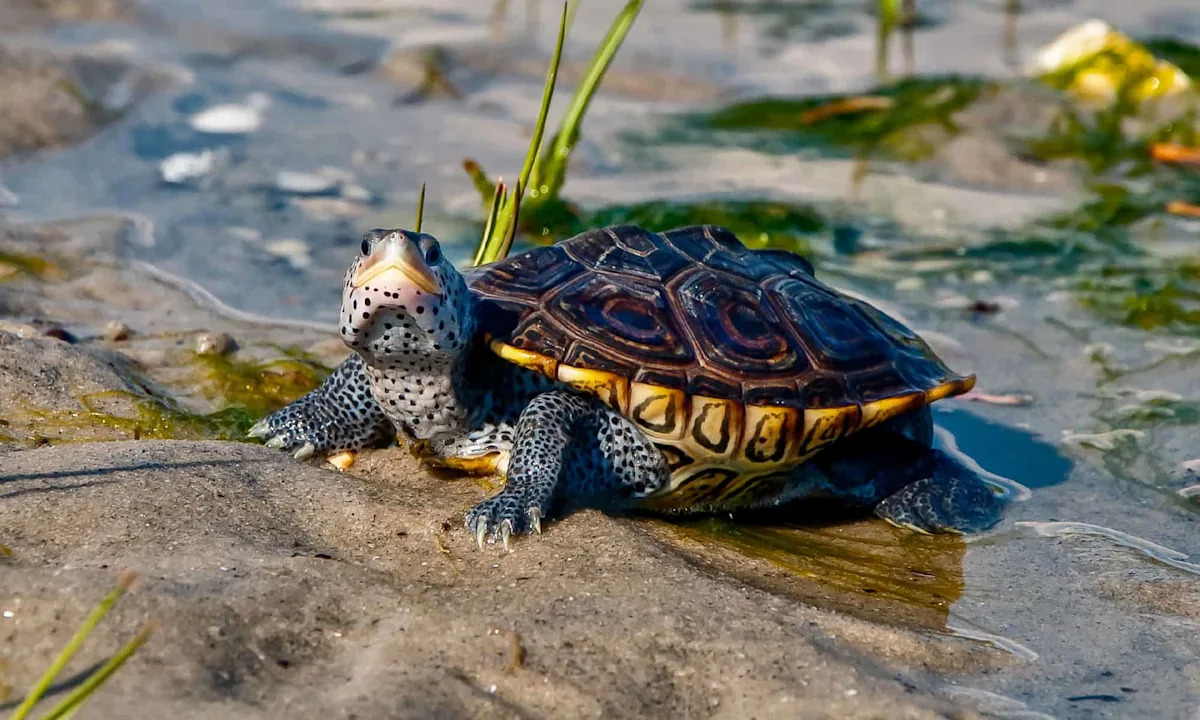
The Diamondback Terrapin (Malaclemys terrapin) was officially designated as the Maryland state reptile in 1994

While mollusks like clams, snails, and mussels make up the majority of terrapins’ diets, they will also consume fish, worms, insects, and some species of crustaceans.
©iStock.com/JasonOndreicka
(iStock.com/JasonOndreicka)
The diamondback terrapin is an aquatic turtle with a shell covered in distinctive diamond-shaped rings. It is found in and near the brackish tidal waters of the Chesapeake Bay, including rivers and marshes.
Thediamondback turtle is the only turtle species in North America that lives exclusively in brackish water. In May, diamondback terrapins typically mate in the water at night. Females visit beaches after mating, where they create nests in the sand. They lay around 15 eggs that are pinkish-white in color.
The diamondback terrapin’s carapace, or shell, can range in color from brownish or greenish to gray or nearly black. Black patches or stripes cover their scaly, gray, or white skin. The rings inside the plates that make up the carapace can be a different color from the rest of the shell and are shaped like concentric diamonds.
Fossil Shell: Ecphora Gardnerae Gardnerae
Ecphora gardnerae gardnerae (an extinct Miocene snail) was officially designated as the state fossil shell of Maryland on October 1, 1994

Around the conclusion of the Miocene era, some 5 million years ago, the Ecphora lived in the tidal seas off the East Coast of modern-day Maryland, which was submerged during that time under the Salisbury Embayment. When the ocean was higher and warmer, a wider range of marine life, including crocodiles, sharks, and whales, likely lived in the area. Ecphora specimens that were buried in silt by retreating waves have been found on cliffs throughout Maryland.
Dinosaur: Astrodon johnstoni
Astrodon johnstoni was officially designated as the state dinosaur of Maryland in 1998.

Astrodon johnstoni was a massive, herbivorous sauropod dinosaur that lived in what is now Maryland 95–130 million years ago during the Early Cretaceous period. Astrodon johnstoni was a 50- to 60-foot-long, 30-foot-tall, 20-ton creature with a long neck and tail. Its name means star tooth, referring to a star-like pattern inside its fossilized teeth. The fossil was named by Christopher Johnston in 1859.
Maryland State Cat: The Calico

Calico cats consist of unusual shades of orange, black and white.
©Kristi Blokhin/Shutterstock.com
(Kristi Blokhin/Shutterstock.com)
In 2001, the calico cat (Felis catus) was declared the official state feline of Maryland.
Calico cats are shades of orange, black, and white. A calico cat must be a true tricolor, with the three colors appearing in separate patches. Some standards define the minimum amount of white that must cover the body, while others permit tabby striping within the color patches.
The majority of calico cats are female. Male calico cats are extremely rare, occurring in only about 1 in every 3,000 calico births. Calico cats, particularly in Southeast Asia, have historically been thought to bring good luck and even wealth.
Horse: The Thoroughbred Horse
In 2003, Maryland declared the thoroughbred horse (Equus caballus) to be the official state horse. The typical thoroughbred horse weighs 1,000 pounds and measures 64 inches tall at the withers. A thoroughbred can have a coat that is chestnut, black, gray, or even roan in color.

A thoroughbred horse’s back legs are particularly long, which amplifies thrust as they gallop.
©Anaite/Shutterstock.com
(Anaite/Shutterstock.com)
Thoroughbred horses can maintain a pace of up to 40 miles per hour for prolonged periods. Thoroughbreds are used by mounted police, show jumpers, and dressage teams. The thoroughbred horse is most recognizable as a racehorse.
The post Discover The 10 Official State Animals Of Maryland appeared first on A-Z Animals.