The post The Platypus: One of the Weirdest Animals on Earth appeared first on A-Z Animals.
Quick Take
-
Platypuses are monotremes, one of the oldest branches of mammals, and they reproduce by laying eggs instead of giving birth to live young.
-
Unlike most mammals, platypuses secrete milk through pores in their skin, allowing babies to lap it from their mother’s fur.
-
This unusual mammal can detect electrical signals to hunt underwater, males carry venomous spurs, and their fur even glows under ultraviolet light.
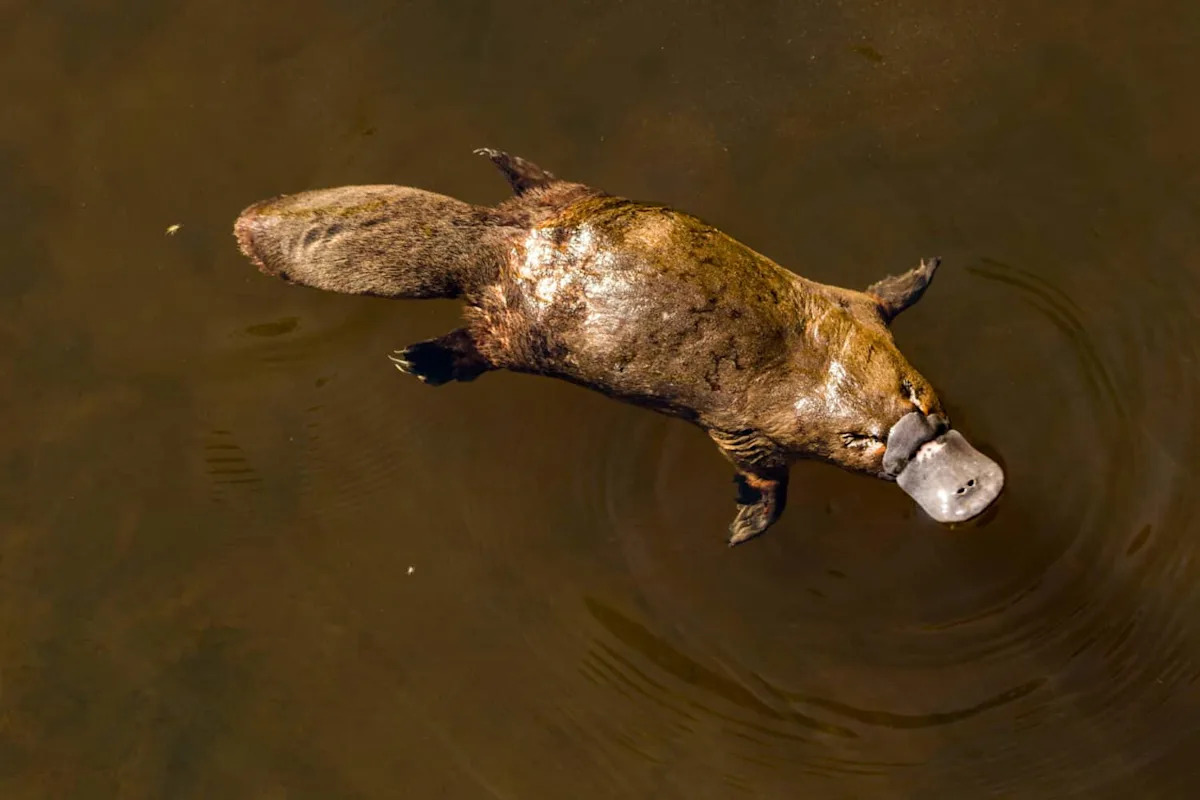
Platypuses are weird looking. They look like someone stitched together a duck and a beaver—flat bill, webbed feet, and a broad tail. But their appearance isn’t even the strangest thing about them. Not by a long shot. Their odd exterior represents one of the most unusual bodies in the animal kingdom.
Let’s play a game. Which of the following do you think is true about this mammal:
-
B. It sweats milk instead of nursing through nipples
-
C. It hunts by sensing electrical signals
-
D. It carries venomous spurs on its legs
-
E. It glows under ultraviolet light
Yup, you guessed it: F, all of the above. The platypus isn’t just weird, it’s biologically alien.

Early European scientists thought the platypus might be a taxidermy hoax because its duck-like bill looked so out of place on a furry mammal.
©Lukas_Vejrik/Shutterstock.com
(Lukas_Vejrik/Shutterstock.com)
A Mammal That Doesn’t Follow the Rules
The platypus lives in freshwater rivers and streams across eastern Australia and Tasmania. Adults are about 15 to 20 inches long from bill to tail and typically weigh about 1.5 and 5 pounds. Males are usually larger than females. So far, there’s nothing particularly unusual about them.
But the animal looks like a mashup of several different species. Its bill resembles a duck’s. Its dense waterproof fur and flat tail recall a beaver. Its webbed feet make it an excellent swimmer.
When European scientists first examined a platypus specimen in the late 1700s, many suspected it was a hoax. Some believed a taxidermist had sewn a duck bill onto a mammal’s body as a prank. True story.
The platypus belongs to a tiny group of mammals called monotremes, which represents one of the oldest branches of the mammal family tree. Their lineage split off from other mammals more than 160 million years ago. Because of that ancient history, monotremes retain traits that seem more reptilian than mammalian. The platypus is the most famous example.
Yes, It Really Lays Eggs
Most mammals give birth to live young. But female platypuses lay between one and three marble-sized eggs at a time.
The mother digs a nesting burrow in a riverbank, often more than 30 feet long. Deep inside the tunnel, she builds a chamber lined with wet leaves and vegetation. After laying her eggs, she curls her body around them and incubates them for about 10 days. During this time, she keeps them warm by holding them against her belly.
When the eggs hatch, the babies are tiny, hairless, and extremely underdeveloped. At this stage they’re about the size of lima beans and completely dependent on their mother.
Egg-laying might sound like a reptile trait, but genetically the platypus is still very much a mammal. Its young drink milk.
But that milk comes in an unusual way.

A platypus hunts underwater with its eyes closed, detecting the tiny electrical signals produced by the muscles of nearby prey.
©bluesmoke/Shutterstock.com
(bluesmoke/Shutterstock.com)
Sweating Milk — Seriously
Most mammals feed their young through nipples. Platypuses don’t.
Female platypuses produce milk through specialized mammary glands, but the milk doesn’t come out through teats. Instead, it seeps through tiny openings in the skin and pools in shallow grooves along the mother’s belly.
The babies then lap the milk directly from the fur.
This unusual system likely reflects the platypus’s ancient evolutionary history. Monotremes branched off early from other mammals and never developed nipples. Instead, they retained the older method of secreting milk through the skin.
Platypus milk is also chemically interesting. Studies have shown it contains powerful antibacterial proteins. Scientists believe these compounds help protect the babies, which are exposed to damp conditions and environmental bacteria in the burrow.
Platypus milk isn’t just food; it may very well also be medicine.
The Bill That Hunts with Electricity
The platypus bill may look like a duck bill, but it works very differently. Rather than being hard like a bird’s beak, the platypus bill is soft and rubbery. Inside it lies an extraordinary sensory system that allows the animal to hunt in complete darkness.
Platypuses close their eyes, ears, and nostrils whenever they dive underwater, taking sight, sound, and smell out of the equation while hunting. Instead, they use something called electroreception.
When fish, shrimp, or aquatic insects move, their muscles produce tiny electrical signals. The platypus bill contains thousands of specialized receptors that detect those signals in the water. By scanning the riverbed with slow side-to-side movements of its head, the platypus can pinpoint prey hidden in mud or gravel by sensing the electricity of other animals.
This ability is rare among mammals. Sharks and rays are known for electroreception, but very few mammals are capable of this feat.
One of the Only Venomous Mammals
Male platypuses carry sharp spurs on the inner side of their hind legs, each of which connects to a venom-producing gland in the thigh. Interestingly, female platypuses also develop spurs when they’re young, but they lose them as they mature.
The venom seems designed primarily for combat between males rather than hunting or defense against predators. During the breeding season, males can use these spurs to stab rivals. Platypus fights can be surprisingly aggressive, especially when males compete for access to females.
The venom isn’t usually fatal to humans, but it’s extremely painful. Victims often report intense swelling and pain that can last for days or even weeks.
They Glow!
As if egg-laying, sweating milk, and venom spurs weren’t enough, scientists recently discovered another strange platypus trait: under ultraviolet light, platypus fur glows.
When exposed to UV light, the normally-brown fur fluoresces with a blue-green color. Fluorescence occurs when a material absorbs ultraviolet light and re-emits it as visible light. Several animals show this trait, including flying squirrels, scorpions, and some birds.
Why platypuses glow is still unknown.
One possibility is camouflage. Many predators can see ultraviolet wavelengths, and fluorescence might help the platypus blend into the environment under moonlight. Another possibility is communication between animals. But for now, it remains one of the many mysteries surrounding this already mysterious mammal.

A platypus’s dense waterproof fur traps air for insulation, helping the animal stay warm while swimming in cold Australian rivers.
©Imogen Warren/Shutterstock.com
(Imogen Warren/Shutterstock.com)
Built for Life in and Out of the Water
The platypus’ unusual traits make it extremely well adapted for its aquatic lifestyle. Its dense fur traps air for insulation, keeping the animal warm in cold streams. The broad tail stores fat reserves and helps with steering while swimming.
Powerful front legs and webbed feet provide propulsion underwater. When swimming, the platypus mainly uses its front feet like paddles. The back feet help steer and stabilize the body. On land, those same webbed feet partially fold back so the animal can walk more easily. Sharp claws allow it to dig long burrows into riverbanks.
For an animal that seems so bizarre, it’s perfectly designed for its environment.
Not a Biological Mistake
At first glance, it is easy to assess the platypus is a weird animal. A duck-like bill on a furry mammal is enough to justify this statement. But the deeper scientists look, the stranger it becomes.
This animal lays eggs yet produces milk. It hunts by detecting electrical signals. Males carry venomous spurs. Its fur glows under ultraviolet light. Even the way it feeds its babies breaks the usual mammalian rules.
The platypus sounds like a biological mistake, but it is actually a remarkable survivor from an ancient branch of the mammal family tree. This animal has thrived in Australia’s rivers for millions of years, not in spite of its odd features, but because of them.
So, yes, the platypus is weird. At least that’s the advective a layperson might use. A scientist would prefer to call it fascinating. A platypus would simply call it survival.
The post The Platypus: One of the Weirdest Animals on Earth appeared first on A-Z Animals.