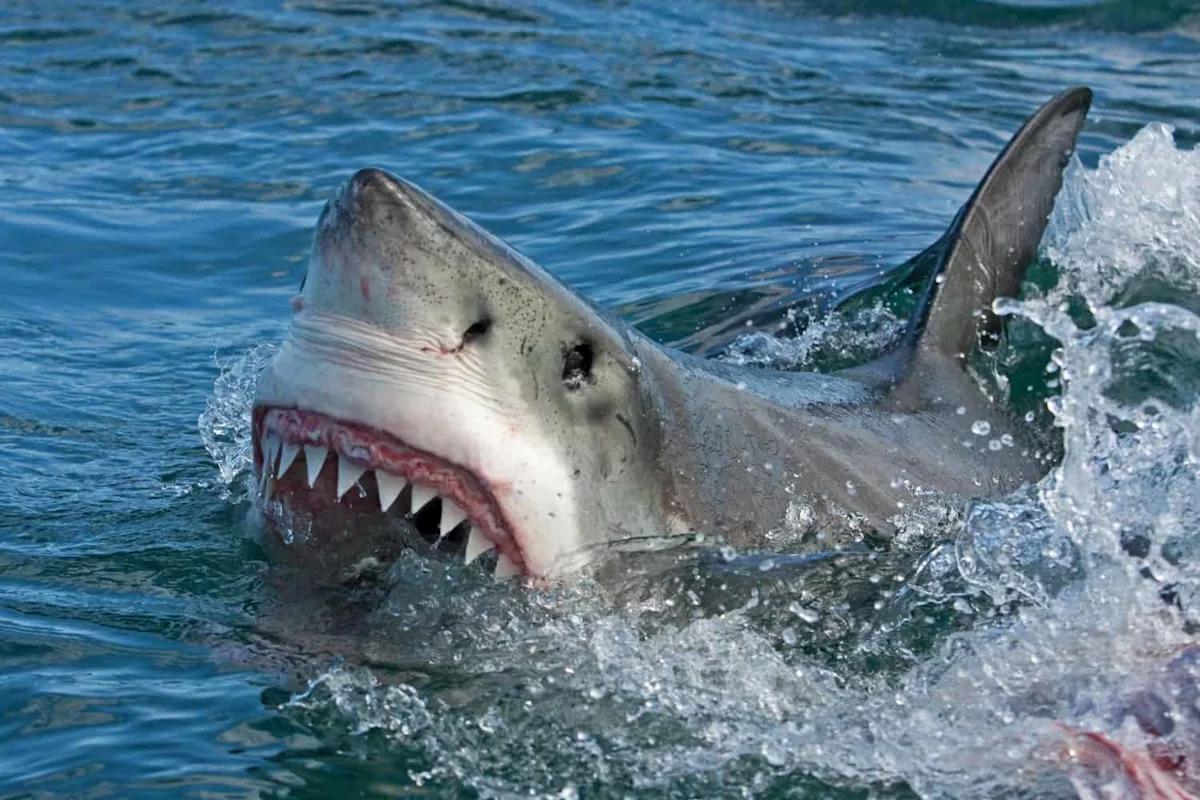
The post Discover The Secret Sense of Great White Sharks appeared first on A-Z Animals.
Quick Take
-
Great white sharks are some of the ocean’s mostincredible hunters.
-
They usually eat fish, rays, sharks, and marine mammals.
-
These large fish have excellent senses, in addition to other abilities that humans don’t have.
-
Great whites can detect electric fields, helping them find prey and giving them a massive advantage when hunting.
-
The Ampullae of Lorenzini is what allows sharks to detect these fields.
Great white sharks are among the ocean’s most intimidating predators, known for their speed, power, and razor-sharp teeth. Despite their incredible strength, their hunting success isn’t based on muscle alone. Beneath the surface, these sharks rely on an extraordinary set of senses that help them locate prey even in dark waters or when their target is hidden from view. Every sense plays a role in making the great white an efficient hunter, from a keen sense of smell to incredible hearing.
Not only do these big fish have certain enhanced senses when compared to humans, but they also have a special additional sense; one which humans lack entirely. One of their most remarkable abilities is the power to detect electric fields produced by other animals. Specialized organs called the ampullae of Lorenzini allow great white sharks to sense tiny electrical signals created by muscle movements and heartbeats. This unique adaptation gives them an advantage when hunting, helping them track prey that would otherwise be nearly impossible to find in the vast, murky ocean.
1. The Great White Shark Diet

Great white sharks are carnivorous, surviving entirely on meaty food sources. They can grow up to 21 feet long and weigh up to 4,500 pounds, which means they need to hunt effectively to survive. They have a lifespan of 70 years or more, demonstrating their prowess in the water. They’re at the top of the food chain, swimming in open water like they own the place.
Unfortunately, great white sharks are misperceived as aggressive, human-hunting predators. Though shark attacks occur, they’re not nearly as common as you might think. Humans are not an integral part of the great white shark diet. In fact, though they don’t have discriminating palates, their preference is for marine mammals and fish.
Most sharks are very particular about what they eat. For instance, great white sharks primarily eat fish, rays, sharks, and marine mammals. They hunt and devour marine mammals like sea lions and seals. Great white sharks are apex predators and while this makes them powerful, they are not without intelligence.
They are not interested in fighting. If they perceive they may be hurt, they steer clear. They eat other smaller sharks if they perceive it safe to do so, but first, they measure the risk and what type of shark they may be up against. These sharks also eat smaller marine species like rays and squids.
When a whale dies in the ocean, it’s also a feeding opportunity for great whites. It’s a massive meal, so they stick around and scavenge. The larger the great white shark, the larger the prey they seek out. On many occasions, great whites find sea lions and seal colonies and gather around. This way, they have easy access to larger prey.
2. Great White Shark Behavior

©solarseven/Shutterstock.com
(solarseven/Shutterstock.com)
These sharks are careful when hunting. Though opportunistic, they’re not rash. Great white sharks are always moving and can be quite elusive as well. They can reach bursts of speed exceeding 20 mph and display both intelligence and an inquisitive nature.
They tend to swim in temperate and subtropical environments and migrate impressively long distances. Their mouths are filled with hundreds of teeth, which help them quickly break through flesh for effective kills.
Though they frequently hunt solo, multiple sharks may feed on the same prey. Each great white shark uses its intelligence, speed, and senses to find prey and subdue it. One of the most peculiar senses great white sharks possess is made possible by the ampullae of Lorenzini.
3. The Ampullae of Lorenzini

©Alessandro De Maddalena/Shutterstock.com
(Alessandro De Maddalena/Shutterstock.com)
Carmen Koepfer, Marine Biologist and Shark Specialist, along with her colleagues, Bryan A. Keller, Nathan F. Putman, R. Dean Grubbs, David S. Portnoy, and Timothy P. Murphy, told A-Z-Animals, “All sharks have this sense. It’s one of the seven senses sharks have. They have an olfactory sense, sight, touch, taste, and hearing but also a lateral line in their bodies that helps them detect pressure changes in the water. The 7th is the ability to detect electric fields. This is a sense we don’t have. The electroreception and magnetism are detected through the ampullae of Lorenzini which are located in the shark’s snout. They are small pores with a jelly-like substance. It is a gelatinous consistency. They look like blackheads!
These are what detect electroreception. All sharks have this extra sense via the ampullae of Lorenzini. The emblematic species for this sense is the hammerhead shark. We have many species of hammerhead sharks, and they have this characteristic head that looks like a hammer which expands the area where these ampullae of Lorenzini are located — these little pores that detect electroreception and electromagnetic fields.
Some studies suggest sharks may use Earth’s magnetic field to help navigate. These studies show that magnetism on the seabed comes from volcanic eruptions that bring to the surface many minerals with different magnetic properties. They accumulate on the bottom either in seamounts or even sedimentation. The different rock formations and sediments on the seabed may act as a highway for sharks during great migrations.
4. Shark Migrations

©Jennifer Mellon Photos/Shutterstock.com
(Jennifer Mellon Photos/Shutterstock.com)
Koepfer and her colleagues continue, explaining that “These electromagnetic fields and properties on the seabed are used by hammerhead sharks and other species to carry out migrations. This is very important for the species: migrations and their habits. These migrations play an important role in the survival habits of different species because the animals are going to have migrations to mate, eat, and carry out different activities. They are essential for the survival of the species.
Speaking specifically about migrations, the great white shark moves from one place to another looking for the presence of certain fatty acids. Certain prey have a different chemical composition in their tissues that is related to the type of diet of these animals. Some animals, depending on where they forage or where they feed, acquire certain types of nutrients. They synthesize them and they get lodged in their tissues, in their muscles, and in their fat.
So, the sharks travel and make migrations. Females specifically look for certain essential fatty acids when they are in periods of gestation, for example. We have many studies that agree with and support these theories about animals that move from one place to another looking for certain types of prey.
These migrations can vary in depth. They can make vertical migrations, either changing their forage area to the surface of the water or to the bottom. Females migrate when they are in periods of pregnancy and reproduction. In juveniles, they aggregate in a certain place, and when they become adults, they go to another place because their energy requirements change. The movement of the animals responds to physiological needs depending on the stage of life, where the animal is located, or the activity it will perform.
5. Vicious Hunters: How Great White Sharks Capture Prey

©Anna Kucherova/Shutterstock.com
(Anna Kucherova/Shutterstock.com)
Koepfer and her colleagues summarize how great white sharks detect electric fields and how that helps them when hunting, saying “One of the tools they use to carry out these migrations is the ampullae of Lorenzini which detects these electromagnetic fields. They use the electromagnetic fields as roads on the seabed where you see a concentration of certain minerals that have a specific magnetic charge. This helps them locate prey on the seabed.
They’re essentially provided with an electrical map of sorts and their unique ability to pick up on these electrical and magnetic fields makes them privy to information they need for survival. Even when the electrical stimulus is weak, they are adept at picking up on it. Not only are they following the roadmaps of the seabed, but they’re also able to pick up on the slightest muscular contractions of their prey. Even when their sight is limited, their ability to detect electroreception gives them an advantage.
It’s ultimately this unique adaptation that makes great white sharks such vicious hunters. It gives them a massive advantage when hunting. But despite their status in the ocean, they are a vulnerable species. It’s humans who ultimately detrimentally impact their populations either taking them as trophies for sport fishing or hunting them for parts of their bodies. Bycatching is a problem for these sharks as well. It just goes to show there are always bigger fish to contend with.
The post Discover The Secret Sense of Great White Sharks appeared first on A-Z Animals.