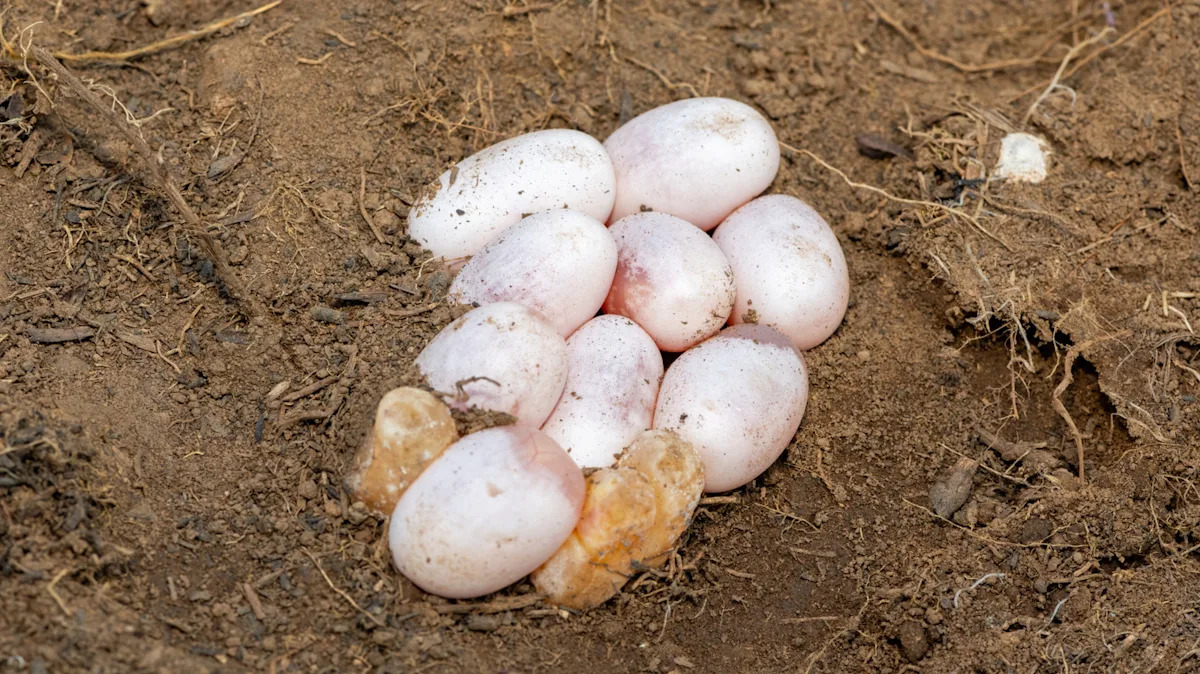
Finding a clutch of mystery eggs in your yard is at once a case for excitement and, depending on what they look like, caution and even consternation. Especially if you’ve adopted a robust, but humane, strategy to keep animals out of your yard, the fact that such a mystery creature has managed to get in, much less lay their eggs, can prove something of a head scratcher. When they do, it can help to have a good understanding of the kinds of animals in your area, which ones lay eggs, and if any are potentially dangerous.
That’s what this guide is here to help with. Focusing specifically on snake eggs — and the various species that may have laid them — we’ll cover the regions in which different species are usually found, and the places in your yard where they’re likely to lay their eggs. Where applicable, we’ll explore nesting behavior specific to certain species, and although the majority of oviparous (egg-laying) snakes in North America are harmless to humans, we’ll provide details on the one, dangerous exception, to ensure you or your family don’t accidentally find yourself in harm’s way.
Read more: What Type Of Nest Is In Your Yard: 8 Ways To Identify Common Pests
Eastern coral snake eggs should be treated with caution and professionally removed

An eastern coral snake in moist soil – Weber/Getty Images
The Eastern coral snake is the only dangerous oviparous snake in North America. In other words, of all the venomous species of snake in North America, this is the only the one that lays eggs. It’s usually found across the coastal southeastern United States, with frequent sightings in states including Florida, South Carolina, Georgia, North Carolina (where it’s endangered), Alabama, and Mississippi. Outside of this range, you’re unlikely to come across Eastern coral snakes, but inside it, they’re one of the snakes you definitely don’t want to see in your yard.
Like many snakes, this species tends to lay its eggs in the summer. Likely areas in your garden include old tree stumps or rotting log piles. Eggs usually appear in clutches of between three and 10, and while they feature much the same characteristics as other species — white, leathery, and with a slightly elongated egg-shape — this species’ eggs typically tend to average around 1¼ inches in length. They often appear more elongated than other snake eggs, too, which may help you to identify them if you’re familiar with the eggs of other species.
Given how dangerous these snakes can be, if you suspect that you’ve stumbled upon a coral snake nest, you should ensure that you, your children, and pets keep well clear. And remember, even if the mother is nowhere to be seen, coral snakes are highly venomous from the moment they hatch. The best course of action if you find their eggs is to call a local wildlife removal expert and have them deal with the problem for you.
Kingsnake egg clutches contain up to 25 eggs

A black kingsnake egg hatching – Borhuah Chen/Shutterstock
There are several species of kingsnakes in the United States, including the common Eastern kingsnake, and the aptly-named black kingsnake. No type of kingsnake is dangerous. In fact, if you have one, it’s the type of scary garden pest that’s actually worth keeping around, as it’s sure to help keep on top of any local rodent populations. As for where they’re found, Eastern kingsnakes range from southern New Jersey, through Florida, into Alabama, and across Georgia and South Carolina. The black kingsnake is typically found east of the Mississippi, its range extending across West Virginia, Illinois, northwest Georgia, and southeastern Louisiana.
Each snake tends to feed quite happily on a number of other garden pests, which is why they’re worth having around. This doesn’t just include rodents, either. In fact, kingsnakes will also eat other reptiles, including copperheads and rattlesnakes, which has got to be reassuring to homeowners in regions where such species are extant. Kingsnakes tend to lay their eggs in spots that afford them warm, moist cover, like rotting logs, sawdust piles, or abandoned mammal burrows. Clutches usually comprise between six and 25 eggs, and like other snakes, each is usually oblong shaped, with a soft, pliable, wrinkled appearance.
Rat snake eggs are usually between 1½ and 2 Inches long

An Eastern ratsnake on a branch – Kyle Lee/Shutterstock
Found across much of the USA, rat snakes vary in color depending on location. They’re found across much of the eastern, southeastern, and central United States; some species extend into the southwest and the Great Plains, and they’re frequently found east of the Mississippi. In most cases, they tend to exceed four feet in length at maturity, which can be quite a startling sight, especially if you weren’t expecting to find a snake in your yard. But, try not to be overly alarmed. They’re not dangerous, although they may bite (non-venomously) if they feel threatened and you accidentally get too close. However, if left alone, their presence is one of the most inexpensive solutions to keeping unwanted rodents out of your yard.
All types of rat snakes lay eggs, usually between late May and Early June, and their clutches usually number between six and 28 eggs, which can make them tricky to discern from other species, like kingsnakes. If you happen to find hatchlings, then this makes it even trickier, since infant snakes look nothing like their parents. They usually come out of the shell with a bold, blotchy pattern, which fades with age. If they’re yet to hatch, the best way to identify them is by their size, which is usually between 1½ and 2 inches long. Otherwise, they are largely indistinguishable from the white, leathery eggs of other species.
Milk snakes lay inch-long eggs in clutches of up to 12

A milk snake on a sun-soaked rock – jcrader/Shutterstock
Found in the majority of the United States (at least, those states east of the Rocky Mountains), milk snakes favor open stretches of land and areas with forestry nearby. They’re often found hanging around structures like barns and other outbuildings — the kind that tend to harbor their favorite foods, like mice and other rodents. Like most other oviparous snakes in the U.S., they’re completely harmless to humans, in fact there’s a strong case to be made for encouraging their presence, particularly if you’re scratching your head for ways to keep mice away from your house. They may even also help to manage populations of unwanted, more dangerous snakes.
Like other snakes, they favor nesting sites that offer both warmth and humidity. This makes rotting logs, rock piles, or even loose soil all likely holding areas for nesting milk snakes. Eggs are laid in clutches of between eight and 12, and like other species, they look rather like elongated bird eggs. They’re usually around an inch in length each and up to half an inch wide, with the soft, wrinkled appearance that’s so typical of most snake eggs.
Gopher snake eggs can be found in gardens across the United States

A gopher snake coiled up in grass – Fusaromike/Getty Images
The gopher snake is one of the most common snake species in the United States. It’s endemic to North America, and while it’s harmless to humans, it’s likely to give you a bit of a fright if you stumble upon one. When they feel threatened, these snakes both flatten and rear their heads, which makes them look like an altogether more dangerous type of reptile. Add to this the rustling sound that they make with their tails (by shaking it through ground litter, like leaves) and it’s easy to see why they’re so often confused with rattlesnakes.
One way to help work out whether it’s a gopher snake or a rattler that’s rustling through your shrubbery is to keep an eye out for eggs. Since rattlesnakes don’t lay them, a nest is usually a fairly good indicator that the snake in your yard is harmless. As for where gopher snakes lay their eggs, they usually look for areas that afford natural cover, like soft soil, tree snags, and even old animal burrows. The eggs themselves are wrinkly and white, laid in clutches of between two and 24, and are approximately 2 inches each in length. When they’re first laid, they’re bound together with a glue-like substance, and whatever stage you find them at, it’s best to leave them alone. These snakes are partial to a range of nuisance critters, including rats, squirrels, and (per the name) gophers, meaning they could well prove a useful ally in your garden’s pest control strategy.
North American racer eggs are roughly textured, like sandpaper

Two black racer snake eggs with their rough, granular texture – Donna Bollenbach/Shutterstock
Another species common across much of the United States and southern Canada, as well as northeastern Mexico, North American racers are also completely harmless. That’s not to say that they won’t stop you in your tracks. As a medium-to-large snake species, individuals can grow up to 1½ meters in length. Their size makes them an excellent adversary for a number of pests around your yard, including frogs, small rodents, and even other snakes, and while they may startle you if they shoot out from a nearby shrub, you should know that they’re probably in pursuit of one of the above mentioned food items, and not your ankles.
In other words, if they’ve made themselves at home in and around your yard, it’s probably not a bad thing. Keep an eye out for clutches of between 9 and 12 eggs, and be mindful around piles of logs, rotting tree stumps, loose soil, and sawdust piles — anywhere loose and warm that’s likely to offer snakes shelter. Each egg is usually around 1⅓ inches long and around ¾ inches wide, and while you should avoid touching them, racer eggs can usually be identified by a raised, bumpy texture, sort of like sandpaper.
Eastern hognose snakes bury their eggs in dry, sandy soil

An eastern hognose snake curled up near a yellow flower – Markparker1983/Shutterstock
Per the name, the Eastern hognose snake is typically found in eastern North America, although its range does cover more than 30 states, so it’s far from uncommon. It’s also far from dangerous. In fact, if threatened, it usually strikes with a closed mouth, and if it senses that the game is truly up, it’s more likely to roll over and play dead (often lolling its tongue) than it is to strike twice. As for where you’re likely to find it, it’s most common in areas of dry, sandy soil — areas in which it can use its eponymous snout to dig nests.
Despite being among the most-common garden-variety black snakes, you may struggle to find an eastern hognose’s nest and eggs. They’re usually laid in loose, sandy soil, down to depths of between 4 and 6 inches. These are usually laid in July, and while it varies, the clutches can comprise anywhere between 10 and 30 eggs, featuring the same wrinkly texture as most other snake species.
Coachwhip snakes prefer dry upland sites, particularly where other animals have burrowed

The red-hued coachwhip snake on rocky soil – Shoemcfly/Getty Images
Coachwhip snakes are found across much of the southern United States, with a range that extends well into northern Mexico. They tend to rely heavily upon burrows that were dug by other creatures. This means that if you live in their native region and you have animals digging holes in your garden, then your yard is likely to appeal to coachwhip snakes. Don’t worry, though. Like most other oviparous snakes, this species is completely harmless.
As well as abandoned animal burrows, coachwhips may lay their eggs in various other places around your garden, provided that they’re dry. Piles of logs, sandy soil, and sawdust piles are likely areas, so always inspect these with caution. Egg clutches usually number between four and 24, with each egg sizing somewhere between 1⅓ and 1⅘ inches in length. Like racers, coachwhip eggs have a slightly granular texture, although it’s always best to leave the eggs alone unless you absolutely have to move them (perhaps to save them from your pet). If you do, contact a wildlife removal expert and have them remove the eggs for you.
Ringneck snakes sometimes nest communally

A ringneck snake with the signatory “ring” around its neck on pavement – Creeping Things/Shutterstock
Named and easily recognizable by the vibrant rings around their otherwise black bodies, these small snakes are widespread across the southeastern United States. They’re mostly nocturnal, which means you’re unlikely to see them helping out in your garden. But help they do. In fact, when they come out to play, they usually spend their time pursuing earthworms, slugs, small amphibians, and even other small snakes. They’re also completely harmless, and while they use venom to subdue their prey, it’s by no means potent enough to be a cause for human concern.
Given their small size compared to other oviparous snakes in North America, you may not be surprised to learn that their clutches are usually smaller, too. Each one usually comprises four or five whitish eggs, and each egg is usually around the size of a penny. They’re usually laid under rotting logs, in loose soil, under rocks, or indeed anywhere that provides cover. Given the size and comparatively small number of eggs, these snakes’ nests can be hard to identify. However, they’re also one of a handful of snakes in North America that sometimes use communal nests. In other words, if you do find a nest, it could well be home to the eggs of more than a single reptile.
Rough green snake eggs look slightly more elongated than those of other species

A rough green snake suspended in the foliage of a tree or bush – leaena/Shutterstock
With their bright green backs and yellow or white(ish) bellies, adult rough green snakes are fairly straightforward to identify. They’re excellent climbers, often found in trees and other plants, and range throughout the Mid-Atlantic and southeastern U.S., from New Jersey to Central Texas and across southern Florida. They’re especially abundant along the margins of rivers and wetlands, which are chock-full of food, like insects.
Rough green snakes usually lay their eggs in early summer, around June or July. They look for places under rotting logs, and just like ringneck snakes, are known for sharing nests with other females. In fact, up to 75 eggs have been found in a single rough green snake nest. That may not sound like a lot given that some snakes lay up to, and over, 30 eggs at a time. But when you know that each individual female in this particular species lays between just five and twelve eggs, that’s potentially seven different snakes using the same nesting site. To be sure, look out for eggs that appear more “elongated” than other snake eggs (if you’re familiar), and which are between ⅘ and 1¼ inches long.
Eastern worm snake eggs are usually less than an inch long

Close-up of a hand holding an eastern worm snake, showing how small the species is – Dominik Meade/Shutterstock
Growing to approximately 13 inches in length, Eastern worm snakes are common across the eastern United States. They’re one of the smallest species of snake you’re likely to find in your garden. They’re also threatened in certain places, including Massachusetts, where it’s illegal to harm or in any way interfere with them.
You can usually distinguish the eggs of Eastern worm snakes quite easily, especially if you know how to identify the parents. The mother snake usually spends quite a lot of time protecting the clutch. In fact, she’ll spend up to 75% of her time there — essentially, whenever she’s not hunting or trying to escape the heat — so there’s a chance you’ll see her before you see the eggs. If not, then look for a clutch between just one and eight eggs. They’ll be laid somewhere that offers easy cover, plenty of sunny warmth, and shelter, such as a log pile, rock pile, or sawdust pile. Just be careful: not only are these eggs tiny (usually less than an inch in length), but they’re very thin-shelled and therefore delicate. They’re also often thicker at one end than the other, which can help to identify them if the mother happens to out hunting.
Enjoyed this article? Get expert home tips, DIY guides, and design inspiration by signing up to the House Digest newsletter and adding us as a preferred search source!
Read the original article on House Digest.