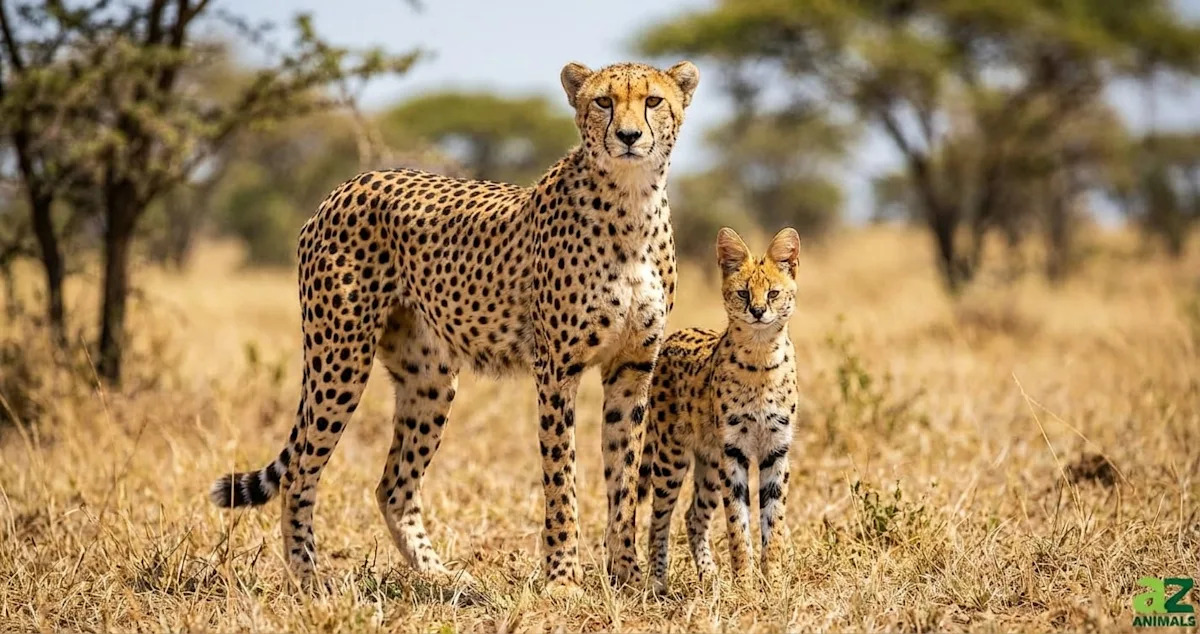
The post How to Tell a Cheetah Apart From a Serval in the Wild appeared first on A-Z Animals.
Quick Take
-
While difficult to tell apart at first glance, there are many physical and behavioral differences between cheetahs and servals.
-
Cheetahs primarily hunt during the day, while servals hunt during dusk.
-
Servals have both stripes and spots, while cheetahs only have spots.
-
There are distinct size differences between servals and cheetahs, with servals being much smaller and sneakier compared to the fast, elongated cheetah.
Cheetahs and servals are two spotted African wild cats with a lean, elegant build. But what are the most obvious differences between them? There are many qualities that make these cats seem related: both have similar coats and long-limbed gaits, and they dominate their habitats. However, despite these similarities, the two animals are built for very different lives. We’ve partnered with an expert source to help you tell them apart at a glance.
Alana Hengstebeck, a wildlife advocate with Zeno Group who has traveled extensively in Africa, has encountered both species in the field. “I remember one night while sleeping in a traditional African hut called a rondavel, hearing the distant chirping call of a cheetah somewhere out in the darkness,” she says. “On that same trip, I caught sight of what appeared to be a beautiful serval cat slipping through the tall grass at dusk.”
Even with that firsthand experience, she acknowledges being confused: “At first glance, they may look somewhat similar, but each is uniquely designed to fill its own role in the ecosystem.”
Using Hengstebeck’s advice, we’ve identified all of the differences between cheetahs and servals, including how you can easily tell them apart. Let’s dive into the details now!
Cheetahs and Servals: the Fastest Ways to Tell Them Apart
The faces of these wild cats are the easiest way to determine how different they truly are. For example, a cheetah has distinctive black tear lines running from the inner corners of its eyes and down toward its mouth. Those marks are hard to miss and belong exclusively to the cheetah; no other wild cat has them, and there is a reason for this. As Hengstebeck notes, those markings “are believed to act a bit like natural sunglasses, helping reduce glare from the sun and sharpening their focus during daytime hunts.”

There are many traits that make cheetahs and servals distinct from one another.
©GUDKOV ANDREY/Shutterstock.com
(GUDKOV ANDREY/Shutterstock.com)
According to the Smithsonian’s National Zoo, cheetahs are primarily crepuscular hunters that rely heavily on sight, scanning the landscape from elevated spots before making their move. Those distinct tear marks are understood to be a functional adaptation for hunting in bright conditions, which is why serval cats do not have markings like this.
When it comes to servals, their dramatically oversized ears are one of their most distinctive features. The Big Cat Rescue stated that these ears are set high on the head and function like radar dishes, allowing them to detect rodents moving underground or through dense cover. They hunt by sound alone, and these ears are the serval’s single most important hunting tool.

Servals are much smaller than cheetahs, with larger ears.
©Benny Marty/Shutterstock.com
(Benny Marty/Shutterstock.com)
Beyond these physical features that clearly distinguish the two cats, what other differences exist between cheetahs and servals? With Hengstebeck’s help, we break down these distinctions.
The Cheetah
It’s no secret that cheetahs are built for speed. Cheetahs can reach 60 to 70 miles per hour in short bursts, making them the fastest land animal on Earth. The mechanics behind that speed are intricate, largely attributed to the cheetah’s long limbs: at top velocity, a cheetah covers 23 feet in a single stride and completes four strides per second, powered by a flexible spine and vertical shoulder blades that are not attached to the collarbone. Their biology allows for a dramatically extended range of motion, something servals do not have.
Adult cheetahs typically weigh between 75 and 140 pounds, distributed across a frame that is aerodynamic from head to tail. Because of this, a cheetah is not built to overpower prey in a prolonged struggle or successfully defend a kill against stronger rivals. Plus, after a high-speed chase, a cheetah often needs time to recover before it can eat, making both its meal and its body more vulnerable to other predators.

Cheetahs run in a very distinctive way, hunting in open areas and grasslands.
©photosfromafrica/iStock via Getty Images
(photosfromafrica/iStock via Getty Images)
“Cheetahs are most often found in open savannas and grasslands across eastern and southern Africa, where wide landscapes allow them to spot prey from a distance and rely on their incredible acceleration,” Hengstebeck says. Dense bush or tall grass works against everything the cheetah’s body is designed to do, which is why they prefer such open areas, unlike servals, but more on that later.
Finally, a cheetah’s coat fits their streamlined profile, complete with spots that are solid and evenly distributed across its body. Cheetahs are also social compared to many wild cats, including the loner serval. While females are typically solitary, males often form small groups called coalitions, holding territory together for the rest of their lives.
At first glance, they may look somewhat similar, but each is uniquely designed to fill its own role in the ecosystem.
Alana Hengstebeck, a wildlife advocate with Zeno Group
The Serval
Servals exist in a very different state of mind compared to cheetahs, and there are many reasons for that. Rather than chasing prey across wide-open terrain, the serval locates and ambushes small animals concealed in tall grass, reeds, wetlands, and dense vegetation, relying on sound to accomplish its hunting goals.

Serval cats prefer cover to hunt, using their ears to hear prey accurately.
©PRESSLAB/Shutterstock.com
(PRESSLAB/Shutterstock.com)
Rather than chasing down a target like cheetahs do, servals take a giant leap and force their body weight down onto the victim, trapping it beneath front paws before delivering a lethal bite to the neck. Hengstebeck describes servals “crouching in the tall grass and leaping in the air as high as 6 feet to snatch low-flying birds in their claws”, which is a hunting style that is entirely dependent on the serval’s extraordinarily long limbs.
Servals are among the most successful hunters on the African savanna. According to the Animal Diversity Web at the University of Michigan, which cites a four-year field study on these cats, servals have a hunting success rate of approximately 48%, which is higher than any other member of the Felidae family. This is due to the factors listed above as well as the serval’s ability to hunt repeatedly throughout the day, targeting small animals rather than waiting for one large opportunity.
Key Differences Between Cheetahs and Servals
Size-wise, servals are considerably smaller than cheetahs, typically weighing between 20 and 40 pounds. Because of this diminutive size range, their diet is overwhelmingly rodent-based, with the remainder of their meals split between birds, insects, frogs, and lizards.

The claws of cheetahs differ from serval claws, given the distinct ways in which they both hunt and run.
©iStock.com/StuPorts
(iStock.com/StuPorts)
The serval’s coat, while superficially similar to a cheetah’s, is quite distinct on closer inspection. The serval’s coat often features bold spots that can merge into stripes along the neck and shoulders. Big Cat Rescue adds an important detail: servals are one of the few cat species with both spots and stripes. Additionally, servals that live near woodlands tend to develop smaller spots that help them blend in, especially since they prefer to hunt around dusk.
A final, more subtle difference between these two cats is that the cheetah has blunt, semi-retractable claws that function like cleats, providing traction and grip at high speed. Their paw prints even show visible claw tips, while the serval has fully retractable claws that stay sharp for its precise attacks on smaller prey.
Conservation: Protecting Both of These Cats
Both cheetahs and servals face real threats, though their situations are very different. Hengstebeck “Cheetah populations have declined significantly over the past century due to habitat loss, conflict with humans, and reduced prey availability,” Hengstebeck says.
According to CITES, fewer than 7,000 cheetahs remain in the wild, and the species is classified as Vulnerable on the IUCN Red List of Threatened Species. The IUCN’s own material noted that cheetahs now occupy only around 9% of their historical range, with the largest remaining strongholds concentrated in Namibia, Botswana, Kenya, and Tanzania.

Both cheetahs and servals are hunted for their fur, with poachers passing serval coats off as young cheetah pelts.
©Joanne_Charnwood/Shutterstock.com
(Joanne_Charnwood/Shutterstock.com)
In contrast to cheetahs, servals remain more widespread across sub-Saharan Africa and are listed as Least Concern overall on the IUCN Red List, though an isolated North African population, found only in Morocco and possibly Algeria, is classified as Critically Endangered, with fewer than 250 mature individuals remaining in completely isolated subpopulations. Servals are also hunted for their fur in parts of West Africa, where skins are sometimes sold as young leopard or cheetah pelts, which is a risk both of these cats share.
As Hengstebeck tells us, “Protecting these landscapes is key to ensuring that future generations will have the chance to experience these remarkable animals in the wild.” Whether you encounter one in its natural habitat or in a conservation or zoo setting, both cats deserve that chance. Understanding the differences between them is a small but meaningful part of appreciating what makes each one worth protecting for future generations and beyond.
The post How to Tell a Cheetah Apart From a Serval in the Wild appeared first on A-Z Animals.