The post A Guide to the Creatures of the Olympic Coast National Marine Sanctuary appeared first on A-Z Animals.
Quick Take
-
The Shipwreck Coast is home to 180 shipwrecks across a 135-mile stretch.
-
This same area is now home to the Olympic Coast National Marine Sanctuary (OCNMS).
-
As a designated Ocean Acidification Sentinel Site, the OCNMS conducts activities such as seafloor mapping and ocean monitoring.
-
A variety of marine animals live here including year-round residents and migrators.
Beneath the waters of the Olympic Coast National Marine Sanctuary (OCNMS) is a wonderland of marine life and seabirds — from towering kelp forests to adorable sea otters and the unmistakable tufted puffin. While the sanctuary wasn’t officially designated until 1994, its history began long before the OCNMS existed.
Below is a comprehensive guide to the incredible creatures that call the sanctuary home — as well as the dramatic beginnings of the Olympic Peninsula.

Located on the coastline of the Olympic Peninsula in Washington State, the Olympic Coast National Marine Sanctuary (OCNMS) is brimming with everything from colorful corals to dolphins, invertebrates, and more.
©lego 19861111/Shutterstock.com
(lego 19861111/Shutterstock.com)
The Storied Past of the Olympic Peninsula & OCNMS
For centuries, a 135-mile stretch of the Olympic Peninsula was known as the “Shipwreck Coast,” due to its treacherous waters and rugged terrain, which led to over 180 documented shipwrecks. However, the history of this region extends back even further than these wrecks. Indigenous peoples — including the Hoh, Makah, Quileute, and Quinault Indian Nation — were the original stewards of these waters for thousands of years.
Today, the OCNMS has rewritten its more recent dark history by working alongside the tribes to manage the sanctuary. Spanning 3,188 square miles of the Pacific Ocean along Washington state, the sanctuary now focuses on maintaining the safety and well-being of its resident animals and wildlife.
As a designated Ocean Acidification Sentinel Site, the OCNMS conducts activities such as seafloor mapping, marine wildlife and habitat surveys, recording underwater sounds, monitoring changing ocean conditions, and assessing how habitats and species may change with environmental conditions.
What was once merely a graveyard of ships is now a thriving protected area that has fostered the return of near-extinct species and created a welcoming “vacation home” for seasonal migrators.
Year-Round Residents
These species live in the OCNMS year-round, relying on its waters and habitats for daily survival.
-
Sea Otter (Enhydra lutris): As a “keystone species” of the OCNMS, sea otters help maintain the health of the surrounding kelp forests.
-
Harbor seal (Phoca vitulina): The most commonly seen marine mammal in the sanctuary, harbor seals often rest on “haul-out” sites, like rocky beaches or offshore reefs.
-
Harbor Porpoise (Phocoena phocoena): Fast-moving mammals, these animals are frequently spotted in nearshore waters, where they feed on small fish and squid.
-
Giant Pacific Octopus (Enteroctopus dofleini): These animals are known to hide out in rock crevices or in the wreckage of one of the sanctuary’s sunken ships.
-
Pacific Rockfish Species (Sebastes spp.): The OCNMS is home to over 30 rockfish species, including black, canary, yellowtail, and deacon. Recent monitoring has also shown a significant increase in some species.
-
Dungeness Crab (Metacarcinus magister): A benefit to both the local economy and tribal fishing, these crabs are often found around the area’s shipwrecks.
-
Bald Eagle (Haliaeetus leucocephalus): The most famous bird resident of the OCNMS, often seen sitting on sea stacks.

Once nearly extinct along the Washington coast, sea otters have rebounded in the Olympic Coast National Marine Sanctuary thanks to long-term conservation efforts.
©2009fotofriends/Shutterstock.com
(2009fotofriends/Shutterstock.com)
Frequent Visitors & Seasonal Regulars
While not permanent residents, these animals return to the OCNMS predictably each year, spending weeks or months feeding, resting, or raising their young.
-
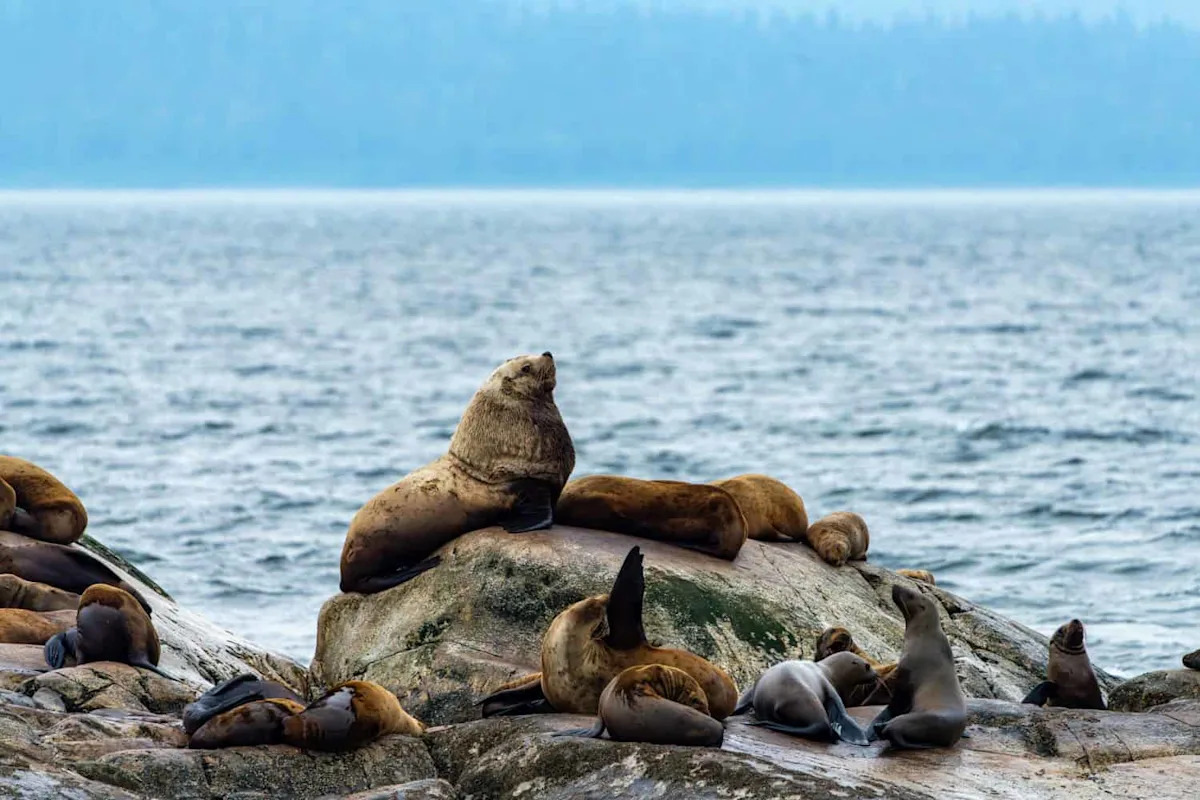
Steller Sea Lion (Eumetopias jubatus): These sea lions are often seen on rocky reefs and offshore islands throughout the sanctuary. They frequently return to rest and forage for fish.
-
California Sea Lion (Zalophus californianus): Migrating from California and Mexico, California Sea Lions appear in large groups along the Olympic Coast during fall and winter months.
-
Northern Fur Seal (Callorhinus ursinus): These seals often pass through the OCNMS while foraging. Rarely seen on land, they can be found in deep waters feeding on squid and smaller fish.
-
Killer Whale (Orcinus orca): Both the fish-eating Southern Residents and the mammal-hunting Bigg’s (Transient) Orcas patrol the OCNMS waters. Their visits often depend on the sanctuary’s salmon and seal populations.
-
Common Murre (Uria aalge): They often nest in dense colonies on rocky cliffs and sea stacks within and near the sanctuary. They return seasonally to breed and forage on small fish.
-
Rhinoceros Auklet (Cerorhinca monocerata): Recognizable by the horn-like plate on their bills during breeding season, rhinoceros auklets visit the OCNMS primarily in spring and summer. They nest in burrows on offshore islands and feed on fish and squid.
-
Pacific White-Sided Dolphin (Lagenorhynchus obliquidens): These energetic dolphins often travel in large, fast-moving pods. They are most commonly observed while foraging for schooling fish and squid.
The Great Migrators: Seasonal Visitors
These species pass through the OCNMS during long-distance migrations, using the Olympic Coast as a critical travel corridor or a temporary feeding stop on journeys spanning thousands of miles.
-
Gray Whale (Eschrichtius robustus): Known as “passage migrants,” these whales perform a 10,000-mile round trip between Mexico and the Arctic every year. You’re likely to see them at OCNMS during the spring as they head north or during the late fall and winter as they head south.
-
Humpback Whale (Megaptera novaeangliae): Humpback whales can be spotted at OCNMS during the summer and fall as they pass through to eat. They are often drawn to krill and small “forage fish” like herring.
-
Minke Whale (Balaenoptera acutorostrata): Known to visit during the summer feeding season, these are the smallest whales found in the OCNMS.
-
Blue Whale (Balaenoptera musculus): Rare but documented visitors to the OCNMS, these whales are drawn to the sanctuary’s dense krill patches.

Humpback whales visit the Olympic Coast National Marine Sanctuary during summer and fall to feed on krill and small schooling fish.
©Tomas Kotouc/Shutterstock.com
(Tomas Kotouc/Shutterstock.com)
-
Fin Whale (Balaenoptera physalus): These whales sometimes pass through the deeper offshore waters of the OCNMS while feeding and migrating.
-
Sooty Shearwater (Ardenna grisea): Migrating from New Zealand, these birds fly to the sanctuary in the summer in search of food. Thousands of these birds are known to cover the water during peak months.
-
Pacific Salmon (Oncorhynchus spp.): Some salmon species, like the Chinook (King) and Coho (Silver), are “anadromous,” so they migrate between salt and fresh water. They often move through the OCNMS during late summer and fall, returning from the open ocean to their home rivers in the Olympic National Park.
-
Tufted Puffin (Fratercula cirrhata): Puffins spend their winters in the North Pacific, returning to the OCNMS offshore islands from April through September.
-
Leatherback Sea Turtle (Dermochelys coriacea): A rare visitor, these turtles will sometimes visit the OCNMS to feed on jellyfish in the late summer.
Life in the Shadows: Invertebrates and the Seafloor
While the seals and whales of the OCNMS often steal the spotlight, the true foundation of the Olympic Coast is found on the seafloor.
-
Ochre Sea Star (Pisaster ochraceus): Sea stars prevent a single species from taking over by preying on mussels. This ensures a biodiverse OCNMS.
-
Giant Green Anemone (Anthopleura xanthogrammica): While these look like harmless underwater flowers, they use stinging cells to paralyze small fish and crabs.
-
Bubblegum Coral (Paragorgia arborea): Unlike traditional coral, these corals thrive in darkness. They grow extremely slowly and provide habitats for rockfish and shrimp.
-
Gooseneck Barnacles (Pollicipes polymerus): These are often found in thick clusters on rocks and shipwreckage.

Ochre sea stars are keystone predators in the Olympic Coast National Marine Sanctuary, helping maintain biodiversity by controlling mussel populations on rocky shorelines.
©Kelly vanDellen/Shutterstock.com
(Kelly vanDellen/Shutterstock.com)
A Sanctuary for the Future
The OCNMS is a testament to the power of ocean conservation. What was once a place of maritime peril has been transformed into a global “sentinel site,” where ancient traditions and modern science work hand in hand. As we continue to map its mysteries and monitor its changing waters, one thing is sure: the future of the Olympic Coast is no longer defined by the ships it lost, but by the incredible life it continues to protect.
The post A Guide to the Creatures of the Olympic Coast National Marine Sanctuary appeared first on A-Z Animals.