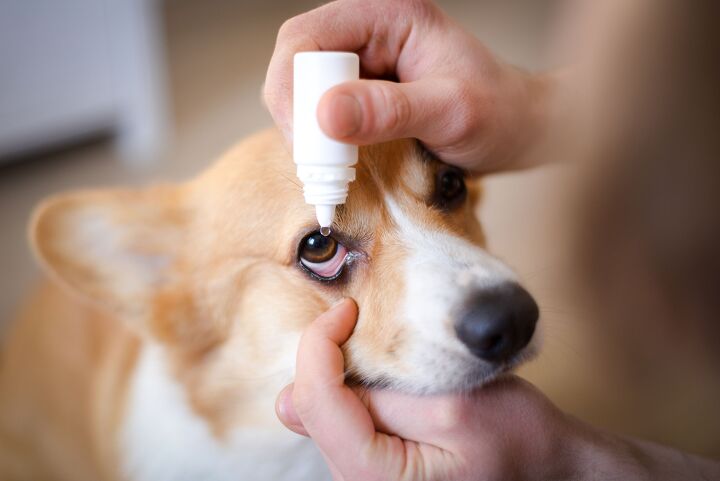
Recognizing your pet’s potential for dry eye is the first step in treating this affliction.

dry eye in dogs its a thing, photo credit Jus OI shutterstock com
My dog has recently had surgery to remove a cancerous growth from her eyelid. And after the stitches were removed, the pain meds finished, and the antibiotics done, my vet advised that I should plan to administer eye drops daily. Forever.
You see, a section of her eyelid had to be excised, and that compromised her ability to close her eye tightly. So, dry eye as a potential outcome made sense. But when I did a little digging about the causes and ramifications of dry eye, I didn’t realize that this affliction is not that uncommon.
What is Dry Eye?
Also known as Keratoconjunctivitis Sicca (KCS), dry eye is exactly what it sounds like: inadequate tear production that ultimately results in insufficient lubrication of the eye. And it’s that lubrication that offers the antibacterial properties needed to fight infection, along with the enzymes your pet needs to keep their eyes clear and free of debris/irritants.
Now, the lubrication fluid itself is comprised of three parts – lipid, aqueous and mucin glands. When dry eye is in play, the watery aqueous layer fails to produce tears, whereas the lipid and mucin glands are still functioning. Hence, you have a dog with mucous-filled eyes and a gunky discharge, but not the liquid needed to keep them clean.
Dogs at Risk?
Of course, we’re talking those flat-faced, brachycephalic breeds known for their shallow eye sockets and bulging eyes – think Pugs, Pekingese, Boxers (to name a few). But other breeds can also be prone to dry eye. You might be surprised to learn that Yorkshire Terriers, Cocker Spaniels, Cavalier King Charles Spaniels, Lhasa Apsos, and West Highland White Terriers are also inclined to experience dry eye. And their care and maintenance need to become a priority.
What Causes Dry Eye?
In addition to facial structure and breed propensity, dry eye can be caused by imperfect eyelids, such as entropion, where the eyelid turns in, ectropion, where it turns out, or, in the case of my dog, where surgery has compromised the eyelid integrity. But it can also be caused by illness, infections, systemic diseases (such as diabetes or hypothyroidism), as well as medications, including some of the oral nonsteroidal anti-inflammatory drugs (NSAIDs) we use to treat our pet’s pain relief.
Solutions to Dry Eye
Dry eye may be a temporary affliction or something more permanent, and either way, it needs to be treated, or else you risk your pet experiencing chronic infections and potential blindness. Once properly diagnosed by your vet, dry eye can be treated with oral medications to help boost tear production or artificial tear drops to emulate natural tear production.
Tips for Administering Eye Drops
According to the American Kennel Club (AKC), wrangling your pooch to administer the eye drops can be easy… if well planned. No surprise that starts with prepping in advance – meaning having the eyedrop bottles on hand and uncapped/open.
Next Steps?
-
Use one hand to hold the bottle/dropper as well as the back of your dog’s head. Cradle them close to your body to help keep your hand steady and your pet calm.
-
With the same hand, gently open your dog’s eyelid and use your other hand to gently pull down his lower eyelid.
-
As you pull down the lower eyelid, it will form a pocket. This is where you’re going to drop the fluid to allow it to spread across the eye surface.
-
When finished, pull out those high-value treats.