The post From Pets to Flocks: How Red-Crowned Amazon Parrots Took Over Los Angeles appeared first on A-Z Animals.
Quick Take
-
Red-crowned Amazons have formed thriving wild populations in Los Angeles, with 3,000 to 5,000 birds counted.
The parrots’ presence in California may help prevent extinction, as their native populations in Mexico continue to decline.
These birds coexist safely with other species and predators while feeding mainly on non-native fruits and seeds.
I am not a native of Southern California. Since moving here over a decade ago, I have heard stories of the infamous wild parrots that are heard long before they are seen. Yet, I have never seen any myself. That all changed recently when a flock of dozens of brightly green and red parrots settled in my neighborhood for a spell, before flying off for unknown adventures.
This got me thinking about what brought the parrots to Southern California. As it turns out, they may have gone from being pets to forming flocks, and in doing so, the red-crowned Amazon parrots took over Los Angeles.
How Red-Crowned Amazons Became Los Angeles Transplants
Los Angeles is home to transplants from not only around the country but around the world. These transplants are not only of people but also of wild animals. Case in point, the red-crowned Amazon. This parrot did not originate in Southern California, but over the last several decades, it has called Los Angeles and the surrounding cities home.
There are a variety of beliefs as to how the red-crowned Amazons made their way to California. One theory is that they flew from their native Mexico into Southern California. While this is possible, the distance the birds would have had to travel makes this theory less likely than others.

Multiple theories abound as to how the red-crowned Amazons found a home in Southern California.
©Yi Han Design/Shutterstock.com
(Yi Han Design/Shutterstock.com)
Other theories include:
-
Busch Gardens Fire: Busch Gardens theme park was home to red-crowned Amazons. In the 1970s, a fire broke out. It is believed the birds escaped and formed a colony in Pasadena, which still exists today.
-
Exotic Bird Store Release: Other stories involve one or more bird stores going out of business and releasing the birds into the wild.
-
Personal Pet Release: red-crowned Amazons are not easy keepers. Therefore, it is believed that when people could no longer care for them, they were released in Southern California.
The truth of the matter is that there may be no single reason why and how the birds made a home in Southern California. But for decades, these birds have called the region home, along with other exotic birds that chirp and squawk from the treetops throughout the southern region of the Golden State.
What Red-Crowned Amazons Look Like
Red-crowned Amazons are birds that will likely be heard before they are seen. The birds have a loud, distinctive squawk that cannot be mistaken for any other bird. Fortunately, when they finally settle into a tree, they calm down. So much so that there could be hundreds in a tree, with a passerby being completely unaware of their presence.

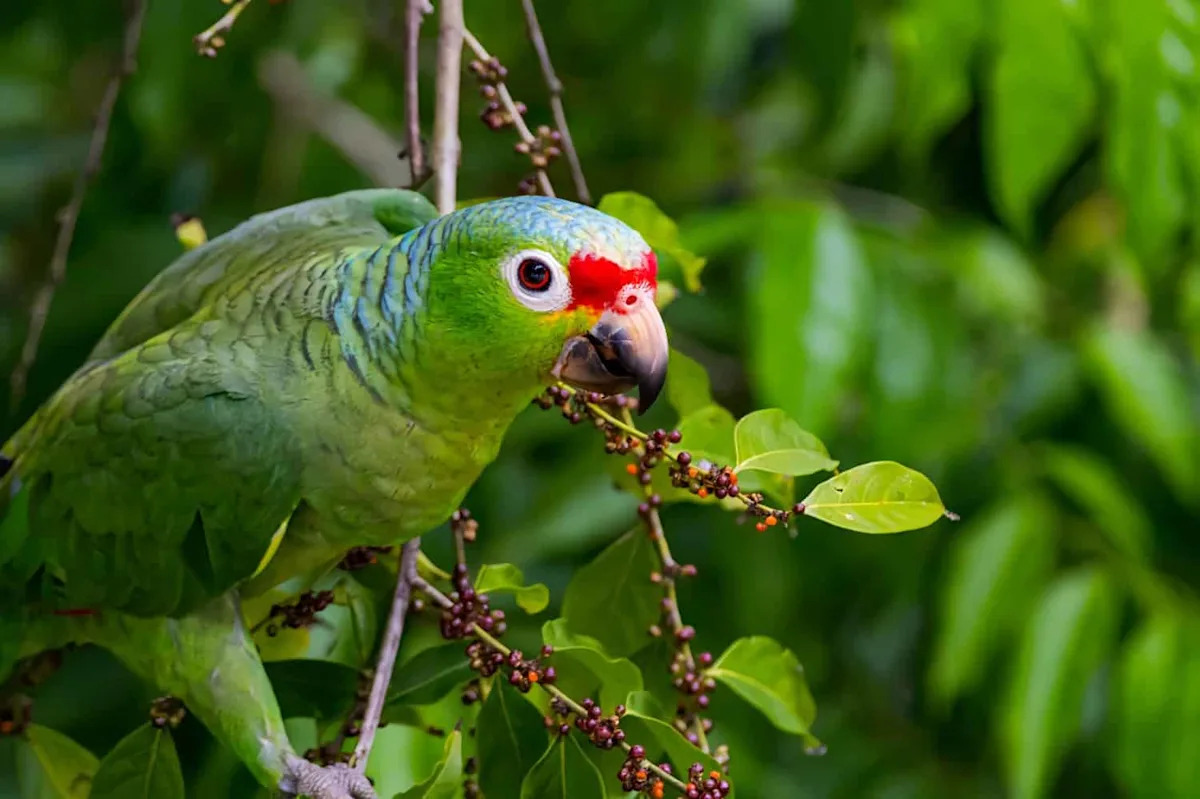
Red-crowned Amazons are brilliant shades of green and red.
©Jolanta Beinarovica/Shutterstock.com
(Jolanta Beinarovica/Shutterstock.com)
The best way to identify the red-crowned Amazons (outside of their vocalizations) is by their brilliant coloration. The parrots are a vivid bright green with a red crown and forehead. Some may also have red or blue feathers on the undersides of their wings.
At times, they may be mistaken for another similar-looking parrot, the Lilac-crowned Amazon. The main distinction between the two is the coloration on their heads and crowns. As the name suggests, the Lilac-crowned Amazon has light purple feathers instead of red.
Both of these parrots have a presence in Southern California, but has it come at the expense of other bird species?
Are Red-Crowned Amazons an Invasive Species?
When a species is not native to a region, it is generally considered invasive. However, in the case of the red-crowned Amazons, the birds are not invasive. Instead, the parrots are considered natives due to their home in and around the Rio Grande Valley.

Red-crowned Amazons are not an invasive species. They were deemed native in 2019 by the U.S. Fish and Wildlife Service.
©Nick Pecker/Shutterstock.com
(Nick Pecker/Shutterstock.com)
Red-crowned Amazons have been part of the Los Angeles and surrounding counties’ landscape for decades. But these birds have made Southern Texas their home for much longer than that. Red-crowned Amazons were initially spotted in the state in 1885. It is believed the birds crossed into Texas because of a drought in Mexico. However, it is likely the parrots were crossing the border long before that.
With its long history in Texas, the red-crowned Amazon was designated a native bird of Texas in 2019 by the U.S. Fish and Wildlife Service. Unfortunately, the red-crowned Amazon is not mentioned in the Migratory Bird Treaty Act of 2018. This means there are no federal protections for the parrots, despite how few remain in Mexico.
Red-Crowned Amazons Are Endangered
Given the size of the population in Los Angeles and the surrounding areas, it is hard to imagine that the red-crowned Amazon is an endangered species. In fact, in 2019, the U.S. Fish and Wildlife Service determined that the exotic bird did not “warrant protection under the Endangered Species Act.” But when the population of the birds’ native Mexico is examined, it is clear why the red-crowned Amazon is categorized as endangered.

Red-crowned Amazons are endangered in their native Mexico.
©Martin Mecnarowski/Shutterstock.com
(Martin Mecnarowski/Shutterstock.com)
The IUCN determined that the red-crowned Amazon should be categorized as endangered because its population continues to dwindle in Mexico. At last count, there were between 2,000 and 4,300 mature red-crowned Amazons in the country. As the population has decreased year after year, the United States’ population is far greater than Mexico’s, with 3,000 to 5,000 mature individuals in California alone.
The biggest threats to the red-crowned Amazons in Mexico include:
It is believed that in the last decade, the red-crowned Amazons have lost between 50% and 85% of their native habitat in Mexico. As urbanization continues to spread and land is cleared for agriculture, it is believed that the population may not be able to sustain itself. If this happens, the beautiful parrots that were once widespread in Mexico may disappear from their country of origin.
Impact of Red-Crowned Amazons on Other Bird Populations
As more red-crowned Amazons establish themselves in California, this is seen as a positive development for the species. The birds, which very well may go extinct in Mexico, could help save the species with their permanent homes in California and other parts of the country.

Red-crowned Amazons have not had a negative impact on other bird populations in Southern California.
©Eng Kwee/Shutterstock.com
(Eng Kwee/Shutterstock.com)
However, this raises the question of how red-crowned Amazons affect bird species in Southern California. As it turns out, no negative impacts on other bird species have been determined to date. Much of this has to do with what the red-crowned Amazons eat.
Unlike other birds in California, red-crowned Amazons prefer a diet of seeds, fruits, and flowers from non-native trees. Therefore, things like guava, fruits from African Oil palm trees, figs, and more are what the parrots target. They have shown no signs of forcing native birds out of their nesting sites, nor are they aggressive toward other birds. The Red-crowned Amazons have found their own little niche in Southern California that may just save the species.
Red-Crowned Amazons Have Predators
Despite not being aggressive toward other bird species, Red-crowned Amazons do have predators in Southern California. While they may be a bit different from the predators in Mexico, these animals can and do bring harm to the brightly-colored birds. Consequently, conservationists are concerned about the future of red-crowned Amazons as they become more comfortable in mostly urban settings.

Red-crowned Amazons have a number of predators.
©Tracy Starr/Shutterstock.com
(Tracy Starr/Shutterstock.com)
The predators that target Red-crowned Amazons and their eggs include:
Just because red-crowned Amazons have found a home in Southern California does not mean they are immune to harm. However, with the size of their flocks and the loud sounds they produce, it may make some predators think twice before coming in contact with them.
Are There Other Wild Exotic Birds in Southern California?
As brilliantly colored as the red-crowned Amazons are, they are not the only impressive-looking exotic birds to be found in Southern California. Thanks to the mild climate, many birds that are native to other regions have found a comfortable habitat in the Golden State.
Some other exotic birds to be found in Southern California include:
-
Yellow-chevroned parakeet

Blue-crowned parakeets are another species of exotic bird that call Los Angeles home.
©Foto 4440/Shutterstock.com
(Foto 4440/Shutterstock.com)
In total, there are thousands of exotic and tropical birds that call Southern California home. They have become a part of the landscape, leading many to believe they have always been there. The unfortunate truth is that had these birds not been released, accidentally or not, their populations may be in a more dire state than they are now.
While it is never encouraged to set a pet free because it can no longer be cared for, in this case, it may be what keeps the red-crowned Amazon from going extinct, as so many other bird species are doing daily.
The post From Pets to Flocks: How Red-Crowned Amazon Parrots Took Over Los Angeles appeared first on A-Z Animals.