The post The Surprising Role Cities Now Play in Bird Migration appeared first on A-Z Animals.
Quick Take
-
A Colorado State University study using weather radar found that nearly half of bird migration stopover hotspots in the U.S. are located in metropolitan areas.
-
Urban water sources, such as ponds and fountains, supply hydration and support insects that birds eat.
-
Slightly warmer city temperatures extend feeding time for migrants.
-
Cities also pose risks, including light pollution and window collisions, but bird-friendly planning can reduce these dangers.
Migrating birds travel thousands of miles each year between breeding and wintering grounds. Along the way, they must pause to rest and rebuild energy reserves. A recent study from Colorado State University suggests that nearly half of these stopovers now occur in urban areas. Researchers found that in western North America, birds are more likely to stop in metropolitan areas, where water and vegetation can be limited.
Urban environments may appear dominated by buildings and roads, yet they also contain parks, trees, and artificial water sources. These resources can provide food, shelter, and hydration for birds arriving after long flights. Radar observations from the study revealed that nearly half of migration stopover hotspots are located in metropolitan areas during the spring and fall migration seasons. These findings indicate that cities have become an important part of the modern migration landscape. While urban environments create new hazards, they also supply resources that many birds now rely on during their journeys.
Parks and Green Spaces Provide Resting Habitat
Large parks within cities can function as resting areas for migrating birds. Trees and shrubs offer cover where birds can hide from predators and recover from long flights. Lawns and wooded sections also support insects, berries, and seeds that supply quick energy.

Smith Lake is filled with Canadian Geese in the wintertime at Washington Park in Denver, Colorado.
©Susan Hodgson/Shutterstock.com
(Susan Hodgson/Shutterstock.com)
Parks such as Denver’s City Park and Washington Park contain mature trees and patches of dense vegetation. These areas allow birds to perch, forage, and rest before continuing their migration. The concentration of resources within a limited space allows birds to replenish energy quickly.
Urban vegetation also creates microhabitats that resemble natural environments. A mix of trees, shrubs, and grass attracts many insect species. Migrating birds take advantage of this food supply. Because birds often arrive exhausted after overnight flights, easy access to food can determine whether they recover successfully before resuming travel.
Urban Water Sources Support Traveling Birds
Fresh water is another key resource for migrating birds. In dry regions, natural wetlands and streams may be scattered across large areas. Cities often gather water into fountains, ponds, irrigation systems, and small reservoirs. These sources allow birds to drink and bathe after long flights. Along Colorado’s Front Range, urban ponds and waterways provide dependable water during migration seasons. Retention basins and park lakes often support aquatic insects as well. Birds feed on these insects while resting nearby in vegetation.
Artificial water sources can also remain available longer than natural pools. Irrigation and stormwater management keep water levels steady during dry periods. As a result, migrants may concentrate in urban areas where water is easier to find. Access to water improves survival during long migrations by helping birds maintain body condition.

Golf courses, like this one in Denver, provide a reliable source of water for migratory birds.
©Rebecca Dickerson/Shutterstock.com
(Rebecca Dickerson/Shutterstock.com)
Warmer City Temperatures Extend Activity
Cities often remain slightly warmer than the surrounding countryside due to what scientists call the urban heat island effect. Buildings, pavement, and other structures store heat during the day and release it slowly at night. This keeps nighttime temperatures higher than those in nearby rural areas.
For migrating birds, warmer conditions can extend feeding time. Insects remain active longer in mild evening temperatures. Birds can therefore gather more food before resting overnight. These conditions may help birds recover faster from long flights.
Milder temperatures can also reduce cold stress during early spring or late autumn migration. Birds resting in city parks may experience fewer freezing nights than those stopping in open countryside. Although temperature differences are small, they can influence insect activity and plant growth, which affects food availability for migrating birds. Here are some examples of species that migrate through Denver each year:
Nashville Warbler
The Nashville warbler is a small migratory songbird that appears in the Denver area during spring and fall migration. Adults show yellow underparts, olive upperparts, and a pale eye ring. These birds breed in northern forests and spend winters in Mexico and Central America. During migration, they stop in wooded parks and river corridors, searching leaves and branches for insects such as caterpillars and flies before continuing their journey north or south.

The Nashville warbler is an example of a migratory bird that benefits from urban parks on its flight path.
©Paul Reeves Photography/Shutterstock.com
(Paul Reeves Photography/Shutterstock.com)
American White Pelican
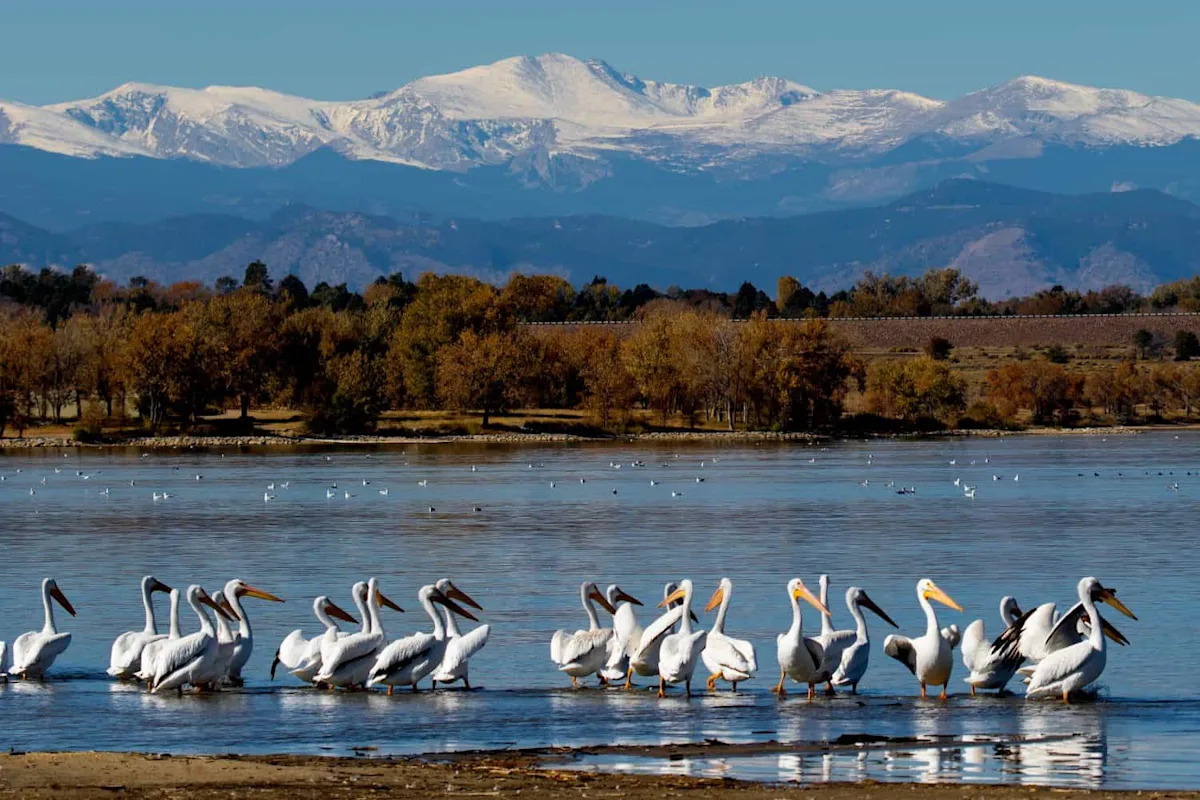
American white pelicans migrate through Colorado during spring and fall as they travel between wintering grounds along the Gulf Coast and breeding colonies in the northern Great Plains and Canada. Large flocks sometimes stop at reservoirs and lakes near Denver, including Cherry Creek Reservoir and Barr Lake, where they rest and feed on fish.

Large flocks of pelicans sometimes stop over in Denver during spring and fall migration.
©Bonnie Taylor Barry/Shutterstock.com
(Bonnie Taylor Barry/Shutterstock.com)
Sandhill Crane
Sandhill cranes migrate through Colorado along the Central Flyway while traveling between wintering areas in the southern United States and breeding grounds in northern regions. Although the largest concentrations occur on the eastern plains and in the San Luis Valley, cranes occasionally pass near the Denver area during migration, flying overhead in large, V-shaped flocks.

Sandhill cranes migrate in large numbers through Colorado.
©Barbara Smits/Shutterstock.com
(Barbara Smits/Shutterstock.com)
Light Pollution Confuses Night Migrants
Many bird species migrate at night to avoid predators and cooler daytime temperatures. They navigate by using stars, magnetic fields, and landscape features. Artificial lighting in cities can interfere with this navigation system. Bright lights attract migrating birds and can cause them to circle buildings repeatedly, wasting energy and increasing exhaustion. Birds may remain disoriented until dawn, when they eventually descend to rest.

This image, taken from the west of Denver, shows the intensity of light pollution from the city.
©Mike Berenson/Shutterstock.com
(Mike Berenson/Shutterstock.com)
Reducing unnecessary nighttime lighting can help protect migrating birds. For example, Denver and other Colorado cities have implemented “Lights Out” initiatives that encourage turning off decorative building lights during peak migration periods. Lower light levels allow birds to navigate more accurately and continue their journey without becoming trapped in illuminated areas.
Window Collisions in Urban Areas
Glass windows present another danger for migrating birds. Birds often see reflections of trees or sky on building surfaces and attempt to fly through them. The result is a collision that can injure or kill the bird.
Urban areas with large glass buildings experience many of these collisions during migration seasons. Birds that stop in city parks may later encounter reflective surfaces as they move between feeding and resting areas.
Various methods can reduce this problem. Window films, patterns, or screens make glass visible to birds and reduce strikes. In Denver and other cities, building owners and city planners are increasingly adopting these solutions as part of bird-safe building initiatives.
Uneven Distribution of Green Space
Bird activity in cities often varies by neighborhood. Areas with more trees, gardens, and parks support greater insect diversity and plant cover. Migrating birds, therefore, concentrate in neighborhoods with abundant vegetation. Researchers describe this pattern as the “luxury effect.” Wealthier neighborhoods often contain mature trees and well-maintained landscapes. These conditions attract insects and provide more habitat for birds.

Wealthier urban and suburban neighborhoods often have more trees and green spaces for migrating birds.
©Arina P Habich/Shutterstock.com
(Arina P Habich/Shutterstock.com)
Cities can reduce this imbalance by planting trees and creating green spaces across all neighborhoods. For example, Denver has recently updated its Urban Forest Strategic Plan and met its 2025 tree planting goals, reflecting active efforts to expand vegetation equitably. Expanding vegetation not only benefits birds but also improves shade, air quality, and recreation opportunities for residents.
What Individuals Can Do To Help Migrating Birds
People living in apartments or houses can help migrating birds in several simple ways. Turning off unnecessary outdoor lights at night during spring and fall migration reduces light pollution that can confuse birds flying overhead.
Adding window decals, patterned film, or screens to large windows and glass doors helps birds see the glass and avoid collisions. Providing fresh water in a shallow birdbath on a balcony, patio, or yard can help birds rehydrate after long flights.
Planting native flowers, shrubs, or small trees attracts insects and produces berries that serve as food for migrating birds. Keeping cats indoors or supervised outdoors also protects birds, since free-roaming cats kill large numbers each year. Avoiding pesticides helps preserve the insects many migrating birds depend on for food.
Urban Areas in Modern Migration Routes
Migration patterns continue to change as landscapes evolve. Recent studies confirm that climate change and habitat loss are altering migration timing and routes, and there is growing evidence that birds are relying more on urban resources. Cities, therefore, play a growing role in supporting migratory species.
Urban parks, waterways, and tree-lined streets create pockets of habitat that birds can use during long journeys. Although cities present hazards, they also provide food, shelter, and water that migrants need.
Recognizing the ecological role of cities allows planners and residents to improve conditions for birds. Small changes in lighting, vegetation, and building design can reduce risks and strengthen urban stopover habitats.
The post The Surprising Role Cities Now Play in Bird Migration appeared first on A-Z Animals.