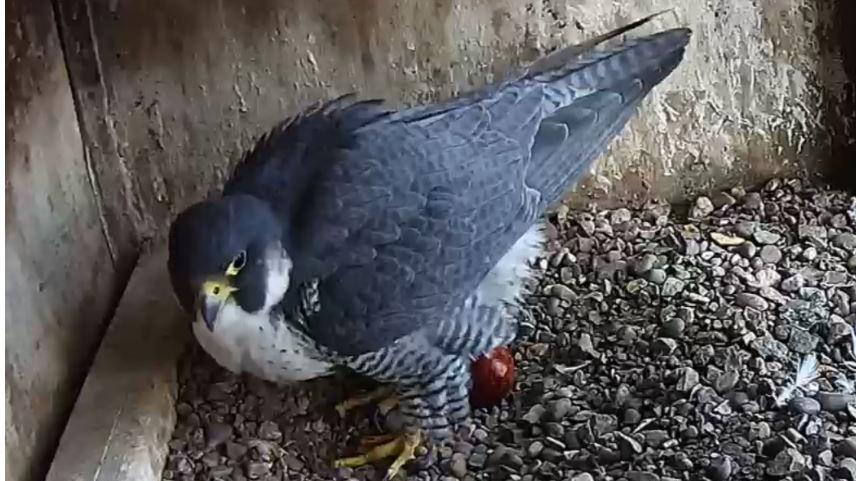
A cathedral’s resident peregrine falcon chose Mothering Sunday to lay her first egg of the year.
Since then, the breeding pair living on the spire of Leicester Cathedral have added a second to the clutch, webcams operated by Leicester Peregrine Project have shown.
The expectant mother will hopefully hatch and then raise a new family over the summer months, said project lead Jim Graham.
“When it comes to this time of year, it does tend to get a little bit tense to see when the first egg is going to be laid,” he said.
Graham, president of the Leicestershire and Rutland Ornithological Society, said Leicester had seen breeding peregrines for more than a decade, and the installation of platforms and webcams at the cathedral in 2016 had helped support the birds of prey.
He said: “The birds immediately took to it and have been breeding on that site since 2017.
“But there’s been a lot of heartache along the way with various birds dying either through intruder activity from other peregrines or bird flu when we lost five birds in one year.
“There’s always been a story to tell. Sometimes good, sometimes not so good.”

The falcon has begun raising a family on the spire of Leicester Cathedral [Leicester Peregrine Project]
Peregrine falcons are the world’s fastest animals, able to reach speeds of up to 200mph (322km/h) when diving down on to prey.
They nest in high places such as urban towers and rural cliffs and have excellent binocular vision, allowing them to see prey from as far as 1.8 miles (3km) away.
Ringing has shown that previous Leicester Cathedral hatchlings have gone on to other locations in Leicestershire, with one spotted in Wigston earlier in March.
Graham said while populations in habitats like moorlands and mountains in the UK had been declining, urban peregrines were on the rise with pairs in Hinckley, Market Harborough and hopefully soon in Melton Mowbray and Loughborough.
He said: “For urban peregrines there’s very little persecution, it’s much safer and there’s plenty of nesting sites.
“And more importantly, probably there’s plenty of food in the shape of feral pigeons. They are becoming much more successful.”
For people wanting to see Leicester’s peregrines offline, the society is hosting watch days on 28 March, 9 April and 14 April.
Correction 20 March 2026: The article has been updated to remove the incorrect line that stated the mother was part of a brood hatched on the spire in 2024.
Listen to BBC Radio Leicester on Sounds and follow BBC Leicester on Facebook, on X, or on Instagram. Send your story ideas to eastmidsnews@bbc.co.uk or via WhatsApp on 0808 100 2210.
Related internet links