The post What It Really Means When Your Cat Sleeps on You appeared first on A-Z Animals.
Quick Take
-
Cats sleep on you for warmth, using your body heat to stay comfortable and conserve energy.
-
This behavior shows trust, as cats only rest deeply where they feel safe and secure.
-
Shared scent strengthens bonding, marking you as part of their social group.
-
Sleeping on you reinforces emotional attachment, making you their preferred source of comfort.
When your cat curls up on your chest, legs, or pillow, it can feel like a tiny, purring mystery with fur. Many cat owners assume their pets are just looking for a soft spot, but there is much more to it. Your cat’s choice to sleep on you combines instinct, emotion, and habit, revealing much about how it sees you—and what you mean to it.
A Warm, Purring Space Heater
One of the simplest reasons your cat sleeps on you is also one of the most powerful: warmth. Cats naturally seek out warm, cozy spots because their bodies are built to conserve heat. Studies show that domestic cats are most comfortable in temperatures warmer than most people prefer, so they gravitate toward sunny windowsills, radiators, laptops, and—most of all—your body heat.
When you’re lying still, your chest, lap, or feet become a steady source of gentle warmth that helps your cat maintain a comfortable body temperature with very little effort. On a chilly night, your blanket traps that heat, turning you into a living heating pad. This is especially true for smaller or short-haired cats, which can lose warmth more quickly and may rely on warm surfaces to stay comfortable. Your breathing and heartbeat provide a rhythmic, soothing background—like a built-in white noise machine—that signals to your cat it’s safe to relax deeply.

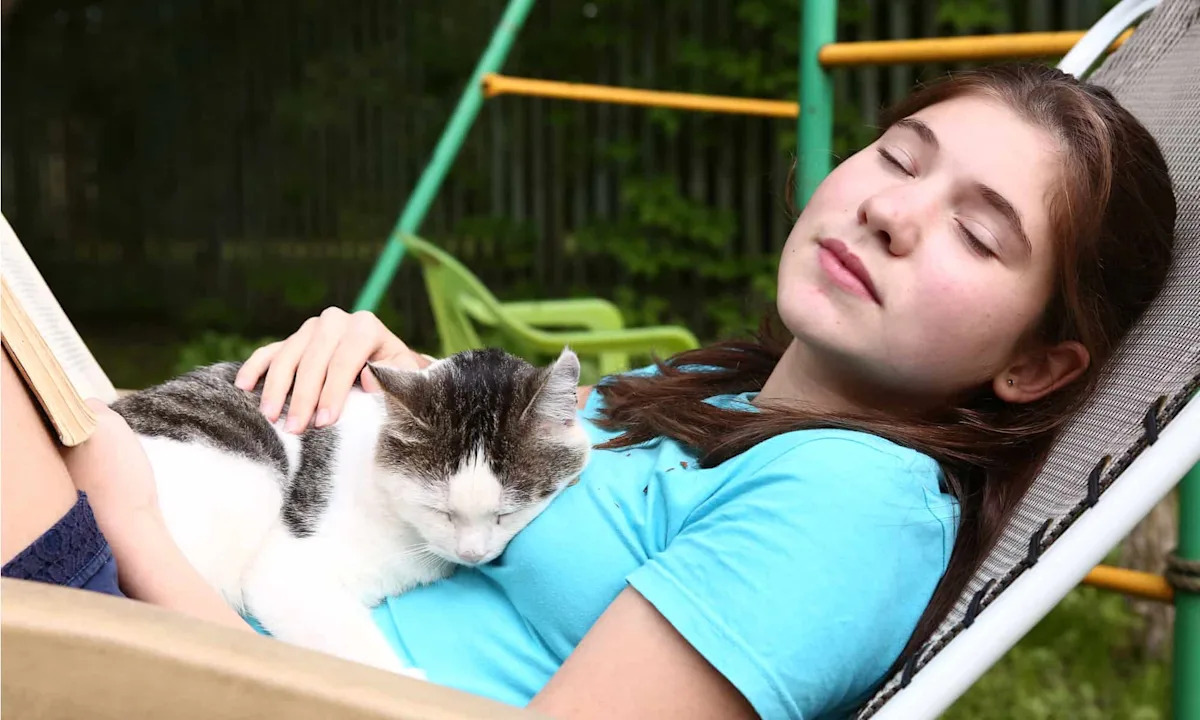
Kitties like snuggling because it keeps them toasty warm.
©zhukovvvlad/Shutterstock.com
(zhukovvvlad/Shutterstock.com)
Trust: Sleeping While Vulnerable
Sleep is one of the most vulnerable states for any animal, and cats are no exception. In the wild, cats must balance their role as predators with the reality that they can also become prey, so even resting cats stay partially alert and choose safe places to nap. When your cat chooses to sleep directly on you, they are doing something surprisingly bold: they are letting their guard down in your presence.

Sleeping on a person helps a cat feel protected.
©Magui RF/Shutterstock.com
(Magui RF/Shutterstock.com)
Some behavior researchers and veterinarians explain that cats form attachment bonds with people in a way similar to how children bond with caregivers. Those who sleep close to their humans are displaying trust and emotional comfort, similar to how bonded cats rest near or against each other. However, it should be noted that this is not a universal consensus, and a 2026 study in Hungary showed no sign of attachment to the owner in the cat groups studied, even among friendly cats.
Nevertheless, if your cat chooses to sleep on your chest, it is placing itself right over your heart and lungs, where there is steady movement and sound while you sleep. This behavior mirrors kittenhood, when young cats pile up close to their mother to hear her breathing and feel the rise and fall of her sides.
Security: Using You as a Safe Base
Beyond simple trust, there is growing scientific evidence that many cats see their humans as a secure base—a kind of emotional anchor they rely on when they feel unsure. This secure‑base effect helps explain why a cat may choose to sleep on you rather than just near you. By resting on your body, your cat positions itself right next to its “safety zone” at the very moment when it is least able to defend itself. If your cat tends to nap on you more during storms, after a stressful vet visit, or when new people are in the house, they may be leaning even harder on that sense of security you provide.
Scent: Blending Smells Into One “Family”
To your cat, the world is written in scent. Cats have tens of millions of scent receptors in their noses—far more than humans—and they rely on these chemical messages to understand who belongs in their social group, which spaces are safe, and where they should return. When your cat rubs their cheeks against your hand or furniture, they are leaving behind pheromones that quietly say, “This is mine; this is familiar.”

Cats like to blend their scent with yours as a way of saying, “We are family.”
©Kulkova Daria/Shutterstock.com
(Kulkova Daria/Shutterstock.com)
Sleeping on you takes that scent blending to another level. As your cat lies on your chest, legs, or pillow, its fur picks up your scent, and your skin and clothes pick up its scent. This shared scent makes you part of your cat’s “scent family”—the inner circle that feels safe and comforting. Many owners notice their cats also love to sleep on worn T-shirts or in laundry baskets because their scent has become a sort of portable security blanket. When your cat settles on you at night, it is renewing this shared scent map, reinforcing the idea that you and your home are its territory—and that you belong together.
Bonding: Turning Cuddles Into Relationship Glue
It is easy to joke that cats are aloof, but research suggests that the stereotype is outdated. Multiple studies now show that domestic cats can form attachment bonds with their humans that look a lot like the bonds children form with caregivers. In attachment tests, cats that are securely bonded use their person as a base from which to explore; they are calmer when their human is present and show mild but manageable distress when that person leaves.
When your cat sleeps on you, that quiet physical closeness becomes part of how this bond stays strong. Some behaviorists compare it to the way close human relationships are reinforced by small, everyday moments—like sitting side by side on the couch, hugging, or holding hands. For cats, sharing sleep is one of those key bonding experiences, similar to mutual grooming or resting in a pile with a trusted companion. Over time, these nightly or daily naps on your lap can deepen your cat’s sense of connection to you, which may explain why some cats clearly choose one favorite person to sleep on more than anyone else does.
Why Certain Spots on You Matter
If you pay attention to where your cat chooses to sleep on your body, you may notice patterns that match their personality and needs. Many cats prefer a person’s chest because it offers warmth, a steady heartbeat, and a slightly elevated view of the room—a nice balance of comfort and awareness. Others choose the space behind your knees or along your side because those areas are stable and less likely to move suddenly.

Your cat loves sleeping near your head because it is warm and your hair smells like you.
©Nataliabiruk/Shutterstock.com
(Nataliabiruk/Shutterstock.com)
Some cats like to sleep on or near your head, especially on your pillow. Behavior experts suggest that your head is one of the warmest parts of your body and also one of the most strongly scented, thanks to your hair and scalp. Sleeping near your face keeps your smell front and center while giving your cat a high, soft perch. If your cat regularly curls up over your feet or ankles, it may be because those spots let it stay close without getting jostled every time you roll over. The specific location may change over time, but in each case your cat is balancing warmth, safety, and the opportunity to monitor its surroundings.
Nighttime Routine: Why It Happens at Bedtime
Many people notice that their cats are most determined to sleep on them at night. Part of this is practical: when you lie down and stay relatively still, you become the perfect landing pad. But cats are also naturally crepuscular, meaning they are most active at dawn and dusk. By the time you are ready to sleep, your cat may be ready for a long, deep stretch of rest after their evening zoomies.
Because nighttime is quiet and predictable, it often becomes a kind of ritual. Your cat may learn that when you pull back the covers and settle in, that is their cue to pick their favorite spot on you and relax. Over weeks and months, this routine can become deeply ingrained, almost like an unspoken agreement that you will share the bed. Some owners find that their cats even get impatient if they stay up late, meowing or pacing as if to say, “It’s time for our bedtime together.” This regular co‑sleeping is another way your cat builds a stable, secure pattern around your presence.
Comfort for You, Comfort for Them
While most of the focus is on what your cat gets out of sleeping on you, the habit can bring real emotional comfort for humans too. A soft, warm cat purring on your chest can help you feel calmer, less lonely, and more grounded after a stressful day. Many people describe these moments as one of the highlights of living with a cat.

If your cat is bothering your sleep, you can set up a cat bed nearby or make them lay next to you instead of on top of you.
At the same time, there are some trade‑offs. Research on sleep quality suggests that sharing a bed with pets can lead to more disturbances at night, especially if the animal moves around, meows, or wakes earlier than you do. Some people may notice more restless sleep or leg twitches when pets share the bed. If you love the bonding but struggle with sleep, you can try setting up a cozy cat bed right next to you, so your cat still gets the warmth and security of being close without staying directly on top of you all night.
When Your Cat Suddenly Starts—or Stops—Sleeping on You
Changes in your cat’s sleeping habits can sometimes offer clues about their health or stress level. If your cat suddenly starts sleeping on you much more than usual, it could simply mean they feel especially bonded or chilly, especially in winter. But it might also mean they are feeling insecure because of a new pet, a move, or changes in your schedule, so they seek extra reassurance from your presence.
Conversely, if a cat that has always loved sleeping on you suddenly stops, it is worth paying attention. It might be too warm, slightly uncomfortable with a new blanket or mattress, or simply exploring new favorite spots. However, a sudden shift combined with other signs—like hiding, reduced appetite, or less grooming—can signal that your cat is not feeling well. In those cases, a check‑up with your veterinarian can help rule out pain, illness, or age‑related issues that make certain positions less comfortable.
Respecting Boundaries While Enjoying Cuddles

Cats are like butterflies: it’s best to wait for them to come to you rather than chasing them.
©Victoria Antre/Shutterstock.com
(Victoria Antre/Shutterstock.com)
Even if your cat often sleeps on you, their preferences can change from moment to moment. Sometimes they may stretch across your chest; other times they prefer your lap or the space at your side. Respecting these shifting boundaries is part of building a strong relationship. Forcing a cat to stay in one spot, or grabbing it suddenly when it is trying to settle, can break that sense of safety it associates with you.
You can gently encourage co‑sleeping by making yourself an inviting place to rest: wear soft, comfortable clothes, use a blanket your cat likes, and pat the spot beside you when you sit or lie down. Reward calm, relaxed behavior with quiet praise or a slow blink, which many cats interpret as a friendly, non‑threatening signal. Over time, your cat will associate your body and your presence with consistently kind, gentle experiences—making it even more likely it will choose you as its favorite bed.
What It Really Means for Your Relationship
When your cat sleeps on you, they are not just treating you like a cushion. They are choosing you as a source of warmth, security, and familiarity, blending your scents and weaving daily rituals that strengthen your bond. Modern research on feline attachment shows that many cats rely on their humans for emotional safety in much the same way that young children and dogs do with their caregivers. Your cat may not use words, but by curling up on your chest or legs and drifting off, it is delivering a clear message: “With you, I feel safe enough to sleep.”
If you are comfortable sharing your space, embracing this habit can turn ordinary evenings into small but meaningful moments of connection. Each time your cat chooses you as its favorite sleeping spot, it is quietly confirming that you are not just the person who fills the food bowl—you are its trusted friend, its secure base, and its favorite place to rest.
The post What It Really Means When Your Cat Sleeps on You appeared first on A-Z Animals.