For most people, animal intelligence evokes images of dogs winning competitions or lab rats running through mazes. With a handful of notable exceptions, the idea that wild animals spend their time thinking, planning, and strategizing doesn’t typically come to mind. It might even seem ludicrous. Instead, they’re perceived as instinct-driven; ruled by hunger and mating rituals rather than any meaningful introspection.
But that assumption continues to crumble under the weight of real science every single year. All across the animal kingdom, researchers are unearthing behaviors that challenge not only what they thought animals were capable of, but also their entire definition of intelligence as a whole. Believe it or not, these aren’t just flukes or party tricks, either. They’re signs of complex cognition, memory, planning, emotional awareness, and even cultural learning. In some cases, animals — separated from humans by literally hundreds of millions of years — have independently evolved mental abilities that seem eerily similar to our own.
As scientists observe wildlife and learn more about them each year, one thing becomes crystal clear: Intelligence isn’t just a single thing, and it certainly doesn’t belong to just one species. It manifests in different forms, shaped by different needs, in brains that look nothing like a human’s. And every new discovery shifts what people assume about the world around them, expanding what it means to show empathy, and helping them realize there are active minds all around.
Read more: 12 Types Of Bears, Ranked By Danger Level
Ravens

Raven perched on a branch – Gerald Corsi /Getty Images
Thanks to mythology — and perhaps Edgar Allan Poe — most people think of ravens as somewhat eerie and arguably clever, but not necessarily intelligent in the strictest sense. Scavengers by nature, they’re often viewed as croaking symbols of death in folklore or brooding props in Halloween decor. Mysterious? Sure. Mischief-makers? Definitely. But critical thinkers? Not really.
In fact, scientific research has shown that ravens as young as four months have demonstrated cognitive abilities on par with great apes. In fact, in one study, a raven famously saved a token to exchange for food after a 17-hour delay, which is something most animals (and some toddlers) can’t pull off. Not only did this study demonstrate that ravens can plan for the future, but they can also delay gratification for better rewards later. Juvenile ravens old have shown advanced social and physical reasoning. And adults? Scientists have observed them monitoring social hierarchies, remembering individual faces, and using referential gestures such as pointing to communicate with other ravens.
What that all adds up to is a bird that’s capable of formulating mental models, then acting on them. That means ravens aren’t just reacting to their environment. They’re actively observing it and using that information strategically and over time. And the fact that a bird separated from humans by over 320 million years of evolution can display this level of abstract thinking suggests intelligence is far from just a mammal thing. It’s a product of environment, necessity, and adaptability.
Bears

Bear leaning against green car – Rusm/Getty Images
If you think bears are strong-but-simple creatures, you’re not alone. Many see them as solitary beasts driven almost entirely by hunger, not intellect. The media certainly doesn’t help, often portraying them as either dangerous predators or nomadic foodies. Sure, bears can break into a cabin or open a cooler, but that’s just sheer tenacity, right? Surely it’s less about bears being intelligent and more about them being opportunistic.
On the contrary, research is painting a much more impressive picture — one where bears demonstrate a stunning range of cognitive abilities. In addition to remembering the location of food sources years later, relocated bears can navigate hundreds of miles through unfamiliar territory to return home. Bears have even shown that they can count objects on a screen in controlled experiments. Similar experiments have seen bears solve mechanical puzzles using trial-and-error learning. In the wild, Alaska brown bears pass down proprietary salmon fishing skills to their young through complex teaching techniques and communication. It’s really no surprise, then, that zookeepers often rank bears above dogs in intelligence, due to their adaptability, problem-solving skills, and curiosity.
What makes a bear’s intelligence remarkable is that they’re generally solitary animals. Unlike what you might expect from primates or dolphins, bear smarts don’t come from social structures. Think about how much humans learn from each other, for example. But for the 8 species of bears around the world, much of what they learn comes from their environments, since foraging across vast, seasonal territories requires memory, innovation, and flexibility. Challenging the assumption that intelligence must always be social, bears make it abundantly clear that brains can grow sharp in silence, forged not so much in conversation, but in survival.
Raccoons

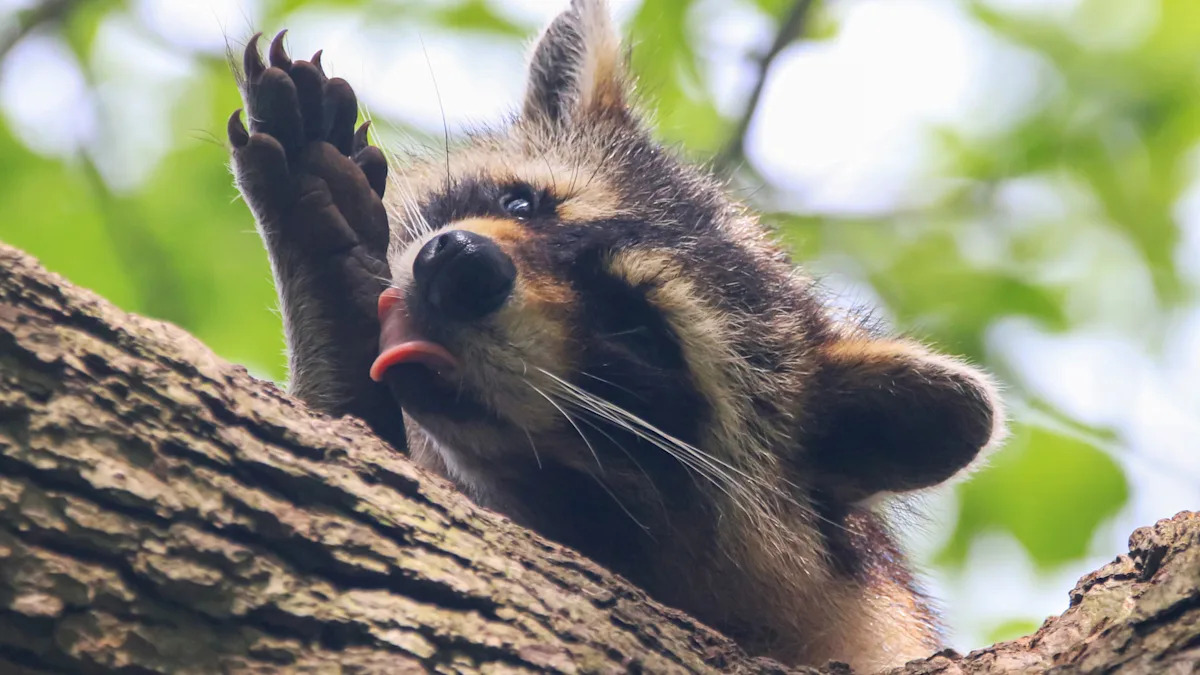
Raccoon looking for food – Carol Hamilton/Getty Images
Raccoons are often seen as pesky troublemakers you want to keep away from your hummingbird feeders. But it can be hard to take these masked burglars seriously when they’re constantly sneaking through your backyard like they’re on some elaborate heist. They earn points for cleverness thanks to their street smarts, but they’re rarely thought of as truly intelligent.
But science says otherwise. Raccoons have brains the size of a cat’s, and yet they pack as many neurons as a dog. At about 438 million neurons (nearly twice as many as cats), they rank surprisingly high on the mammalian intelligence scale. But what does that actually mean? It means it’s not all that surprising that in lab studies, raccoons have opened complex locks, solved puzzles through trial-and-error, and even passed cognitive tests originally designed for primates. If that weren’t remarkable enough, studies have also shown that raccoons remember solutions for years, adapt quickly to new challenges, and their sense of touch is so advanced that nearly two-thirds of their sensory cortex is dedicated entirely to interpreting tactile information.
This incredible blend of brainpower, memory, and motor skills makes raccoons one of the most behaviorally flexible animals in North America. And it means they’re not just surviving urban environments, but instead, actively solving them. Their success demonstrates that intelligence isn’t just about brain size: It’s about problem-solving, the drive to explore, and, of course, adaptability. In a world reshaped by humans, raccoons are powerful proof that evolution favors the clever. And that sometimes, the best tool for survival is a curious mind. That, and a pair of tiny, unstoppable hands.
Elephants

Family of elephants in Africa – Abdelrahman M Hassanein/Getty Images
Commonly perceived as gentle, majestic giants, elephants are often admired for their memory and their circus tricks, but they’re rarely discussed in the same breath as apes or dolphins when it comes to raw cognitive firepower. For many, their intelligence is assumed to be simple, even mechanical, but not sophisticated: Follow the herd, avoid danger, and find food.
That couldn’t be further from the truth. Elephants have been shown to demonstrate advanced emotional and social intelligence. This includes behaviors as nuanced as unsolicited consolation, empathy, and even mourning their dead. They’ve also shown the ability to wait for a partner before executing a joint task — evidence of real-time strategic thinking in a cooperative setting. But here’s something even more impressive: Elephants have demonstrated body awareness, such as realizing when their own body is the obstacle to solving a problem. Rather than depending on trial-and-error to solve puzzles like most other animals, elephants have been able to crack multi-step challenges using just insight.
What’s wild is that elephants reached this level of intelligence through a completely different evolutionary path than primates or dolphins. This phenomenon is called convergent cognitive evolution in action. In the case of elephants, that intelligence isn’t just mental: It’s deeply emotional, social, and physical. Understanding just how smart these animals are isn’t just fascinating, It’s essential. Because with habitat loss on the rise, protecting elephants means recognizing them not just as wildlife, but as sentient, thinking beings with rich inner lives and the intelligence to prove it.
Alligators & Crocodiles

Crocodile in a swamp – Adam Bartosik/Getty Images
Crocodilians have a long history of being typecast as brainless brutes, and people avoid crocodile- and alligator-infested waters for good reason. In popular imagination, they’re cold-blooded in every sense of the term. People may recognize them as ancient, but for many, that doesn’t necessarily mean advanced. And in that sense, they’re little more than living fossils waiting to snap their jaws down on the first thing that moves.
But studies have shown that crocs and gators can learn complex associations, communicate through vocalizations and infrasound, and engage in play behavior ranging from surfing waves to mock sparring with otters. Beyond that, these amazing creatures have been observed using tools, such as balancing sticks on their snouts to lure in nest-building birds. But the wild part? They do this only during bird nesting season, when twigs are in high demand. Some species even show signs of name recognition, and their sensory systems are so refined, the pressure receptors on their faces function like primate fingertips, making it possible for them to detect even the slightest ripple in the water.
All of this points to a brain that’s vastly more capable than people give it credit for. So they’re not just prehistoric relics: Instead, alligators and crocodiles are survivors with adaptive intelligence shaped over 100 million years. Understanding their cognition doesn’t just shift how people see modern reptiles. It also gives them new insight into the mental lives of extinct animals like dinosaurs. Crocodilians challenge the idea that big brains and fuzzy faces are the only route to complex thought. Because sometimes, sharp minds come with even sharper teeth.
Octopuses

Octopus deep underwater – Wrangel/Getty Images
It takes a very special person to find these tentacle shapeshifters endearing, and most probably wouldn’t associate their alien appearance with high intellect. Maybe these slippery sea creatures are clever enough to hide in a reef or squeeze through tight spaces, but intelligent? That label usually gets stamped on animals with fur, faces, or, at the very least, backbones.
But here’s the thing: Octopuses aren’t just smart, they’re shockingly smart. They’ve even been known to short-circuit lights for no other reason than sheer boredom. Scientists have also observed octopuses solving complex puzzles, opening jars from the inside, and using coconut shells and stones as tools, planning ahead to create portable shelters. They, like us, also exhibit distinct short-term and long-term memories. But that doesn’t mean we think alike. Their brains, which are radically different from a human’s, contain around 500 million neurons, most of which are in their arms. This allows each limb to think and act semi-independently, as if their entire body is a brain. Not only do they recognize individual humans and display unique personalities, but they’re even known to mimic other sea creatures based on the threat level of their predators.
Octopus intelligence matters because it forces humans to rethink what a mind can look like. And because their cognitive abilities evolved along an entirely different path from mammals and birds, it makes them a prime example of convergent intelligence — the idea that complex thinking can arise in radically different forms. From there, it’s about asking whether or not an octopus’s mind can help researchers develop a deeper understanding of consciousness and cognition, even when it means looking at the weirdest mind in the ocean.
Dolphins

Two dolphins swimming together – Naluphoto/Getty Images
You may view dolphins as cute and playful, and fun to watch at aquariums or online. All the tricks they do certainly make them seem clever. But does that put their intelligence in the same league as apes or even humans? That’s not really how most people frame them. They’re social and trainable, but not really all that cerebral.
But did you know that a dolphin’s brain is larger than any nonhuman primate’s? Not only that, but their relative brain size (encephalization quotient or EQ) ranks second only to a human’s. Dolphins are one of the few animals able to pass the mirror test for self-awareness. But what’s arguably more impressive is how they’ve demonstrated metacognition, or the ability to think about their own thoughts. They even understand abstract concepts, such as different versus same. Their societies are layered with alliances of alliances, which empower them to coordinate complex group hunts and develop cultural traditions, like specific tool use, passed down through generations. In the lab, they’ve learned artificial languages, recognized themselves in video, and remembered unique vocal “names” of tankmates decades after being separated.
Once again, it’s a situation where dolphin intelligence evolved along a different track than humans. Despite their brains being structured so differently, they’ve reached similar cognitive milestones when compared to humans. This changes how humans interact with dolphins in the water, and forces us to rethink the line that divides humans and animals.
Mountain lions

Mountain lion looking over his shoulder – Michael Fitzsimmons/Getty Images
Mountain lions are often seen as silent stalkers you should definitely avoid, and we spend time learning warning signs that a mountain lion is slinking nearby. The stereotype paints them as hunters driven almost entirely by instinct: Solitary, reactive predators lurking just on the edge of the wilderness. All this mythology makes it even easier to assume these big cats are elusive ghosts rather than intelligent, thinking animals.
But the truth is, mountain lions are both clever and calculated survivors. For instance, their ambush hunting tactics require them to analyze terrain, move strategically, and, of course, be patient. Mountain lions have been known to stalk prey all night, adjusting position across multiple miles before striking. Not only that, they also cache their kills, hiding them from scavengers, and feeding under the cover of darkness. This is the sort of behavior that strongly suggests both foresight and resource management. Beyond that, mountain lions aren’t as solitary as many people assume. In fact, some create food-sharing networks, a type of altruism that requires memory and social awareness.
In the end, it adds up to a portrait of a highly adaptive predator. They are not just driven by instinct, they’re shaped by both experience and flexible decision-making. They’re also one of the few large carnivores to thrive across the Americas despite centuries of eradication efforts. While their intelligence doesn’t necessarily look like tool use or mirror tests, it features the ability to navigate complex situations, from rocky cliffs and shifting prey patterns to overlapping territories and encroaching cities. And that kind of survival takes brains, not just brawn.
Beavers

Beaver rolling log through stream – Tony Leprieur/Getty Images
Easily dismissed as simple-minded woodaholics, beavers have a reputation for being nature’s construction drones, driven by some incessant need to chew wood and slap tails. While their dams are certainly impressive, the default assumption is that they’re operating on autopilot, but not so much with intelligence.
Their behavior tells a much more deliberate story. Beavers build dams, of course, but they also build functional lodges and even canals, all designed with such precision that it rivals similar selections done by human engineers. Researchers have observed them rerouting water with levees, filling dry canals with spring water, and even executing environmental solutions that have left government officials speechless. That includes one DIY damming project that saved over $1.2 million in planned flood prevention. In one experiment, beavers covered a loudspeaker playing the sound of running water, suggesting not just a reaction, but a practical fix to a perceived leak.
In the end, their machinations require foresight, adaptability, and spatial awareness: Characteristics that goes far beyond basic instinct. Moreover, beavers challenge the idea that intelligence only looks like laboratory-based problem solving. Their minds are wired for engineering in the wild, and the work they do — and the intelligence they employ to see it through — is embedded in ecosystems. They are strategic, dexterous, and fully capable of long-term planning.
Crows

Crow perched atop tree branch – Creativenature_nl/Getty Images
Crows are often brushed off as noisy, messy scavengers. They’re smart for birds, perhaps, but mostly, they’re just pests. They’re the kind you see loitering in parking lots or digging through trash. And rather than inspiring awe, they’re far more likely to inspire side-eyes.
But these birds aren’t just smart. In fact, their intelligence shows up in ways that feel shockingly human. In cities across Japan and the U.S., for example, crows have learned to drop hard-shelled nuts into crosswalks. Why? As cars run over them, the shells are cracked open, and the crow retrieves them when the light turns red. They don’t just repeat the behavior, either. They’ve been observed to adjust their drop height based on how hard the nut’s shell is, while also adapting to the flow of traffic. In lab studies, crows manufacture and modify tools, solve multi-step puzzles, plan for the future, and remember human faces for almost two decades — especially the ones they don’t like.
What makes crows so compelling is that their intelligence doesn’t just exist in forests or labs. Although their brains are small, they’re packed with 1.5 billion neurons (the same as many monkeys) and structured for super-efficient cognition that rivals primates in reasoning power. They’ve learned to exploit human systems, understand human patterns, bring gifts to humans they like, and even hold long-term grudges against the ones they don’t like. And in a world shaped by humans, that kind of urban-smart intelligence might be the most impressive of all.
Want more design inspiration? Join our free newsletter to get the best home and garden tips, design hacks, and DIY projects delivered right to your inbox. You can also add us as a preferred search source on Google.
Read the original article on Outdoor Guide.