I lost my soul dog, Bobbi — my first service dog — at just 11 years old to kidney disease tied to a tick-borne illness she had been living with for most of her life. She contracted canine ehrlichiosis before I adopted her — back when she was surviving as a street dog in the Bahamas — and by the time the long-term damage surfaced, there was nothing we could do.
It’s the kind of loss that rewires how you think about “optional” care.
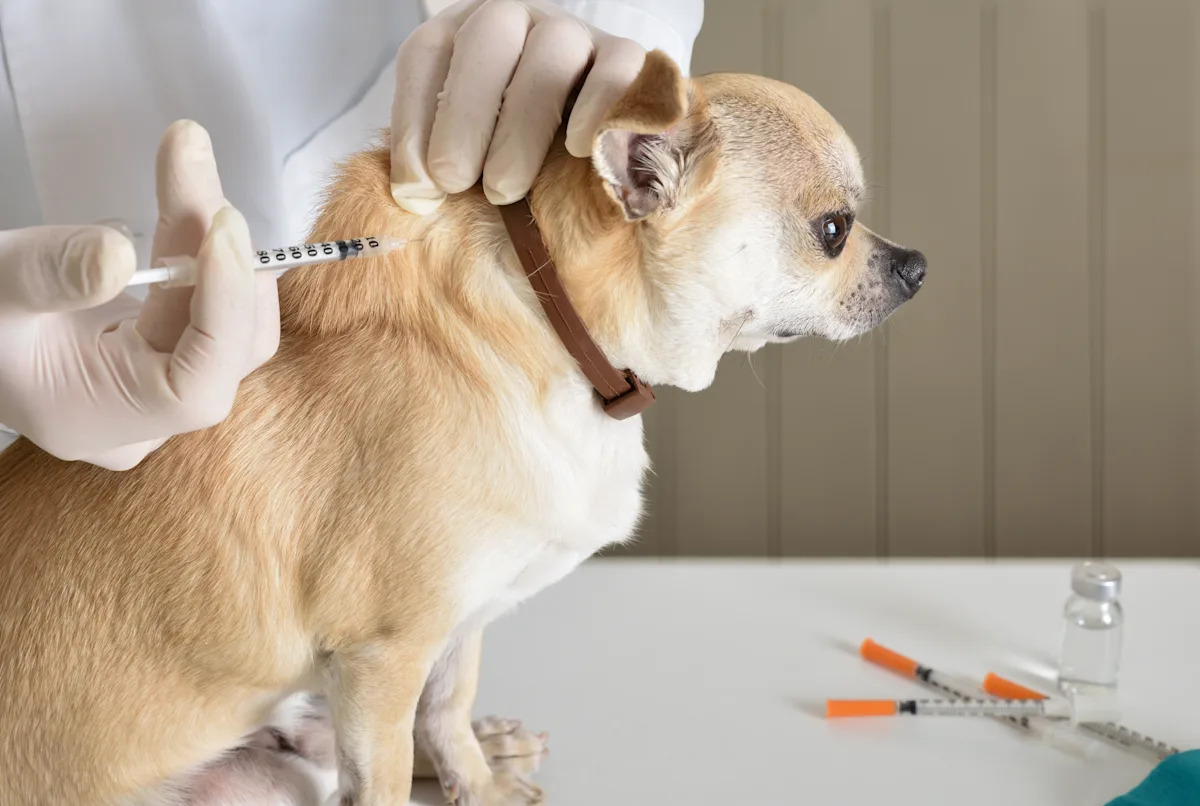
Now, every spring, I don’t guess. I sit down with my veterinarian and go through everything — vaccines, preventatives, what’s changed, and what actually matters.
Because this time of year isn’t just about warmer weather and longer walks. It’s when risk ramps up. Ticks become active, mosquitoes return, and bacteria begin thriving in places your dog encounters every day, from puddles to neighborhood parks.
And yet, for most pet owners, the spring vet visit feels confusing at best.
There are more vaccines than ever. Preventatives come in multiple forms. Costs add up quickly. And it’s not always clear what’s essential versus what’s simply recommended.
I now travel year-round with Poppy, my 13-pound Chiweenie and current service dog, and each spring we go through this process with her veterinarian, Dr. Bethany Yurek in Colorado. Over time, I’ve learned how to separate what’s critical from what’s situational — and how to ask better questions in the exam room.
Here’s what veterinarians say your dog actually needs right now, and where you may have more flexibility than you think.

Bobbi, my first service dog, whose experience with a tick-borne illness reshaped how I approach preventive care each spring.
(Casey Rogers)
Which dog vaccines are actually essential?
Veterinarians generally divide vaccines into two categories: core and non-core, and understanding that distinction makes everything else easier.
Core vaccines are considered essential for nearly all dogs, regardless of lifestyle, because they protect against diseases that are either widespread, highly contagious, or pose a risk to humans.
Rabies sits firmly at the top of that list. It’s almost always fatal once symptoms appear, and because it can spread to humans, vaccination is legally required in many regions. If you travel with your dog — even for something as simple as crossing into Canada — you’ll need proof of a current rabies vaccine.
The other major core vaccine is DHPP, which protects against distemper, parvovirus, hepatitis, and parainfluenza.
These are not minor illnesses. Distemper can impact the respiratory, gastrointestinal, and nervous systems, sometimes causing permanent neurological damage. Parvovirus is especially aggressive, attacking the gastrointestinal tract and often requiring intensive treatment to survive.
For adult dogs, boosters are typically given every one to three years, depending on the vaccine and your veterinarian’s recommendation.
If you’re trying to streamline your dog’s care, this isn’t the category to cut from. These vaccines form the baseline of protection.
Do dogs really need the leptospirosis vaccine?
Once you move beyond core vaccines, recommendations become more individualized — and leptospirosis is one of the most common gray areas.
The disease is caused by bacteria spread through the urine of infected animals, including rodents, raccoons, deer, and even livestock. It can survive in wet soil and standing water, which makes exposure surprisingly easy.
Dogs don’t need to be deep in the wilderness to be at risk. A city park after rainfall, a muddy trail, or even a damp backyard can be enough.
“Any dog that goes outside regularly is at risk,” Yurek says.
One reason leptospirosis can feel confusing is that the vaccine isn’t perfect. It protects against several common strains of the bacteria, but not all of them. That’s why it’s considered non-core.
Still, many veterinarians are recommending it more frequently than they did a decade ago.
That’s partly because cases have been increasing, but also because the consequences can be serious. Leptospirosis can affect the kidneys and liver and, in some cases, can be transmitted to humans.
Risk tends to be higher in warm, wet climates and after heavy rainfall or flooding, but cases have been reported across much of the U.S.
For dogs that travel, hike, or spend time in environments where wildlife is present, it’s increasingly viewed as a smart preventative rather than an optional add-on.
Why heartworm prevention matters more than ever

Many heartworm preventatives are given as monthly chewable medications, making them easy to administer at home.
(Petra Richli via Getty Images)
Heartworm disease is one of the most serious conditions veterinarians deal with — and one of the most preventable.
It’s spread through mosquito bites, which means the risk begins as soon as temperatures consistently rise above about 50 degrees. That window is getting longer in many parts of the country.
What makes heartworm especially concerning is how quietly it develops. After infection, it can take months for a dog to test positive, all while worms are growing and affecting the heart and lungs.
By the time symptoms appear — coughing, fatigue, difficulty exercising — the disease is already established.
“Heartworm disease is a silent condition,” Yurek explains. “Even when we treat it, there can be lasting damage.”
Historically, heartworm was most common in the Southeast and along the Gulf Coast. Today, it has been diagnosed in all 50 states, making it a nationwide concern.
Treatment is possible, but it’s not easy. Dogs often require months of restricted activity to prevent complications, along with multiple injections and follow-up visits. For many pet owners, the process is physically and emotionally taxing.
Prevention is far simpler — and far less expensive.
Vet-recommended heartworm preventatives to consider
Most heartworm preventatives require a prescription, but there are a few widely trusted options that veterinarians recommend regularly:
-
Simparica Trio — a monthly chew that covers heartworms, ticks, fleas, hookworms, and roundworms, making it one of the most comprehensive options.
-
Heartgard Plus — a long-standing monthly chew focused on heartworm prevention, with added protection against some intestinal parasites.
-
Interceptor Plus — another monthly option that protects against heartworms as well as whipworms, hookworms, and roundworms.
For Poppy, I prefer a combination chew because it simplifies the routine. One dose each month covers multiple risks, which makes it easier to stay consistent.
That consistency is key. Even missing a single dose can leave a gap in protection, especially during peak mosquito season.
Tick prevention isn’t just a summer issue anymore
Tick exposure has changed significantly in recent years.
Warmer winters and shifting climate patterns have extended tick activity well beyond the traditional spring and summer months. In some areas, ticks are now active nearly year-round.
They carry a range of diseases, including Lyme disease, ehrlichiosis, babesiosis, and Rocky Mountain spotted fever. Some of these infections cause immediate symptoms, while others can remain undetected until long-term damage occurs.
In Bobbi’s case, ehrlichiosis affected her health for years before the full impact became clear.
Veterinarians typically recommend a layered approach.
“Check your dog for ticks regularly, especially after time in the grass, woods, or on trails,” Yurek says. “I also recommend a preventative treatment to reduce the risk of bites and disease transmission.”
That check doesn’t need to be complicated, but it does need to be thorough. After being outside, run your hands slowly over your dog’s body, applying light pressure to feel for small bumps. Ticks can be as tiny as a poppy seed, especially in their early stages, and are easy to miss if you’re just scanning visually.
“You want to pay close attention to the areas where ticks tend to hide. This includes around the ears, under the collar, between the toes, along the belly, under the tail, and in the armpit area where the legs meet the body,” Yurek says. “On dogs with thicker coats, it can help to part the fur as you go, especially around the neck and shoulders.”
If you do find a tick, remove it as soon as possible using a pair of fine-tipped tweezers, gripping it as close to the skin as you can and pulling straight out without twisting. The goal is to remove the entire tick, including the head, to reduce the risk of infection.
There are several types of preventatives available, including topical treatments, collars, and oral medications. Many pet owners now opt for combination products that protect against ticks, fleas, and heartworms in one monthly dose.
How to decide what your dog actually needs
One of the biggest misconceptions about veterinary care is that there’s a universal checklist that applies to every dog.
In reality, care should be tailored.
A dog that rarely leaves an urban apartment has a very different risk profile than one that hikes regularly, swims in lakes, or travels frequently.
That’s why the most valuable part of a spring vet visit isn’t the checklist — it’s the conversation.
Instead of simply agreeing to every recommendation, it helps to ask:
-
What does this protect against?
-
How common is this disease in my area?
-
Does my dog’s lifestyle increase their exposure?
These questions shift the appointment from routine to intentional.
For me, that shift happened after losing Bobbi. It’s not about doing everything — it’s about understanding what matters most and making informed decisions based on that.
Why spring is the most important time to check in
Seasonal changes don’t just affect the weather — they change disease patterns.
As temperatures rise, parasites become more active, and bacteria thrive in conditions that are common in everyday environments. That makes spring the natural time to reassess your dog’s protection plan.
It’s also when prevention is most effective.
By the time symptoms appear, especially with conditions like heartworm or tick-borne illnesses, treatment becomes more complicated and outcomes less predictable.
A single, thoughtful visit can prevent far more serious — and expensive — issues later in the year.
For veterinarians, that’s the simplest way to think about spring care: not as an extra task, but as a strategic one.