The post A 7-Foot Nile Monitor Steals Crocodile Eggs — Then Follows a Hatchling appeared first on A-Z Animals.
When we think of Africa and the animals that live there, it’s easy to think of the Big Five. The well-known Big Five are lions, buffalo, African elephants, black rhinos, and leopards. However, thousands of different animals roam this continent other than the African Big Five. And sometimes, we get the pleasure of capturing glimpses of these other animals and how they live.
Monitor Lizard Sighting in Zimbabwe
The short YouTube clip at the top of this blog post takes us to Zimbabwe. The Snakes in Zimbabwe YouTube page posted this video. This channel shares videos of snakes and other wildlife commonly seen in southern Africa, including animals such as elephants, leopards, buffalo, and lions.
Giant Lizard Hunting for Eggs
At the start of this video, a large monitor lizard crawls through thick brush, appearing to forage. Its head moves back and forth, its tongue shooting in and out of its mouth. Like snakes, monitor lizards use frequent tongue-flicking to sample chemical cues in their environment, so the lizard may be following scent trails toward food. As we continue to watch, we notice it reaches an area that appears to be a giant nest.
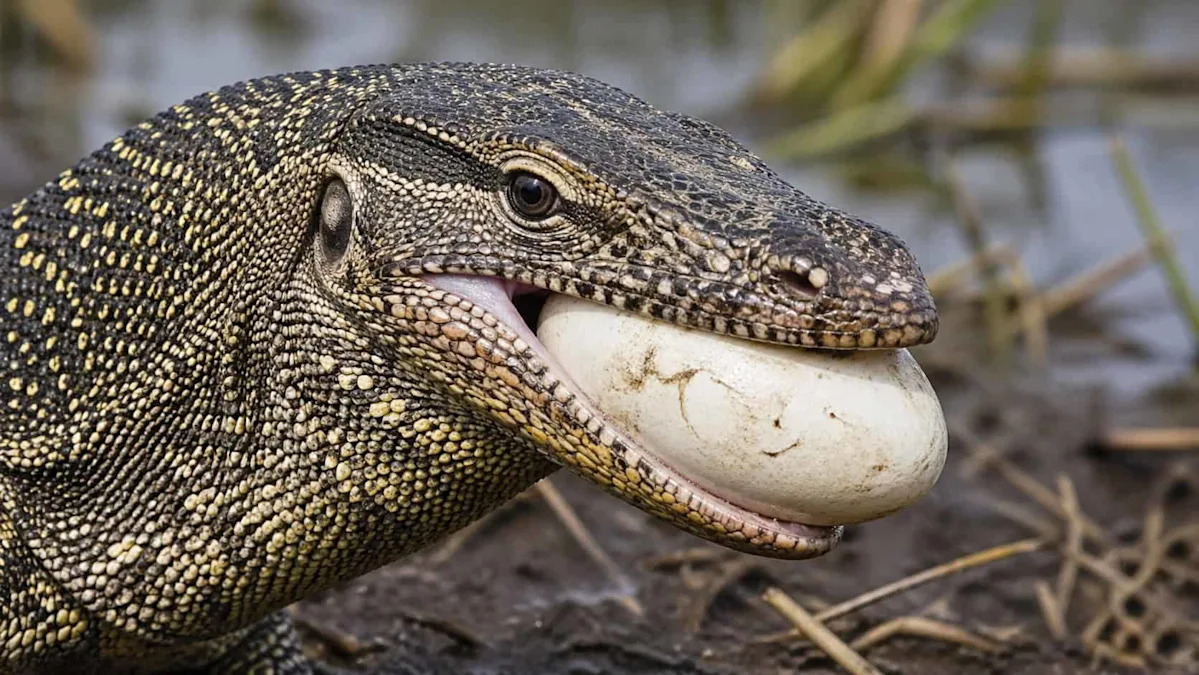
As it crawls atop the nest, we are startled by the sight of a baby crocodile. It appears to be a very young crocodile, possibly a recent hatchling. It’s a tense moment because Nile monitors are known to raid crocodile nests, eat eggs, and prey on small crocodiles. Instead, the monitor rummages around in the nest and soon picks up a large crocodile egg in its mouth. The lizard struggles to crack the egg to drink its contents and finally succeeds, also swallowing the crushed shell.
The baby croc is still dangerously close to the giant lizard, perched on the edge of the nest. The monitor finds a second egg and goes through the same process to consume it. As it finishes up, the baby croc begins to crawl closer to the lizard and then turns left. Unfortunately, it has caught the attention of the monitor lizard, which begins to follow it, its tongue shooting in and out rapidly as if sampling a potential meal.
The video ends with the little fella scurrying down the left side of the nest, while the monitor is still in pursuit. Will it catch the poor critter? We hope not!
Nile Monitor Lizard in Africa

Nile monitors are fast, powerful lizards on land and are also strong swimmers, but precise top-speed figures are not well established.
©Dave Montreuil/Shutterstock.com
There are more than 80 recognized species of monitor lizards, though the exact number can change as taxonomists revise species classifications. Monitor lizards are found across parts of Africa, Asia, Australia, and nearby islands, depending on the species. Population sizes vary considerably by species.
Journal studies such as the Monitor Lizards: Pan-African Check-List of Their Zoogeography conclude that the Nile monitor lizard has the widest distribution. The Nile monitor (Varanus niloticus) is also sometimes called the water leguaan. Their population is listed on the IUCN Red List as a species of least concern.
Nile monitors can exceed 7 feet in length, and large individuals may weigh more than 22 pounds. These powerful, opportunistic predators feed on a wide range of prey, including fish, amphibians, birds, reptiles, eggs, insects, small mammals, and carrion. And as the video shows, crocodile eggs can be part of a Nile monitor’s opportunistic diet.
The post A 7-Foot Nile Monitor Steals Crocodile Eggs — Then Follows a Hatchling appeared first on A-Z Animals.